Chapters (24)
- Cover
- Title
- Copyright
- Dedication
- Contents
- Preface
- The Letter
- To the Reader
- Chapter One: A Death in the Family
- Chapter Two: Farewell and a Call to Duty
- Chapter Three: Listen and Learn
- Chapter Four: Planting the Seeds of War
- Chapter Five: A Call to Arms
- Chapter Six: Selecting the Best Riflemen
- Chapter Seven: The Long March to Boston
- Chapter Eight: 1775: The Continental Army—From Defense to Offense
- Chapter Nine: 1775: The Order Is Given
- Chapter Ten: 1775: A Sortie Delayed
- Chapter Eleven: 1775: River-Ready Batteaux?
- Chapter Twelve: 1775: Winter in the Forest Primeval
- Chapter Thirteen: 1775: Quebec—Setting the Stage for Battle
- Chapter Fourteen: 1775-1776: Quebec—The Forlorn Hope
- Postscript
- Acknowledgments
James Newman had shown his sons how to make paper-wrapped rifle charges containing enough powder to send a lethal bullet 300 yards down-range, hit a target 200–300 yards away, inflict lethal damage on an enemy soldier [usually an officer], and reload in less than a minute.
2. Nitre: archaic term for saltpeter or ammonium nitrate, an essential ingredient for making black powder when mixed with sulfur and charcoal.
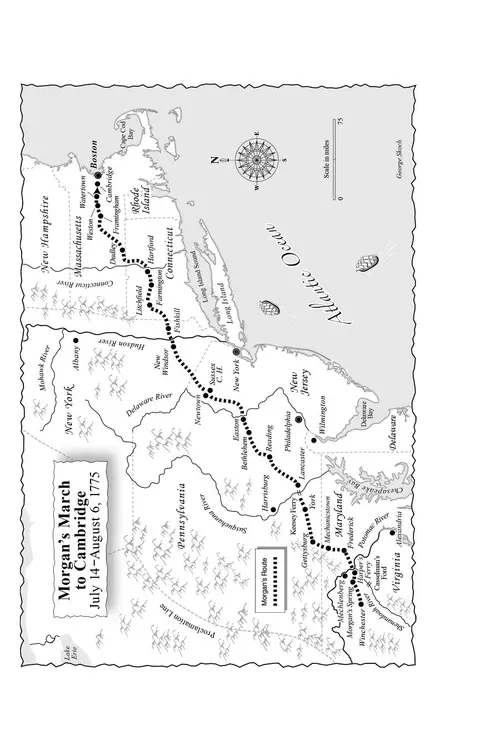
Chapter Seven: The Long March to Boston
Chapter Seven
THE LONG MARCH TO BOSTON
The days since Mr. Henry’s April 29th warning about being “hunted, hounded, and hung by the British if we lose” have been full of preparations to prevent that very outcome. Much of May and June 1775 has been spent getting seed in the ground in what appears to be a very dry planting season and the very strong likelihood of war against what many of us call “our mother-country.”
Herewith, the most relevant entries in the journal Captain Morgan ordered me to keep:

Thursday, May 4th, 1775: A Trusted Courier delivered a message to Rev. Thruston, the Chairman of our Frederick County Committee of Safety from Mr. Patrick Henry, dated Tuesday, May 2nd. Capt. Morgan instructed me to record it in our Rifle Co. Journal:
To my Dear Patriot friends in Frederick County,
Lord Dunmore has pledged to pay £330 for the gunpowder and weapons he seized from our Williamsburg Armory on the night of 20–21 April. I regard this to be a wholly inadequate response to our demand that he return the seventeen barrels of powder, twenty-three muskets, and fifteen pistols he stole and placed aboard HMS Magdalen. We need our gunpowder and firearms more than His Majesty’s money.
Members of the Williamsburg Committee of Safety have informed me Governor Dunmore has fortified his palace in Williamsburg with Royal Marines and two naval cannons. It is also suspected he has secretly dispatched his family to refuge at his personal estate, Porto Bello.1
According to these reports, he is also fortifying this place and has surrounded it with Royal Marines and a large contingent of armed Royalists.
I initially planned to call on Captain Morgan’s new Frederick County Rifle Company for support in capturing the Governor and his Royal officials. That will no longer be necessary for nearly 800 Patriot volunteers from neighboring counties now reinforce my Hanover County Militia. We are now in a comfortable encampment less than a day’s march from Williamsburg. Correspondents and messengers indicate another 2,500 Patriots are prepared to join us if needed.
While I still believe it would be preferable to seize the initiative, I am being counseled by Messrs. Thomas Nelson, Richard Henry Lee, and Thomas Pendleton to break off this engagement and proceed to Philadelphia as a Virginia delegate when Congress convenes on May 10th.
I shall keep you apprised,
Patrick Henry