Chapters (24)
- Cover
- Title
- Copyright
- Dedication
- Contents
- Preface
- The Letter
- To the Reader
- Chapter One: A Death in the Family
- Chapter Two: Farewell and a Call to Duty
- Chapter Three: Listen and Learn
- Chapter Four: Planting the Seeds of War
- Chapter Five: A Call to Arms
- Chapter Six: Selecting the Best Riflemen
- Chapter Seven: The Long March to Boston
- Chapter Eight: 1775: The Continental Army—From Defense to Offense
- Chapter Nine: 1775: The Order Is Given
- Chapter Ten: 1775: A Sortie Delayed
- Chapter Eleven: 1775: River-Ready Batteaux?
- Chapter Twelve: 1775: Winter in the Forest Primeval
- Chapter Thirteen: 1775: Quebec—Setting the Stage for Battle
- Chapter Fourteen: 1775-1776: Quebec—The Forlorn Hope
- Postscript
- Acknowledgments
There was total silence. Everyone in the semi-circle was staring at Captain Morgan as he replied, “You’re looking at him.”
There was an immediate cheer as the Riflemen bounded to their feet, waving their weapons over their heads, yelling “Huzzah!” and slapping each other’s backs.
Chapter Twelve: 1775: Winter in the Forest Primeval
Chapter Twelve
1775: WINTER IN THE FOREST PRIMEVAL
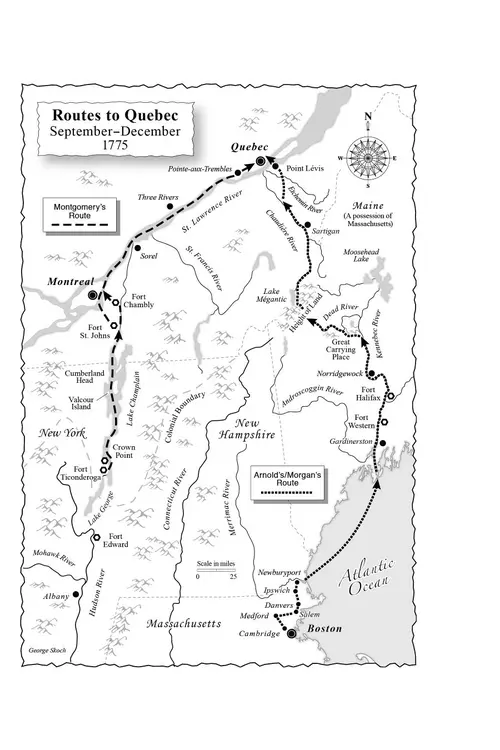
Fort Halifax, Maine, on the Kennebec River
Wednesday, September 27th, 1775
Our Advance Force—250 Riflemen, three Indians, and two women—departed Fort Western early on the morning of the 25th with three canoes, thirty-one batteaux—ten for each Rifle Company and one for Captain Morgan’s Headquarters equipment— including my field desk.
Six Riflemen, two from each Rifle Company, have augmented our “Vanguard Headquarters” to assist in moving our one canoe, our single batteau, and in setting up and taking down tentage while serving as messengers, and protectors of Captain Morgan in close combat with the enemy. Corporal Sullivan, the non-commissioned officer in charge of this little detachment, reports to me.
Each heavily laden batteau, containing about a thousand pounds of gear, is being rowed, “poled” (pushed), and sometimes pulled, up the Kennebec River by our Riflemen. In “good water”—calm, gentle current, deep enough for our batteaux to avoid rocks and shoals—the four men responsible for each boat are sufficient. Unfortunately, the Kennebec River seems to have very little “good water.”
The rest of us—124 Riflemen and the two women—are walking beside the slowly moving flotilla on the now overgrown but still passable military road built in the 1850s between Fort Western and Fort Halifax. Captain Morgan expected to make the eighteen-mile trip from Fort Western to Fort Halifax in just one day. We certainly could have done so by walking single file on the old path beside the river. But by dusk on the 25th we traversed just six miles upstream because moving the heavy batteaux against the current on this part of the Kennebec often requires men to wade into the water and help manhandle the boats across shallows and around rocks.
So the men would have an opportunity to warm their rations and dry their clothing—at 6:00 p.m. on Monday the 25th, Captain Morgan ordered the column to hold up at a small clearing on the west bank of the river. He directed each Rifle Company to set up a perimeter and pull their loaded batteaux close as possible to the shoreline—a task demanding at least a dozen men lifting, pulling, and pushing each boat.
By the time all thirty-one batteaux were at least partially on the riverbank, more than half the Riflemen in the Advance Guard were wet—some of them for most of the day. Capt. Morgan was one of them. He told me to go back down the column and “Instruct every company to gather tinder, kindling, and firewood sufficient to keep a large bonfire lit through the night to heat food, dry wet clothing, and warm the men.”