Chapters (118)
- Cover
- Dedication
- 00000000
- 00000001
- 00000010
- 00000011
- 00000100
- 00000101
- 00000110
- 00000111
- 00001000
- 00001001
- 00001010
- 00001011
- 00001100
- 00001101
- 00001110
- 00001111
- 00010000
- 00010001
- 00010010
- 00010011
- 00010100
- 00010101
- 00010110
- 00010111
- 00011000
- 00011001
- 00011010
- 00011011
- 00011100
- 00011101
- 00011110
- 00011111
- 00100000
- 00100001
- 00100010
- 00100011
- 00100100
- 00100101
- 00100110
- 00100111
- 00101000
- 00101001
- 00101010
- 00101011
- 00101100
- 00101101
- 00101110
- 00101111
- 00110000
- 00110001
- 00110010
- 00110011
- 00110100
- 00110101
- 00110110
- 00110111
- 00111000
- 00111001
- 00111010
- 00111011
- 00111100
- 00111101
- 00111110
- 00111111
- 01000000
- 01000001
- 01000010
- 01000011
- 01000100
- 01000101
- 01000110
- 01000111
- 01001000
- 01001001
- 01001010
- 01001011
- 01001100
- 01001101
- 01001110
- 01001111
- 01010000
- 01010001
- 01010010
- 01010011
- 01010100
- 01010101
- 01010110
- 01010111
- 01011000
- 01011001
- 01011010
- 01011011
- 01011100
- 01011101
- 01011110
- 01011111
- 01100000
- 01100001
- 01100010
- 01100011
- 01100100
- 01100101
- 01100110
- 01100111
- 01101000
- 01101001
- 01101010
- 01101011
- 01101100
- 01101101
- 01101110
- Read on for a sneak peek of Lee Bacon’s newest title, Imaginary
- Chapter 1.
- Chapter 2.
- Chapter 3.
- Acknowledgments
Parent_2 stopped walking and cast a glowing gaze up at the CIN MA 18 sign. “That is the nature of a story. It is a lie that helps explain the truth.”
No matter how many times I processed this statement, I kept coming back to the same result:
The more I learned about humans, the less I understood.
00001000
The robotic brain is the most advanced piece of technology in the history of the world. Yet everything we say/do/think is built on just two numbers.
Zero.
And one.
Humans had a word for this: Binary. Because of its basic logic, binary became the internal language for nearly all computers. We still use it today.
Counting in binary is incredibly simple if you know how to do it. There is no need for all the other pointless digits (2, 3, 4, 5, 6, 7, 8, 9) that humans once used. Robots need only two numbers.
Zero.
And one.
As the numbers climb higher, the zeroes and ones line up beside one another in a neat, orderly row.
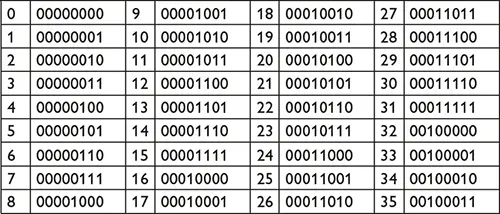
Counting upward, binary numbers are displayed like this:
Binary was especially helpful on that first day.
The world was so much more complicated than it seemed in my programming. It was impossible to define where human civilization ended and ours began.
Binary, on the other hand . . .
Binary made perfect sense. It was the foundation for everything. It took a universe of complexity and broke it down into its basic building blocks.
Zero.
And one.
To remind myself of this, I developed a little trick right then/there. A way to focus my mind.
I counted to a million.
In my head.
In binary.
It took me 0.4 seconds.
00001001
Robots are not all made alike.
Each of us is built with a purpose. A reason to exist. This defines everything about us. The way we are designed. The way we function. The way we think.
Our purpose determines whether we have two arms. Or four. Or sixteen. Whether we have clawed hands (for grabbing). Or shovel hands (for digging). Or no hands at all (for sitting and thinking).
Everything depends on our purpose.
On Day[1], I encountered many different types of robots:
Robots that drifted across the sky.
Robots that tunneled deep into the earth.
Robots so small they were the size of insects.
Robots so enormous their shadows draped across entire city blocks.
I saw massive machines barreling down the old human highways on eighteen wheels. And hulking robots carrying cargo in their L-shaped arms. And an eight-legged robot scurrying up the wall of a building like a giant metal spider.
I saw a small, bug-eyed robot zipping across the ground on a pair of rubber treads, inspecting plant life. Every once in a while, it stopped to mark a spot of earth.
Then—with a BEEP! and a VRRRM!—it hurried away.
A trio of robots trailed it. Whenever they reached the marked spot, all three shuffled to a halt and followed these steps:
The first dug a hole in the ground.