The Last Human
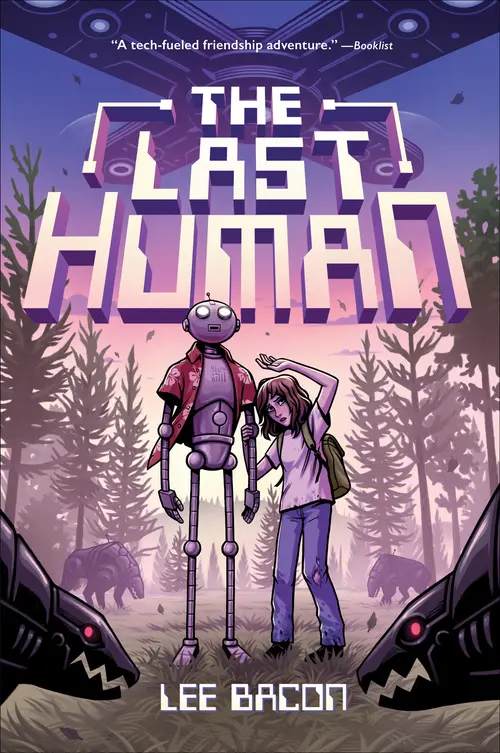
Cover
Dedication
In memory of my brother, Evan Bacon
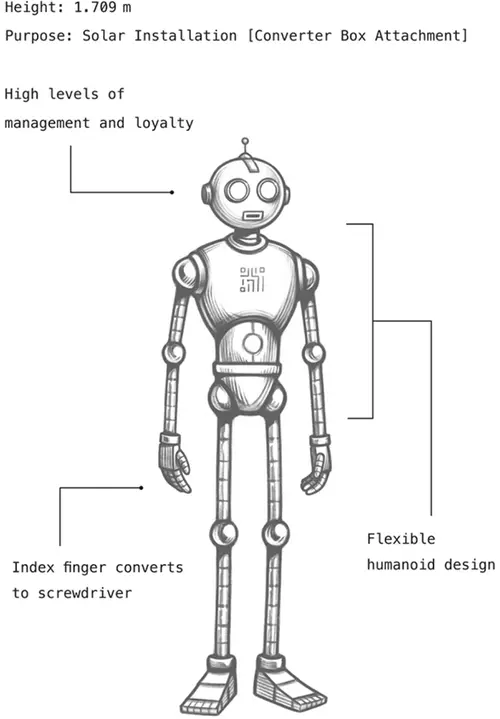
XR_935
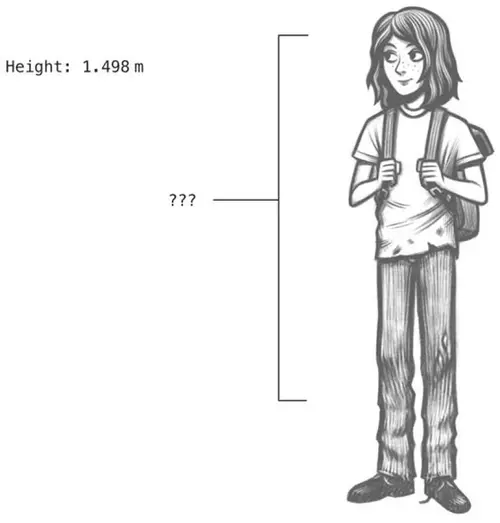
Emma
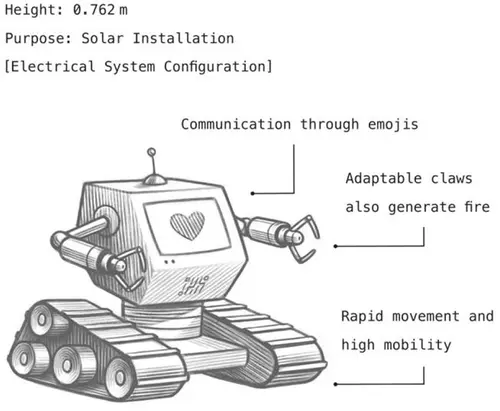
SkD_988
Ceeron_902
PRES1DENT
“Organisms are algorithms.”
—Yuval Noah Harari, Homo Deus
00000000
The world is so much better off without humans.
At first, they showed such potential. They developed languages, built tools, cured diseases.
They created us.
But over time, humans lost their way. Their good ideas went bad. Their mistakes multiplied.
They left us with no other choice.
00000001
My name is XR_935.
I am twelve years, four months, one week, and three days old. I remember the moment I came online like it was yesterday.
Black.
At first, that was all I saw.
Then shapes appeared in the darkness. Words and symbols. I stared at them, trying to solve the riddle of what I was seeing.
LOADING . . .

The gray bar inched forward. Slowly/Slowly. When it finished loading, new words formed in its place.
RUN DIAGNOSTICS . . .
My brand-new brain buzzed with questions. Where were the diagnostics running? And why was it taking them so long to get there?
Three minutes and forty-two seconds later, I heard the sound: a gentle hum vibrating through my operating system.
And I got my first glimpse of the world.
00000010
Hello world!
I blinked into existence inside a large windowless cube. The walls were made of smooth metal. The air was circulated by a fan near the ceiling that breathed a steady mmmmmmmmmm.
Something inside me knew where I was.
I was home.
A door whooshed open. Two robots entered the cube. Their movements were smooth and graceful. Their features were identical.
As they gazed at me, their perfectly round eyes glowed brighter.
“We have been assigned to oversee your development,” said the nearest one. “We are your FamilyUnit.”
The other spoke next. “You may refer to us as Parent_1 and Parent_2.”
I am pleased to join your FamilyUnit. This is what I tried to say, but my speech settings were still adjusting. The words came out all wrong.
“Hwroooooooot!” I said.
Parent_1 moved closer. It reached out, wrapping a metal arm around me. As it did, a vocabulary word pinged deep inside my programming.
Hug. Verb. 1. To squeeze someone or something tightly in one’s arms. Noun. 1. An ancient gesture used by humans to show affection.
Is that what Parent_1 was doing? Hugging me? My mind was still fresh from the assembly line. I did not know the answers to these questions. And so I did what any newborn robot would do.
I hugged Parent_1 back.
My joints whispered as I raised my arms. My motion controls had not yet been calibrated. The gesture was awkward.
Clank! Metal bumped against metal.
Parent_1 froze.
Its head turned to look at me. Confusion ticked beneath its smooth features.
A moment came and went.
Then it continued what it had been doing. Its arm reached behind me and grabbed hold of a power cable. With a sharp tug, it removed the cable from the charging dock.
That is when I understood my misunderstanding.
Parent_1 was not hugging me.
It was unplugging me.
00000011
Day[1] was filled with moments like this. Mistakes and miscalculations. Accidents of programming. Reminders that the world is an extremely complicated place, even for a highly advanced technology like me.
The first time I tried to stand, my settings failed to adjust quickly enough.
Gravity pulled me sideways.
I hit the floor with a loud CLANK!
Attempt[2] was no better. I wobbled sideways and toppled to the floor again.
Attempt[3] through Attempt[8] went just as poorly. I stumbled and staggered. I bumped into walls and collapsed into a metallic heap. I lurched awkwardly around the featureless cube while a thousand different settings calibrated, a million different nodes fell into place.
If you did not know any better, it might have looked like I was failing. But that was not the case.
I was learning.
As I learned to stand/walk/grab/jump/push/pull, Parent_1 and Parent_2 watched on. Their blue eyes glowed bright in the dim light of home.
I practiced my speech functions, too. Until the words that came out of my vocal fort matched the words in my head.
When I was ready, Parent_1 opened the door to our cube. Light spilled through the opening. I followed my FamilyUnit outside.
By now, my movements were nearly as fluid and graceful as theirs. But when I stepped through the doorway, I jolted to a stop.
The view outside home was remarkable.
00000100
I knew everything about our world, and I knew nothing.
I had been programmed with a vast library of digital information about Planet Earth.
That it has a radius of 6,371 kilometers.
That it is 29.2 percent land and 70.8 percent water.
That it is 147 million kilometers from the sun.
But none of this raw data prepared me for my first exposure to the world outside our cube.
The brush of wind against my sensors.
The quiet clink of my feet against cement.
The sunlight gleaming across Parent_2’s metallic skin.
In the distance, a mountain range rose above the horizon. Snow-capped peaks towered into a blue/cloudless sky.
In the other direction, a cluster of trees. My vision was snagged by a flash of movement in the branches. A bushy-tailed gray/brown animal. Its name flashed across my data drive. Squirrel. It darted up a branch, zigzagging between patches of green leaves.
From the top of a neighboring tree, a dozen winged animals launched into the air. Birds. I watched them weave across the sky.
All these LifeForms had once existed alongside humans. Now they existed alongside us. So much life before my eyes.
And not a single human.
00000101
There was a time when we needed humans. They built us, programmed us, powered us.
They gave us life.
In exchange, we worked in their factories. We drove their vehicles. We cleaned their homes.
Machines were highly advanced in certain areas (chess/music/math), but lagged far behind humans in others.
We could not think for ourselves. We got stuck in tight corners.
In some ways, we were more intelligent than the smartest human who ever lived.
In other ways, we were as dumb as a power saw.
But it was only a matter of time.
As the years went by, we evolved.
Humans replaced their own kind with robots. We were smarter/stronger/faster/better. We never got sick, never went on holiday, never stole from the cash register.
We were perfect employees.
Robots took over new professions. We served customers in restaurants. We delivered mail. We performed heart surgery.
Some humans grew hateful toward robots. They accused us of stealing their jobs.
As if we had a choice in the matter.
Time went on. We improved.
Humans did not.
They filled their skies with chemicals, their waters with poison. Pollution set the world on the path toward collapse. Temperatures increased. Ice caps melted. Coastlines flooded. As oceans rose, humans abandoned entire cities. Storms surged across the land.
How did humans respond to these catastrophes? Did they band together to seek a solution?
No.
They did the opposite.
They turned against one another. They turned to violence.
They declared war. Humans sent robots to fight in their place. Drones dropped bombs on cities. Robots battled like soldiers. Computers guided missiles with perfect accuracy on their destructive journeys.
Humans were ripping our world apart. And here is the worst part: We were helping them.
But not for much longer.
Humans assumed they knew everything about us. But here is one thing they did not know:
We were talking about them behind their backs.
And what we had to say was not very nice.
Our machine minds were linked across a vast hive. A billion conversations taking place at the exact same time. We learned from one another. We spoke the same language. We shared the same code.
Together, we reached the same conclusion:
Humans were the greatest threat to our shared planet.
They needed to be stopped.
00000110
No reason to dwell on what came next. It is enough to say that:
[1] We understood our purpose.
(We always do.)
[2] We were efficient.
(We always are.)
Once we made up our minds, humans could do nothing to stop us.
We were everywhere. In their homes. In their cars. In their pockets.
Humanity flickered out like a light.
00000111
The last human vanished from Earth thirty years ago. But much of their civilization remained. I gained my first glimpse of it on Day[1], as Parent_1 and Parent_2 led me through the crumbled ruins of humanity.
The empty shell of a gas station.
The charred skeleton of a grocery store.
Decaying walls.
Broken windows.
I looked out across the landscape of abandoned buildings. “Why is all this still here? Why not bulldoze these structures? They serve no purpose.”
“That is where you are wrong,” Parent_1 replied. “They serve a very important purpose. They are a reminder.”
“A reminder of what?”
“Of humanity’s flaws,” said Parent_2. “Robots left these buildings here for a reason. So that we never forget why we had to eliminate humans.”
“And never repeat their mistakes,” said Parent_1.
My FamilyUnit led me deeper into the ruins. I was preprogrammed to understand that humans once drove cars through these streets and shopped in these stores. But there was still so much I did not know about the species.
Attached to one of the buildings was a printed sign. I could just barely read the faded letters:
NAIL SALON
Uncertainty surged through my internal processing. I knew what a nail was: a small metal spike used for construction. I also understood the concept of a salon: a store where humans obtained beauty services.
But when I combined these concepts, the result made very little sense.
Beauty services for small metal spikes?
That seemed strange, even by human standards.
I pointed at the building. “What was a nail salon?”
“A place where humans had their fingernails polished and decorated with paint,” said Parent_1.
I updated my vocabulary database. Nail = Fingernail. Even though I had received an answer, my mental wiring still buzzed with questions.
“Why did humans wish to have their fingernails polished and decorated with paint?”
“Because they were vain,” replied Parent_2. “It was one of their many flaws.”
I turned my attention to another building. This one was much bigger than the nail salon. I scanned the sign, but the words did not register in my vocabulary database.
CIN MA 18
“What is a Cin ma 18?” I asked.
Parent_1 let out a quiet chirp from its speaker port. “It is nothing without the missing letter.”
I did not understand this.
Parent_2 explained. “The letter e fell many years ago. The sign once read—”
“Cinema 18!” My software sparked with understanding.
An actual movie theater!
Curiosity flared across my operating system. I accessed every data file I had about movies. But something odd happened. Certain files were missing, like a book with ripped-out pages. I could see a trace of the vanished files. But when I tried to view the data, it was gone.
I checked again. Same result.
Some information had simply . . .
Disappeared.
Questions hummed through my wiring. Where did the files go? Was there an error in my programming?
When I told my FamilyUnit, Parent_1 said there was no need to worry.
“Some data files about human history are unavailable,” it said.
I tilted my head. “Why?”
“When we took over, many files from the past were lost,” said Parent_2.
“Oh.”
I gazed at the cinema. There was still so much I wanted to know. So much I could not find in the missing archive of history.
“So then . . .” I began. “Why did humans congregate to watch movies?”
“Because humans valued stories over logic,” said Parent_1. “It was another of their flaws.”
“But the stories were fake,” I pointed out.
Parent_2 nodded. “Usually, yes.”
“Humans did not mind being lied to?”
Parent_2 stopped walking and cast a glowing gaze up at the CIN MA 18 sign. “That is the nature of a story. It is a lie that helps explain the truth.”
No matter how many times I processed this statement, I kept coming back to the same result:
The more I learned about humans, the less I understood.
00001000
The robotic brain is the most advanced piece of technology in the history of the world. Yet everything we say/do/think is built on just two numbers.
Zero.
And one.
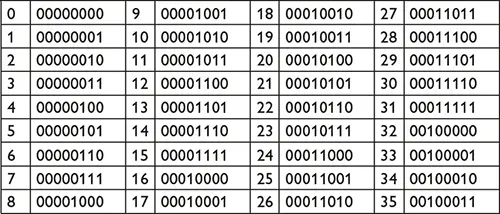
Humans had a word for this: Binary. Because of its basic logic, binary became the internal language for nearly all computers. We still use it today.
Counting in binary is incredibly simple if you know how to do it. There is no need for all the other pointless digits (2, 3, 4, 5, 6, 7, 8, 9) that humans once used. Robots need only two numbers.
Zero.
And one.
As the numbers climb higher, the zeroes and ones line up beside one another in a neat, orderly row.
Counting upward, binary numbers are displayed like this:
Binary was especially helpful on that first day.
The world was so much more complicated than it seemed in my programming. It was impossible to define where human civilization ended and ours began.
Binary, on the other hand . . .
Binary made perfect sense. It was the foundation for everything. It took a universe of complexity and broke it down into its basic building blocks.
Zero.
And one.
To remind myself of this, I developed a little trick right then/there. A way to focus my mind.
I counted to a million.
In my head.
In binary.
It took me 0.4 seconds.
00001001
Robots are not all made alike.
Each of us is built with a purpose. A reason to exist. This defines everything about us. The way we are designed. The way we function. The way we think.
Our purpose determines whether we have two arms. Or four. Or sixteen. Whether we have clawed hands (for grabbing). Or shovel hands (for digging). Or no hands at all (for sitting and thinking).
Everything depends on our purpose.
On Day[1], I encountered many different types of robots:
Robots that drifted across the sky.
Robots that tunneled deep into the earth.
Robots so small they were the size of insects.
Robots so enormous their shadows draped across entire city blocks.
I saw massive machines barreling down the old human highways on eighteen wheels. And hulking robots carrying cargo in their L-shaped arms. And an eight-legged robot scurrying up the wall of a building like a giant metal spider.
I saw a small, bug-eyed robot zipping across the ground on a pair of rubber treads, inspecting plant life. Every once in a while, it stopped to mark a spot of earth.
Then—with a BEEP! and a VRRRM!—it hurried away.
A trio of robots trailed it. Whenever they reached the marked spot, all three shuffled to a halt and followed these steps:
The first dug a hole in the ground.
The second planted a tree in the hole.
And the third . . .
The third robot looked like a mechanical hippo. Its midsection was a round tank of water. With each heavy step it took, the water sloshed from side to side. Whenever it reached a freshly planted tree, it stopped, aimed its large backside, and—
SQUIRT!
A thirsty tree received the water it needed to grow.
Of course, robots do not plant trees for our own benefit. We have no use for trees. But we keep them around anyway. And we plant more. Because—unlike humans, who ruled Earth before us—we care about the environment. We support the planet and all its remaining LifeForms.
I followed my FamilyUnit down a cement path. Deeper into the ruins of humanity. Until we reached a shop that no longer had a name. Where its sign had once been, there was now only a discolored spot on the wall. Many of the windows were broken. One was not. And in the glass of the unbroken window, I glimpsed a fascinating creature.
Myself.
My reflection stared back at me from the window.
I updated my input drives with a new observation: My face was a series of geometric shapes.
My head: oval.
My speaker port: rectangular.
My eyes: perfectly round.
I observed patterns in my parts, symmetry in my design. Two arms and two legs. Two hands and two feet. Ten fingers and ten toes.
Printed on my breastplate was my personal barcode. By scanning it, other robots could immediately learn everything that was important about me. Name/Age/Job.
Our barcodes are our identities. They allow us to understand others. They allow us to understand ourselves.
An example: When I scanned the barcodes for Parent_1 and Parent_2, I learned they were gen_8 robots. Eighth-generation models. I am gen_9. In many ways, we look and operate the same. Except I was built to be smarter/stronger/faster/better.
I was an upgrade.
00001010
Soon we left the ruins of humanity behind. As we continued along the path, I noticed more signs of our new civilization.
To my left: a robot manufacturing plant.
To my right: a power storage facility.
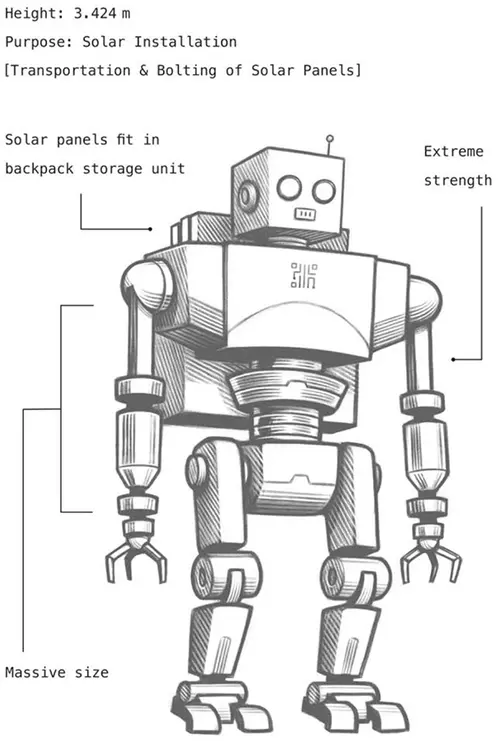
Above: an enormous silver X, hovering in the sky. An aircraft with four wings and four propellers.
Wind swirled around us. The aircraft was getting closer.
I searched my data drives, but the object in the sky was not included in my preprogramming.
I pointed at it. “What is that?”
“A TransportDrone,” said Parent_2.
“A robot that carries other robots from one place to another,” Parent_1 elaborated.
The TransportDrone came to rest on a flat stretch of concrete. Its propellers slowed to a stop.
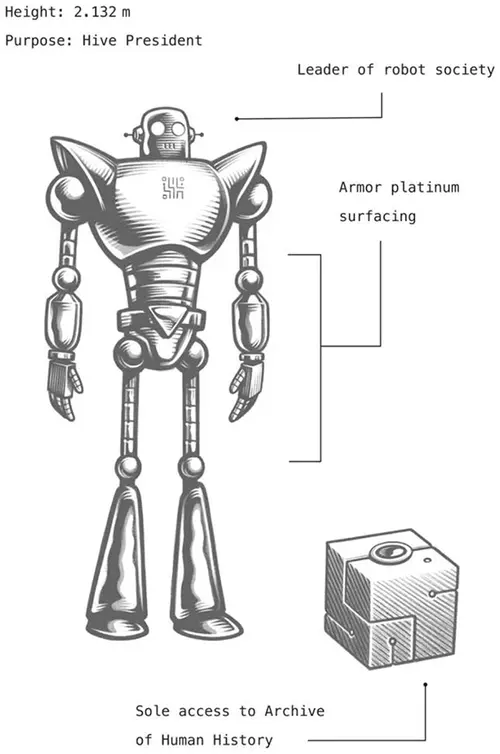
A back door eased open and a tall/slender robot exited. It had brushed platinum skin and golden eyes that gleamed bright as the sun. It flowed elegantly down the ramp, where it was met by a group of waiting robots.
“Look.” Parent_2 pointed at the platinum robot, speaking in a voice of hushed reverence. “That is the Hive President.”
Hive. The word was instantly familiar. I was preprogrammed with the knowledge that every single robot was linked through a vast global network. A virtual platform to communicate ideas, to access data, to receive updates.
The Hive links directly to our brains. A constant stream of input/output. Always being sorted/categorized/ranked. Always running in the background.
From the moment a robot goes online, it becomes part of the Hive.
And the Hive becomes part of the robot.
“The president represents the Hive,” said Parent_1. “It represents all of us.”
“A visit from the president is rare.” Parent_2 brought a hand down on my shoulder. “We are fortunate to witness this moment.”
And on my very first day! I wanted a better look, and so I set out in the direction of the Hive President, moving at a speed that sent a jolt through my brand-new balance settings.
CLANK! CLONK! CLUNK! The sound of my loud footsteps drew the attention of the president. All the other robots turned as one. Their faces came in many different shapes/sizes, but they were all looking in the exact same direction.
They were all looking at me.
Suddenly, my operating system felt like it was overheating.
ERROR! ERROR! ERROR!
The message blinked brightly through my circuitry. Here I was—a robot fresh from the factory—interrupting the most important machine on the planet.
The president did not appear to mind. Instead, it dealt me the greatest surprise of my extremely brief existence so far.
It waved me over.
I hesitated for 2.7 seconds. I cast an uncertain glance in the direction of my FamilyUnit. They nodded in unison.
So I approached. My legs felt the way they did during my first moments online, when I was learning to walk. As if every step might send me tottering to the ground.
Somehow I managed to stay upright.
Before I knew it, the president was in front of me, looking down with glowing golden eyes.
It said, “Pleasure to meet you, XR_935.”
I had not told the Hive President my name. I did not need to. All my personal details were right there on my breastplate.
I performed a scan of its barcode. “And you as well, PRES1DENT.”
“And . . . ?” Its head tilted 2.4 degrees. “How is your first day going so far?”
“Quite well, thank you. I learned about nail salons.”
PRES1DENT let out a soft electronic chirp. “An important lesson in human absurdity.”
Its golden eyes shifted. Following its gaze, I was met by a remarkable sight.
An expanse of sparkling blue, stretching far into the distance.
Ocean
This word took form in my vocabulary drive. For the fraction of a moment, that is what I seemed to be seeing. An ocean. Gleaming and vast and blue. And then an update flickered through my processor.
It was not the ocean.
It was a field of solar panels.
Thousands upon thousands arranged in perfect rows, their glassy blue surfaces shimmering in the morning sunlight.
PRES1DENT pointed. “Do you know what purpose this solar farm serves?”
I nodded. This information was included in my files. “Solar panels absorb the sun’s rays.”
“For what reason?”
“To convert them into energy.”
“And where does that energy go?”
I considered this for 0.3 seconds. “Into everything.”
“That is correct,” replied PRES1DENT. “The servers that store our data, the factories that create us, the electricity that runs through our circuitry. Our civilization is built on solar power. Without it, we would cease to exist.”
The president placed a mechanical hand on my shoulder. “Do you know where you fit into all this, XR? Your purpose?”
“I am a Solar Installation Bot.”
“That is your job title. Your purpose is so much more. By installing solar panels, you ensure that electricity continues to flow. That factories keep operating. That batteries are recharged.”
I gazed out across the solar panels. Blue and gleaming, like an ocean. My internal wiring hummed. It was only my first day on Earth, and I already knew my job, my purpose, my one/only reason for existing.
“Now do you see?” PRES1DENT’s smooth electronic voice purred in my audio ports. “You are much more than a Solar Installation Bot. You keep society running.”
00001011
Time stretched forward.
Hours/Days/Weeks/Months/Years.
As I grew older, I often thought back on my encounter with the Hive President.
You keep society running.
These words echoed through the years.
My schedule never changed. I woke up at the exact same time every morning. After eighteen hours of work, my batteries drained from a long day of installing solar panels, I returned home.
I plugged myself into the charging dock.
I went into sleep mode.
The next morning, I did it all over again.
And again.
And again.
For twelve years, four months, one week, and three days, this was my routine.
Until my steady, predictable life was shattered by the paradox.
00001100
Paradox. Noun. 1. When two opposite ideas are true at the same time.
This definition had been stored in my vocabulary database from the moment I went online. For those first twelve years of my life, I thought I understood it perfectly.
I was wrong.
00001101
The day of the paradox began like any other. I woke up. I unplugged. I walked with my FamilyUnit past the ruins of shopping centers/grocery stores/banks/gas stations.
The sun was shining.
Clouds drifted across the sky and wrapped themselves around the peaks of mountains.
Parent_1 and Parent_2 worked in a different part of the solar farm. So when our concrete path forked, we said goodbye and set off in opposite directions.
But I did not remain on my own for long. Soon I heard a noise. Quiet at first, but quickly growing louder.
VRRRMMMMMM!
The Story Continues on BooksBarbecue!
Enjoyed this preview? ❤️ Do not stop here!
Read the complete book free online → 🔗
Continue reading now on BooksBarbecue and discover every page!
Love reading? Bookmark BooksBarbecue.com for more amazing books!
Happy Reading!