Chapters (12)
In a few days a man named John Nodgen came to Calias. Towns which had failed to get a road looked upon him in the way a sick man would an undertaker. He was a red-haired Irishman with teeth wide apart and wildish blue eyes, who had the reputation of moving more towns than any other one man. He brought horses and wagons, block and tackle, and massive steel trucks. He swore like a stranded sailor, and declared they would hold up any two buildings in Calias.
The saloon was the first building deserted. The stock had not been removed when the house movers arrived, and in some way they got the door open and helped themselves to the "booze," and when full enough to be good and noisy, began jacking up the building that had been the pride of the hopeful Caliasites. In a few weeks a large part of what had been Calias was in Megory and a small part in Kirk.
It had stopped raining for a while, and several large buildings were still on the move to Megory when the rain set in again. This was the latter part of July and how it did rain, every day and night. One store building one hundred feet long had been cut in two so as to facilitate moving, and the rains caught it half way on the road to Megory. After many days of sticking and floundering around in the mud, at a cost of over fourteen hundred dollars for the moving alone, not counting the goods spoiled, it arrived at its new home. The building in the beginning had cost only twenty-three hundred dollars, out of which thirty cents per hundred had been paid for local freighting from Oristown. The merchant paid one thousand dollars for his lot in Megory, and received ten dollars for the one he left in Calias.
This was the reason why Rattlesnake Jack's father and I could not get together when he came out and showed me Rattlesnake Jack's papers. It was bad and I readily agreed with him. I also agreed to sign a quit claim deed, thereby clearing the place, so she could complete her proof. Everything went along all right, until it came to signing up. Then I suggested that as I had broken eighty acres of prairie, the railroad was in course of construction, and land had materially increased in valuation—having sold as high as five thousand dollars a quarter section—I should have a guarantee that he would sell the place back to me when the matter had been cleared up.
"I will see that you get the place back"—he pretended to reassure me—"when she proves up again."
"Then we will draw up an agreement to that effect and make it one thousand dollars over what I paid", I suggested.
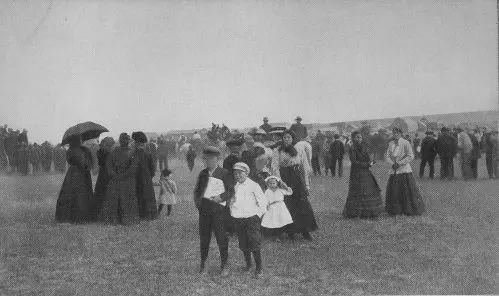
Everybody for miles around had journeyed thither to celebrate. (Page 108.)