Chapters (12)
Shortly after coming to Pencer, he went to work for an Iowa man on a ranch near by, and later a prosperous squaw-man, who owned a bank, took him in, where in time he became book-keeper and all round handy man, later assistant cashier. The ranchman whom Woodring had worked for previous to entering the bank, bought the squaw-man out, made Woodring cashier, and sold to him a block of stock and took his note for the amount. In time Woodring proved a good banker and his efficient management of the institution, which had been a State bank with a capital stock of twenty-five thousand dollars, had been incorporated into a National bank and the capital increased to fifty thousand dollars, and later on to one hundred thousand dollars. He dealt in buying and selling land as well as feeding cattle, on the side, and had prospered until he was soon well-to-do. Coincident with this prosperity he had been made president of not only that bank—whose footing was near a half-million dollars—but of some other three or four local banks in Nebraska, also a Megory county bank at Fairview—which is the county depository—and a large bank and trust company at the town of Megory, with a capital stock of sixty thousand dollars. Today Frank Woodring is one of the wealthiest men in northwest Nebraska.
The local ball team of their town was playing Megory that day, and a few hours later out at the ball park, I was shouting for the home team with all my breath, the batter struck a foul, and when I turned to look where the ball went, there, standing on the bench above me, between two white girls, and looking down at me with a look that betrayed his mind, was Len Woodring. Our eyes met for only the fraction of a minute but I read his thoughts. He looked away quickly, but I shall not soon forget that moment of racial recognition.
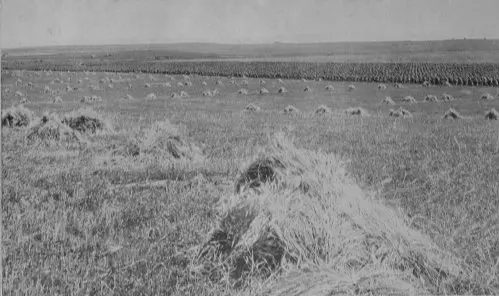
Everything grew so rank, thick and green.
And now when I found my affections in jeopardy regarding the love of the Scotch girl, I thought long and seriously over the matter, and pictured myself in the place of the Woodring family, successful, respected, and efficient business men, but still members of the down-trodden race. I pondered as to whether I could make the sacrifice. Maybe they were happy, the boys had never known or associated with the race they denied, and maybe were not so conscientious as myself, although the look of Len's had betrayed what was on his mind.