Chapters (12)
I spent the Fourth of July in Victor, where the people shook their heads gravely and said, "Tipp county will never raise a crop." The crops had dried up in Tipp county the year before. I read that the railroad men who run from Kansas City to Dodge City reported that the pastures through Kansas were so dry along the route, that a louse could be seen crawling a half mile away. In parts of Iowa the farmers commenced to put their stock in pens and fed them hay from about the middle of June, there being no feed in the pastures. Through eastern Nebraska, western Iowa and southern Minnesota, the grasshoppers began to appear by the millions, and proceeded to head the small grain. To save it, the farmers cut and fed it to stock, in pens.
CHAPTER XLII
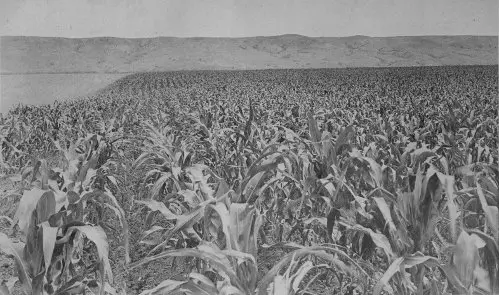
The crops began to wither. (page 289.)
The markets were being over-run with thin cattle from the western ranges, where the grass had never started on account of lack of moisture. I watched my flax crop and early in July noticed it beginning to wilt, then millions of army worms began cutting it down. On the eleventh I left for Megory county, with my stock, to harvest the winter wheat there. It had been partially saved by the rain in June. The two hundred and eighty-five acres of flax was a brown, sickly-looking mess, and I was badly discouraged, for outside of my family trouble, I had borrowed my limit at the bank, and the flax seed, breaking, and other expenses, had amounted to eleven hundred dollars.
About this time the settlers all over the western highlands began to desert their claims. Newspapers reported Oklahoma burned to a crisp, and Kansas scorched, from Kansas City to the Colorado line. Homesteaders to the north and west of us began passing through the county, and their appearance presented a contrast to that of a few years before. Fine horses that marched bravely to the land of promise, drawing a prairie schooner, were returning east with heads hanging low from long, stringy necks, while their alkalied hoofs beat a slow tattoo, as they wearily dragged along, drawing, in many cases, a dilapidated wagon over which was stretched a tattered tarpaulin; while others drew rickety hacks or spring wagons, with dirty bedding and filthy looking utensils. These people had not made a dollar in the two years spent on their homesteads. At Pierre, it was said, seven hundred crossed the the Missouri in a single day, headed east; while in the settlements they had left, the few remaining settlers went from one truck patch to another, digging up the potatoes that had been planted in the spring, for food.