Chapters (59)
- Conn Iggulden
- Contents
- About the Author
- Also by Conn Iggulden
- Dedication
- Maps
- Pronunciation
- Locations
- Characters
- Ten tribes of Athens
- Part One
- Part One
- 1
- 2
- 3
- 4
- 5
- 6
- 7
- 8
- 9
- 10
- Part Two
- Part Two
- 11
- 12
- 13
- 14
- 15
- 16
- 17
- 18
- 19
- 20
- 21
- Part Three
- Part Three
- 22
- 23
- 24
- 25
- 26
- 27
- 28
- 29
- 30
- 31
- 32
- Part Four
- Part Four
- 33
- 34
- 35
- 36
- 37
- 38
- Historical Note
- THIS IS JUST THE BEGINNING
- Copyright
Given the circumstances, it is hard to be certain what happened next. The only records would be Persian and as with all the things of men, they would not record everything that happened, especially if it reflected poorly on the Great King. The legend is that Themistocles took his own life rather than betray his people. We will never know the details, only that he never came home. His was a magnificent life. I doubt I have done it justice. For those who would like to know more of the period, I recommend: The Histories by Herodotus, Daily Life in Greece at the Time of Pericles by Robert Flaceliere, Plutarch’s Life of Pericles and The Spartan Army by J. F. Lazenby. I’ll keep back the name of my favourite source of all until the next book.
Xerxes would not go on to have a long reign. He was killed by his bodyguard and a eunuch around 465 BC . The cultures of Persia and Greece would not overlap again until a Persian prince named Cyrus came looking for an army to defeat his brother – Artaxerxes. That story of ten thousand Greek mercenaries trying to get home is one I told in The Falcon of Sparta .
In Greece, as Themistocles passes from the stage, two great cities stand: Sparta and Athens. What follows is a struggle between democracy and kings, with its roots in the uneasy but ultimately successful alliance against Persia. Athens and Sparta fought a common enemy at Artemisium, at Salamis, at Plataea and at Mycale under Xanthippus. When that terrible enemy was finally defeated, they did not need one another any longer. They pulled apart, as hostile as ever. The Spartans turned their gaze inward and went home, but the Athenians didn’t. They had seen how well the fleet had worked – stronger together than apart. A nation was born in those ships.
In Athens, a new generation arose: Cimon, son of Miltiades, Aeschylus, the father of tragedy – and Pericles, son of Xanthippus. He would have to guide his people through a conflict as great as any they had known, the city of Athena thrown once again into a crucible. The story that resulted is greater than all that went before.
Conn Iggulden, London, 2020
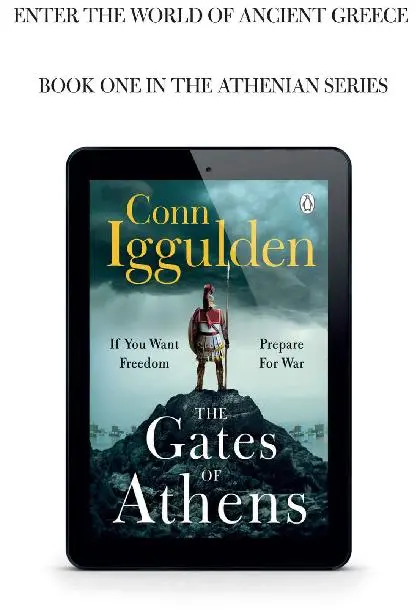
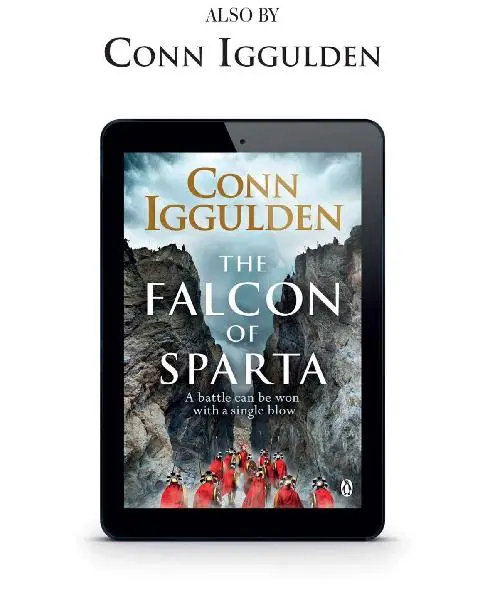

THIS IS JUST THE BEGINNING
Find us online and join the conversation
Follow us on Twitter twitter.com/penguinukbooks
Like us on Facebook facebook.com/penguinbooks
Share the love on Instagram instagram.com/penguinukbooks
Watch our authors on YouTube youtube.com/penguinbooks
Pin Penguin books to your Pinterest pinterest.com/penguinukbooks
Listen to audiobook clips at soundcloud.com/penguin-books
Find out more about the author and discover
your next read at penguin.co.uk
Copyright
PENGUIN BOOKS
UK | USA | Canada | Ireland | Australia
New Zealand | India | South Africa
Penguin Books is part of the Penguin Random House group of companies whose addresses can be found at global.penguinrandomhouse.com .

First published by Michael Joseph in 2021
Copyright © Conn Iggulden, 2021
The moral right of the author has been asserted