Protector

Conn Iggulden
ATHENIAN
PROTECTOR
Book II

Contents
About the Author
Conn Iggulden is one of the most successful authors of historical fiction writing today. He has written bestselling historical series on the lives of Julius Caesar and Geghis Khan, and on the Wars of the Roses, as well as two stand-alone novels: Dunstan, set in the red-blooded world of tenth-century England, and The Falcon of Sparta, where Iggulden returns to the Ancient World. His most recent book, the Sunday Times bestselling The Gates of Athens, is the first in his new Athenian series.
Also by Conn Iggulden
Dunstan
The Falcon of Sparta
ATHENIAN SERIES
The Gates of Athens
THE WARS OF THE ROSES SERIES
Stormbird
Trinity
Bloodline
Ravenspur
THE EMPEROR SERIES
The Gates of Rome
The Death of Kings
The Field of Swords
The Gods of War
The Blood of Gods
THE CONQUEROR SERIES
Wolf of the Plains
Lords of the Bow
Bones of the Hills
Empire of Silver
Conqueror
Blackwater
Quantum of Tweed
BY C. F. IGGULDEN
EMPIRE OF SALT SERIES
Darien
Shiang
The Sword Saint
BY CONN IGGULDEN AND HAL IGGULDEN
The Dangerous Book for Boys
BY CONN, ARTHUR AND CAMERON IGGULDEN
The Double Dangerous Book for Boys
BY CONN IGGULDEN AND DAVID IGGULDEN
The Dangerous Book of Heroes
BY CONN IGGULDEN AND
ILLUSTRATED BY LIZZY DUNCAN
Tollins: Explosive Tales for Children
Tollins 2: Dynamite Tales
Dedication
To Sr. Andrea MacEachen and
Sr. Mauraid Moran – guides in the wilderness.
Maps
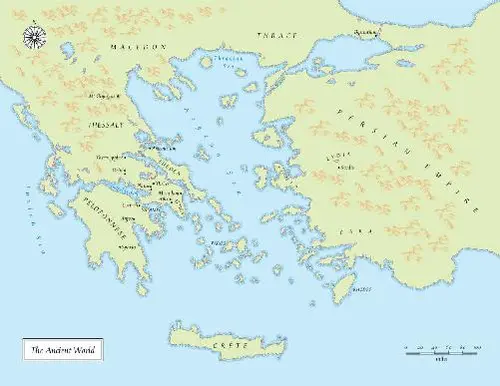
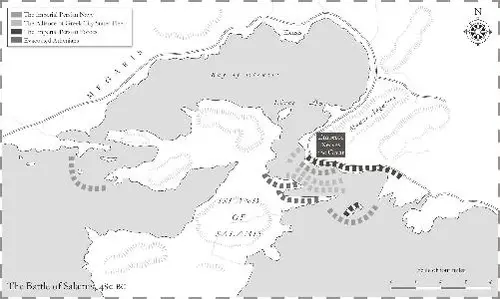
Pronunciation
Military terms
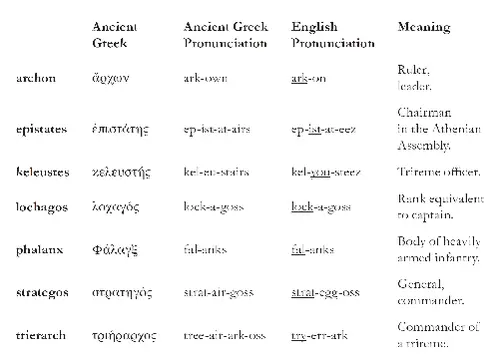
AncientGreek |
Ancient Greek Pronunciation |
English Pronunciation |
Meaning |
|
| archon | ἄρχων | ark-own | ark -on | Ruler, leader. |
| epistates | ἐπιστάτης | ep-ist-at-airs | ep-ist -at-eez | Chairman in the Athenian Assembly. |
| keleustes | κελευστής | kel-eu-stairs | kel-you -steez | Trireme officer. |
| lochagos | λοχαγός | lock-a-goss | lock -a-goss | Rank equivalent to captain. |
| phalanx | Φάλαγξ | fal-anks | fal -anks | Body of heavily armed infantry. |
| strategos | στρατηγός | strat-air-goss | strat -egg-oss | General, commander. |
| trierarch | τριήραρχος | tree-air-ark-oss | try -err-ark | Commander of a trireme. |
Underlining indicates stressed syllables.
Locations
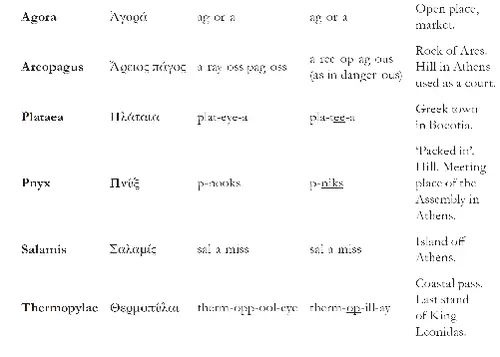
| Agora | Ἀγορά | ag-or-a | ag-or -a | Open place, market. |
| Areopagus | Ἄρειος πάγος | a-ray-oss pag-oss | a-ree-op -ag-ous (as in danger-ous) | Rock of Ares. Hill in Athens used as a court. |
| Plataea | Πλάταια | plat-eye-a | pla-tee -a | Greek town in Boeotia. |
| Pnyx | Πνύξ | p-nooks | p-niks | ‘Packed in’. Hill. Meeting place of the Assembly in Athens. |
| Salamis | Σαλαμίς | sal-a-miss | sal -a-miss | Island off Athens. |
| Thermopylae | Θερμοπύλαι | therm-opp-ool-eye | therm-op -ill-ay | Coastal pass. Last stand of King Leonidas. |
Characters
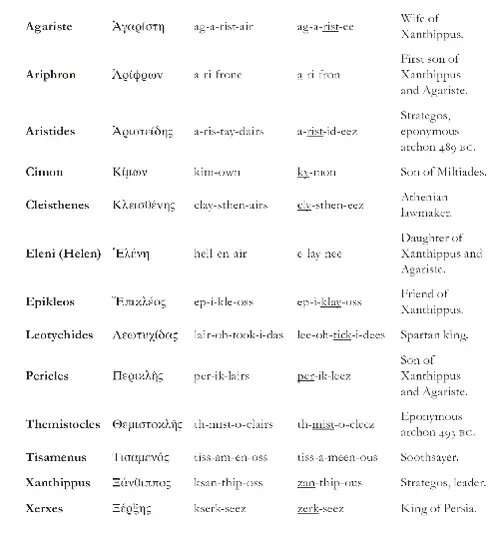
| Agariste | Ἀγαρίστη | ag-a-rist-air | ag-a-rist -ee | Wife of Xanthippus. |
| Ariphron | Ἀρίφρων | a-ri-frone | a -ri-fron | First son of Xanthippus and Agariste. |
| Aristides | Ἀριστείδης | a-ris-tay-dairs | a-rist -id-eez | Strategos, eponymous archon 489 BC . |
| Cimon | Κίμων | kim-own | ky -mon | Son of Miltiades. |
| Cleisthenes | Κλεισθένης | clay-sthen-airs | cly -sthen-eez | Athenian lawmaker. |
| Eleni (Helen) | Ἑλένη | hell-en-air | e-lay -nee | Daughter of Xanthippus and Agariste. |
| Epikleos | Ἔπικλέος | ep-i-kle-oss | ep-i-klay -oss | Friend of Xanthippus. |
| Leotychides | Λεωτυχίδας | lair-oh-took-i-das | lee-oh-tick -i-dees | Spartan king. |
| Pericles | Περικλῆς | per-ik-lairs | per -ik-leez | Son of Xanthippus and Agariste. |
| Themistocles | Θεμιστοκλῆς | th-mist-o-clairs | th-mist -o-cleez | Eponymous archon 493 BC . |
| Tisamenus | Τισαμενός | tiss-am-en-oss | tiss-a-meen -ous | Soothsayer. |
| Xanthippus | Ξάνθιππος | ksan-thip-oss | zan -thip-ous | Strategos, leader. |
| Xerxes | Ξέρξης | kserk-seez | zerk -seez | King of Persia. |
Ten tribes of Athens
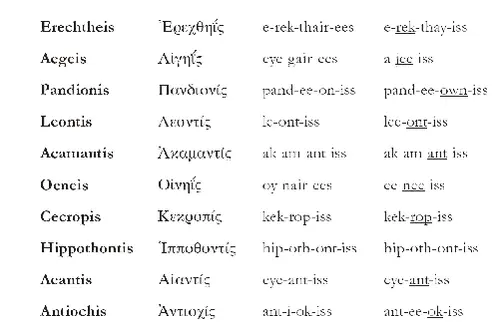
| Erechtheis | Ἐρεχθηΐς | e-rek-thair-ees | e-rek -thay-iss |
| Aegeis | Αἰγηΐς | eye-gair-ees | a-jee -iss |
| Pandionis | Πανδιονίς | pand-ee-on-iss | pand-ee-own -iss |
| Leontis | Λεοντίς | le-ont-iss | lee-ont -iss |
| Acamantis | Ἀκαμαντίς | ak-am-ant-iss | ak-am-ant -iss |
| Oeneis | Οἰνηΐς | oy-nair-ees | ee-nee -iss |
| Cecropis | Κεκροπίς | kek-rop-iss | kek-rop -iss |
| Hippothontis | Ἱπποθοντίς | hip-oth-ont-iss | hip-oth-ont -iss |
| Aeantis | Αἰαντίς | eye-ant-iss | eye-ant -iss |
| Antiochis | Ἀντιοχίς | ant-i-ok-iss | ant-ee-ok -iss |
Part One

Part One
‘There are no pacts between lions and men, nor do wolves and lambs make peace.’
– Homer, The Iliad
1
The king of Persia looked across the heart of Athens.
The sun was hot on the back of his neck, but a breeze blew, warm and gentle, carrying a smell of sweetness – of rot and the sea. Xerxes closed his eyes and breathed, feeling at peace. The great market, the temples, the streets of households, workshops and taverns – they were all abandoned. It was intimate, somehow. He felt as if he sat at a woman’s dressing table, opening every small drawer, learning her secrets.
The soldiers in that place were all his own. They had searched Athens from one end to the other, every storehouse, shop and empty home. The only Greeks within the walls had been half a dozen mindless ancients, left behind by their families. Toothless and blind, they had hissed incredulous, nervous laughter at the strange voices of Persian soldiers. Xerxes had no need of them. Like stray dogs, they had been killed quickly. It was almost a mercy.
General Mardonius walked three paces behind the Great King, deep in his own reverie. Both he and Xerxes had experienced a strange sort of recognition as they’d entered Athens. Places and natural features surfaced from a hundred old reports, suddenly made real. The Acropolis was one, the cliff of limestone that loomed on their left hand, sentinel for the whole city; or perhaps the pale Areopagus rock, where a council of Athenian noblemen had met for centuries.
Xerxes could see the Pnyx hill ahead, rising with trees like blades and white steps on its flanks. In normal times, the famous Assembly met and argued in that place, acknowledging no king or tyrant. He would have liked to see it, those men so busy with their little laws. Yet only the breeze blew there that day. The people of Athena’s city had gone down to the port, to be taken by ship across the deep water. Rather than suffer the predations of his army, rather than learn the consequences of their arrogance, they had run from him.
Xerxes walked through streets where doors hung open and every sound echoed. Beyond a few cats warming themselves on roofs, his Immortals were the only living things he could see. They stood in long, panelled coats, ringlet beards oiled to a shine, like statues themselves. The Great King loved them as his father had, like favourite children or beloved hunting dogs, both the shield and ornament of his reign. Half their number had been killed by the red-cloaked butchers of Thermopylae. His Immortals still reeled from that blow, though they had opened the pass in the end! Xerxes had chosen to mark only that final victory, keeping them as his guards, honouring them with his blessing. The five thousand who lived were survivors: battered and bruised, but stronger for having seen the last Spartans cut down. The Immortals had not broken in that pass. Yet they had believed they were unbeatable, without equal in the world. Xerxes had witnessed their shock, their disbelief. The Spartans had made them feel helpless.
Xerxes had even considered resting the regiment, taking them out of his vanguard. Their commander was a great bull of a man – Hydarnes. With his face pressed in the dirt, he had pleaded for the Immortals then, saying they needed to work, that they would fester like a bad wound if they were given too much time to think. Xerxes had agreed. Honour could not be granted. It had to be earned through sacrifice and hard service.
At the end of a street where potters’ wheels sat untended, the light changed, brighter and airier than the roads around. Xerxes entered the famous Agora marketplace. There were the statues for the ten tribes, with stone tablets to be read out loud. He did not approach them, but he imagined at least a few warned of his own approach. His pride surged at the thought.
Xerxes looked up as a hawk keened overhead, its cry perfectly clear in the still air. The bird wove huge circles over the city and Xerxes could see the head turning, looking for prey. On any normal day, such a sound would have gone unnoticed, lost in bustle and clatter. Yet here, it was as if he sat on a mountain top and all work had ceased. It was a wonder of war, he realised, something ordinary men and women would never know.
‘I swore I would stand here, Mardonius,’ Xerxes murmured. His general only nodded, sensing the king needed no response. ‘I told my father I would finish his work, that I would bring the army to this very spot. I swore I would punish them for scorning our envoys, for refusing to offer earth and water. My father gave them a dozen chances to bend the knee, and they refused every one. They chose this, not us. Even so, to be in this place …’ He shook his head in simple pleasure. Mardonius smiled as he walked. Truly, on such a day, nothing was impossible.
High above those streets, the Acropolis filled the gaze wherever it fell. Xerxes could see temples up there, some of them with a wooden scaffold on the walls and unfinished columns, all to honour the deities of the Greeks. His spies had described it, even to the monuments that commemorated the battle of Marathon, ten years before. That Greek victory over the Persians had hurt his father, Xerxes knew. It had damaged his spirit, perhaps even led to the illness that tore him from the world, half his weight and all his strength gone. Xerxes felt a pulse of rage at that thought. He would take down those stones!
He paused then, seeing movement high on the great rock.
‘Are … people up there still, general?’
Mardonius shaded his eyes to stare up.
‘A few dozen, Majesty. Just some priests, as far as I can tell. We’ll dig them out.’
He did not tell the king that the skinny old men on the Acropolis had blocked the main route to the top. They had also armed themselves with ancient weapons and armour apparently taken from temple walls. Their presence was no more than a biting fly, but they had not been dislodged by the time the young king insisted on entering the city. Mardonius longed to distract Xerxes from his frowning concentration.
On a sudden whim, the young king glanced at the rock of the Areopagus, not a hundred paces off. Without a word to his general, Xerxes jogged to where it touched the street below and clambered up the steps in a rush of youthful energy. He was still breathing lightly as he reached the huge, flat top.
Athenian noblemen had stood there for hundreds of years. The king rested one foot on the highest point, looking up at the Acropolis as it rose before him. Even the Areopagus was dwarfed by it.
Mardonius was physically fit, hardened by months on the march. He too was breathing lightly as he came alongside. Xerxes nodded to him. The king was in a good mood, able to go anywhere he wanted, in the sacred places of his enemies.
Mardonius narrowed his eyes at movement on the Acropolis, reading the scene. There was not much to trouble him.
‘I have sent an entire hazarabam to climb the rear of the great rock, Majesty. There are more men at the foot of the steps there, to distract the Greeks above with arrows. You see them? The rest will overwhelm the defenders when they reach the top.’
‘And then make an example of them,’ Xerxes said. ‘That would please me, general. Make it so. Display the bodies for their gods to see.’
‘As you wish, Majesty.’
Mardonius saw the young king turn slowly, enjoying the elevated position. The sea was dark to the south-west and Xerxes squinted into the distance, the Acropolis at his back.
‘I will not wait, Mardonius,’ he said. ‘I want to go down to the sea, to watch my fleet destroy the last of their hopes. Have this city burned. It seems a dry place. I imagine flames will spread well enough.’
Xerxes looked at the canvas-and-wood awnings of the marketplace a couple of streets over. It was much smaller than he had realised. Its dimensions had been made larger in his imagination by the crimes of its inhabitants.
The market would certainly burn, as would streets of brick and plaster, roofs of tile and ancient wood. Xerxes smiled at the thought of embers lofting gently overhead, spreading. He wanted a great conflagration, a city on fire behind him. He wanted the Greeks to see the plume of smoke, to know their precious Athena could not be defended, that she had been plundered and overthrown and raped. It was a good thought.
‘Fetch me a brand, Mardonius,’ Xerxes said.
He was bright-eyed as the general whistled to waiting servants, never far from their master’s whims. When they understood, one of their number climbed the rock, nervous fingers working flint and steel. The fellow was skilled, scratching sparks onto a tuft held in his cupped fingers, then pressing the nascent flame to a club wrapped in oiled cloth, thick with tar. It spat and crackled as it caught, drawing the eye. The servant prostrated himself on the rock, so that dust stuck to his skin.
Mardonius followed the king down, as if Xerxes led a procession. The flame the king bore grew to a sooty ribbon, making trails in the air as the young man jumped from step to step, then halted in the street below.
The summer had been long and the city was dry. Xerxes raised the brand to a roof and the flame bit at laths of wood beneath the tiles. From each touch, it spread, forcing pale smoke out in thin streams as it took hold. Some tiles cracked in the heat, with notes that were almost musical. Xerxes laughed then, striding forward, pressing the flame to every house he passed. At the end of the street, he turned back, standing in the centre of the roadway as trails of smoke joined and rose, already breathing, already beyond any control or curb.
Mardonius had followed the king. The young man’s smile was hard to resist, the simple satisfaction at his achievement. When Xerxes tossed the burning brand to him, Mardonius snatched it up.
‘Finish what I have begun, general,’ Xerxes said. ‘I have decreed this city will not stand. It is their reward for defying my father. Burn it all! I am for the ships! I would see the fleet of Athens broken. Give thanks! I have shared this with you. This is a day you will remember for ever.’
Mardonius watched with his head bowed as the king strode off in the direction of the sea. When the general realised Xerxes would not stop, his mouth became a thin line. The general gestured sharply then, sending a dozen of the royal guard and sixty archers running down the road after him. Mardonius whistled for more support, hearing the sound carried back to the main forces. His men had pronounced the city clear of threats, but out beyond the walls? The road to the sea might not be safe. Who knew if any fanatics had remained behind to ambush and kill Persians? It would not do to have Xerxes stabbed by some old man at the moment of his triumph.
Mardonius shifted his grip on the burning brand as the breeze blew flames back on him. If he had ever doubted the blessing of the great god Ahura Mazda on the family of the king, he could not that day. He and Xerxes had marched or sailed for months to reach that place, bringing an army and a fleet so vast there was nothing they could not achieve.
He frowned in memory of that long trudge across the bridge of ships and around the sea of the Greeks. He and his men had endured much to stand in Athens that day. Many would not return home. Mardonius had witnessed extraordinary skill and bravery at Thermopylae. He could admit that in his most private thoughts. Yet even the Spartans had fallen in the end. Xerxes had ordered their king’s head removed, the body cut to pieces and thrown into the sea, almost as if he feared the great warrior would rise again. Mardonius shuddered in memory. They had not beaten the Spartans with sword and shield. They could not. In the end, Xerxes had ordered his men to stand back and throw spears, over and over, until the last ones fell.
At sea, the Athenian fleet had been driven back and back, Mardonius reminded himself, putting aside stirrings of superstitious awe. For all their skill and courage, the Greeks had not been able to save Athens, the very heart and wellspring of their power. God was clearly with Persia, and Mardonius dipped his head at the thought. He sent a silent prayer to King Darius, father to nations and companion of his youth, when all the world had been sweet and clean as a new peach. The old man would be watching them, of course, in satisfaction.
The shifting wind brought another flash of heat, the flame whipping across his arm. Mardonius put aside his reverie, focusing on the work that lay ahead. He was weary, in need of a long rest. He was no longer young! He sighed. The king owned his breath, his sore knees. Xerxes saw no weakness, allowed none. Mardonius would go on.
A few cats still watched from some doorways, curling round the legs of his soldiers and mewing. They would all burn. Perhaps the men would fix brands to their tails and send them off to shriek and spread the flames. Such things had been done in other cities, though Mardonius thought it extravagant. Simple was always better than complicated, in his experience.
He thought of the walls that surrounded Athens. Great gates and towers were as much a symbol as any true protection. Yet whatever they were, they could be broken with hammers and hooked poles. He had an army of more than quarter of a million men, fit as any horse or pack of hounds. They would take down the walls.
High on the Acropolis, Mardonius heard thin shouts and the clash of arms, even as the rising plume of smoke obscured it. He bit his lip. It would not do to trap his own men in streets of flame. No, he had to think like an engineer and set about the task with calm thought. Let the king enjoy his victories! Xerxes had earned them.
Another hazarabam of a thousand men came in quick time down the street, appearing out of smoke that still thickened and spread. Mardonius sent a couple of the lowest ranks back to carry his commands, the rest after Xerxes. The king thought nothing of his own safety. He merely trusted his general to secure it.
Mardonius knew he served his king well. His heart burned at the thought, as fiercely as the roofs around him.
2
Spray lashed at Themistocles as the galley surged to greater speed. The sea should have been calm in the strait between the island of Salamis and Piraeus, the great port of Athens. Yet their ram crashed through waves broken and boiled by hundreds of ships, thousands of oars.
Themistocles felt a moment of confusion, the product of leaden weariness. He shaded his gaze with a free hand, relying on balance and powerful legs to hold him steady on deck. For just an instant, he had lost the sense of structure, the patterns of ships suddenly chaos all around him. It was still there, if he could just see it! He wiped seawater from his eyes, feeling the stiffness of salt on his skin. He wore no armour. Only his hoplites and helmsmen did, those men the target of every enemy arrow.
Themistocles gripped a hoplon shield on his left arm and watched the enemy ships. Below his feet, three ranks of thirty rowers gripped oars on either side, one hundred and eighty free men of Athens. They were all free. Even household slaves had been offered freedom if they agreed to row, so he’d heard. He shook his head. That would surely come back to bite them, if they survived the war.
Below his feet, those oarsmen rowed with eyes screwed shut and every breath like molten iron – but they endured. They could see the ships passing on either side well enough, through gaps in the leather and the oarlocks. Ram and prow were both hidden to their view and they relied on officers and the helmsmen to steer straight and choose targets. Their strength and will was another resource, to be spent well rather than squandered. That they were already exhausted did not need to be said.
In the previous hour, Themistocles had been forced to send two hoplites to replace men who had died in their seats, their hearts giving way. Those bodies had been put overboard, watched by those who remained with a terrible, sick gaze. Yet they were young men, one and all. It would not be them next. It would never be them.
Themistocles was down to just twelve hoplites on deck, ready to leap across if the call came for boarding. Those men watched him for orders, for all the world like his own youth, clad in golden bronze. He jerked his head up in response to their gaze, looking as confident as he could. A couple of them flashed a grin before they turned back to look over the sea. Themistocles the unconquerable. Themistocles the bully, the arrogant, who knew no fear! Themistocles the lucky.
He didn’t mind what they called him. It didn’t matter how blessed by the gods they thought he was. Nothing he had ever won for himself had come through fortune or fate. He scowled at that foolish thought and touched his tongue to a medallion held in his cheek. His mother had given it to him. It bore the owl of Athena and, though the cord had snapped, he carried it still. He would rather not tempt the gods to punish his pride, not while he rode a fragile shell in the midst of an enemy fleet.
The Story Continues on BooksBarbecue!
Enjoyed this preview? ❤️ Do not stop here!
Read the complete book free online → 🔗
Continue reading now on BooksBarbecue and discover every page!
Love reading? Bookmark BooksBarbecue.com for more amazing books!
Happy Reading!