Hue and Cry
Chapters (16)
Cover
Dedication
To my nephew, Woody Miller,
and to Devorah.
And Annie, of P.S. 36
Epigraph
When a felony is committed, the hue and cry (hutesium et clamor) should be raised. If, for example, a man comes upon a dead body and omits to raise the hue, he commits an amerciable offense, besides laying himself open to ugly suspicions. Possibly the proper cry is “Out! Out!”
—POLLOCK AND MAITLAND,
History of English Law
Preface
I FIRST “MET” JAMES ALAN MCPHERSON in the Holy Cross College bookstore in Worcester, Massachusetts, in the fall of 1969. I had come to find something to read beyond the nineteenth-century British novels of the course I was taking. Beyond Dickens. Beyond the Brontës. Beyond Thackeray. It was not that I had not been pleasantly, wonderfully nourished by such authors, but I had spent my teenage years in Washington, D.C., primarily devouring American writers, black and white. The literary world beyond America was still a generally new one to me, still a feast of rich, though unfamiliar food, as it were. And because Dinand Library at the Cross was still several months away from being a place I, a black sophomore at a predominantly white school, could comfortably go and know that I could find something familiar, I went once more to the bookstore.
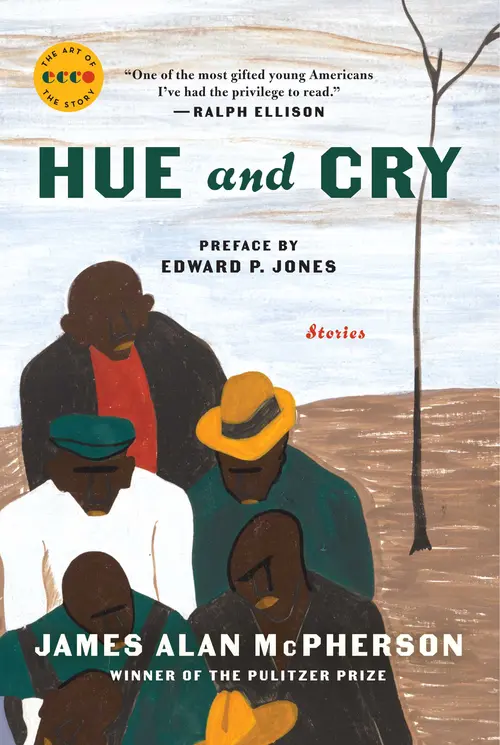
Familiar, then, was what I began to feel when I came upon the paperback Hue and Cry on the store’s shelf. Black cover, orange lettering. And on the back, a black-and-white stamp-sized photograph of Jim, as I, a graduate student, would come to know him, more than ten years later at the University of Virginia. Standing in the bookstore aisle, I had a growing feeling that I knew that man in the photograph in a way that I had not years earlier when seeing pictures of James Baldwin or Ralph Ellison on the backs of their books. Perhaps it was because their photos were those of seasoned, established, older writers. Jim, obviously a long way from being even thirty years old, stood almost shyly in a peacoat, looking as if having his picture taken would never be one of the things he would get used to doing. I felt I knew this man because he looked like me.
I do not now remember how quickly I read all of Jim’s stories, but it could not have been more than a day—college work must have been pushed to the side for several hours.