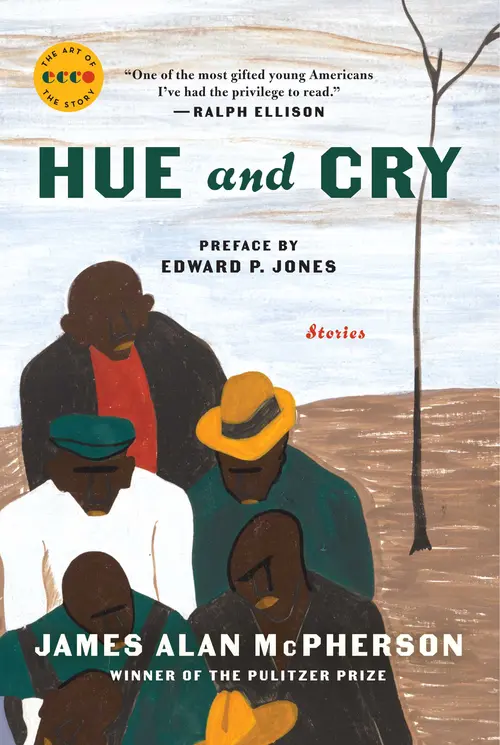
Hue and Cry
Cover
Dedication
To my nephew, Woody Miller,
and to Devorah.
And Annie, of P.S. 36
Epigraph
When a felony is committed, the hue and cry (hutesium et clamor) should be raised. If, for example, a man comes upon a dead body and omits to raise the hue, he commits an amerciable offense, besides laying himself open to ugly suspicions. Possibly the proper cry is “Out! Out!”
—POLLOCK AND MAITLAND,
History of English Law
Preface
I FIRST “MET” JAMES ALAN MCPHERSON in the Holy Cross College bookstore in Worcester, Massachusetts, in the fall of 1969. I had come to find something to read beyond the nineteenth-century British novels of the course I was taking. Beyond Dickens. Beyond the Brontës. Beyond Thackeray. It was not that I had not been pleasantly, wonderfully nourished by such authors, but I had spent my teenage years in Washington, D.C., primarily devouring American writers, black and white. The literary world beyond America was still a generally new one to me, still a feast of rich, though unfamiliar food, as it were. And because Dinand Library at the Cross was still several months away from being a place I, a black sophomore at a predominantly white school, could comfortably go and know that I could find something familiar, I went once more to the bookstore.
Familiar, then, was what I began to feel when I came upon the paperback Hue and Cry on the store’s shelf. Black cover, orange lettering. And on the back, a black-and-white stamp-sized photograph of Jim, as I, a graduate student, would come to know him, more than ten years later at the University of Virginia. Standing in the bookstore aisle, I had a growing feeling that I knew that man in the photograph in a way that I had not years earlier when seeing pictures of James Baldwin or Ralph Ellison on the backs of their books. Perhaps it was because their photos were those of seasoned, established, older writers. Jim, obviously a long way from being even thirty years old, stood almost shyly in a peacoat, looking as if having his picture taken would never be one of the things he would get used to doing. I felt I knew this man because he looked like me.
I do not now remember how quickly I read all of Jim’s stories, but it could not have been more than a day—college work must have been pushed to the side for several hours.
What struck me, as I again read Hue and Cry, for perhaps the third or fourth time in 2018, is how powerful and strangely frightening at times the first five stories of the book are with their men and the often crushing burden of their work. Young Thomas Brown of “A Matter of Vocabulary” bagging potatoes in a supermarket. The waiters and sleeping-car porters slaving away on trains in “On Trains” and “A Solo Song: For Doc.” Robert the janitor forever lugging his “three overflowing cans of garbage” in “Gold Coast.”
The last time I saw Jim, it was winter in Iowa City, nearly fifty years after that sophomore fall of discovering Hue and Cry. The world and life had done many good and bad things to both of us. He was coming to see me read at the University of Iowa. He could barely walk because of illness, but he still had the look of a wise man with secrets he was more than willing to share. I don’t think he knew what part he had played in my getting to that moment in my life.
* * *
UPON READING THE FIRST STORIES in Hue and Cry in 2018, I was struck, again, at how work can become such a yoke for a black man. Jim has this incredible ability to show how much a black man’s work—tied so much to his being—could ultimately contribute to his undoing, no matter how well the job is done. “A Solo Song: For Doc” is a splendid example, well worth, as the worn phrase goes, the price of admission. I always get a feeling of grand relief when I get to the end of “Gold Coast” with Robert’s liberation from his garbage cans, with his realization that his world can be a bigger place than a building of sad and failed people. There is a reason why John Updike chose that story as one of the best of the twentieth century.
The first time I met James Alan McPherson in person, it was 1978 in Washington, D.C. He was alone in a corner of someone’s home, a few hours before his reading at the Library of Congress. He held a glass of white wine in a living room with ten or so people waiting to go to the reading and he indicated to me with a nod that I should come over, something I would never have done on my own. He had already won praise and prizes for Elbow Room, his second book. We talked for some ten or fifteen minutes. He was humble and funny and shy, and it was somehow quietly evident that he knew a lot of things, which was the major reason why I would go to the University of Virginia, where he was then teaching.
With the sixth story in Hue and Cry, Jim begins to explore relationships, especially those between black men and white women (not including “An Act of Prostitution”)—complicated relationships made even more so by the element of race. What comes through with each page is an empathetic understanding coupled with a writer’s knowledge that when dealing with human beings there are no right or wrong answers. There is, to be sure, so much to admire in those final six stories, starting with the dialogue. This is all true, a reader wants to say. Those six, like the first four, are to be savored, each word, which is the way a craftsman like Jim would have wanted it.
—EDWARD P. JONES
July 2018
Washington, D.C.
A Matter of Vocabulary
THOMAS BROWN STOPPED GOING to church at twelve after one Sunday morning when he had been caught playing behind the minister’s pulpit by several deacons who had come up into the room early to count the money they had collected from the other children in the Sunday school downstairs. Thomas had seen them putting some of the change in their pockets and they had seen him trying to hide behind the big worn brown pulpit with the several black Bibles and the pitcher of ice water and the glass used by the minister in the more passionate parts of his sermons. It was a Southern Baptist Church.
“Come on down off of that, little Brother Brown,” one of the fat, black-suited deacons had told him. “We see you tryin’ to hide. Ain’t no use tryin’ to hide in God’s House.”
Thomas had stood up and looked at them; all three of them, big-bellied, severe and religiously righteous. “I wasn’t tryin’ to hide,” he said in a low voice.
“Then what was you doin’ behind Reverend Stone’s pulpit?”
“I was praying,” Thomas had said coolly.
After that he did not like to go to church. Still, his mother would make him go every Sunday morning; and since he was only thirteen and very obedient, he could find no excuse not to leave the house. But after leaving with his brother Edward, he would not go all the way to church again. He would make Edward, who was a year younger, leave him at a certain corner a few blocks away from the church where Saturday-night drunks were sleeping or waiting in misery for the bars to open on Monday morning. His own father had been that way and Thomas knew that the waiting was very hard. He felt good toward the men, being almost one of them, and liked to listen to them curse and threaten each other lazily in the hot Georgia sun. He liked to look into their faces and wonder what was in their minds that made them not care about anything except the bars opening on Monday morning. He liked to try to distinguish the different shades of black in their hands and arms and faces. And he liked the smell of them. But most of all he liked it when they talked to him and gave him an excuse for not walking down the street two blocks to the Baptist Church.
“Don’ you ever get married, boy,” Arthur, one of the meaner drunks with a missing eye, told him on several occasions.
The first time he had said it the boy had asked: “Why not?”
“Cause a bitch ain’t shit, man. You mind you don’ get married now, hear? A bitch’ll take all yo’ money and then throw you out in the street!”
“Damn straight!” Leroy, another drunk much darker than Arthur and a longshoreman, said. “That’s all they fit for, takin’ a man’s money and runnin’ around.”
Thomas would sit on the stoop of an old deserted house with the men lying on the ground below him, too lazy to brush away the flies that came at them from the urine-soaked dirt on the hot Sunday mornings, and he would look and listen and consider. And after a few weeks of this he found himself very afraid of girls.
Things about life had always come to Thomas Brown by listening and being quiet. He remembered how he had learned about being black, and about how some other people were not. And the difference it made. He felt at home sitting with the waiting drunks because they were black and he knew that they liked him because for months before he had stopped going to church, he had spoken to them while passing, and they had returned his greeting. His mother had always taught him to speak to people in the streets because Southern blacks do not know how to live without neighbors who exchange greetings. He had noted, however, when he was nine, that certain people did not return his greetings. At first he had thought that their silence was due to his own low voice: he had gone to a Catholic school for three years where the black-caped nuns put an academic premium on silence. He had learned that in complete silence lay his safety from being slapped or hit on the flat of the hand with a wooden ruler. And he had been a model student. But even when he raised his voice, intentionally, to certain people in the street they still did not respond. Then he had noticed that while they had different faces like the nuns, whom he never thought of as real people, these nonspeakers were completely different in dress and color from the people he knew. But still, he wondered why they would not speak.
He never asked his mother or anyone else about it: ever since those three years with the nuns he did not like to talk much. And he began to consider certain things about his own person as possible reasons for these slights. He began to consider why it was necessary for one to go to the bathroom. He began to consider whether only people like him had to go to the toilet and whether or not this thing was the cause of his complexion; and whether the other people could know about the bathroom merely by looking at his skin, and did not speak because they knew he did it. This bothered him a lot; but he never asked anyone about it. Not even his brother Edward, with whom he shared a bed and from whom, in the night and dark closeness of the bed, there should have been kept no secret thoughts. Nor did he speak of it to Leroy, the most talkative drunk, who wet the dirt behind the old house where they sat with no shame in his face and always shook himself in the direction of the Baptist Church, two blocks down the street.
“You better go to church,” his mother told him when he was finally discovered. “If you don’ go, you goin’ to hell for sure.”
“I don’ think I wanna go back,” he said.
“You’ll be a sinner if you don’ go,” she said, pointing her finger at him with great gravity. “You’ll go to hell, sure enough.”
Thomas felt doomed already. He had told the worst lie in the world in the worst place in the world and he knew that going back to church would not save him now. He knew that there was a hell because the nuns had told him about it, and he knew that he would end up in one of the little rooms in that place. But he still hoped for some time in Purgatory, with a chance to move into a better room later, if he could be very good for a while before he died. He wanted to be very good and he tried all the time very hard not to have to go to the bathroom. But when his mother talked about hell, he thought again that perhaps he would have to spend all his time, after death, in that great fiery hot burning room she talked about. She had been raised in the Southern Baptist Church and had gone to church, to the same minister, all her life; up until the time she had to start working on Sundays. But she still maintained her faith and never talked, in her conception of hell and how it would be for sinners, about the separate rooms for certain people. Listening to his mother talk about hell in the kitchen while she cooked supper and sweated, Thomas thought that perhaps she did know more than the nuns because there were so many people who believed like her, including the bald Reverend Stone in their church, in that one great burning room, and the Judgment Day.
“The hour’s gonna come when the Horn will blow,” his mother told him while he cowered in the corner behind her stove, feeling the heat from it on his face. “The Horn’s gonna blow all through the world on that Great Morning and all them in the graves will hear it and be raised up,” she continued.
“Even Daddy?”
His mother paused, and let the spoon stand still in the pot on the stove. “Everybody,” she said, “both the Quick and the Dead and everybody that’s alive. Then the stars are gonna fall and all the sinners will be cryin’ and tryin’ to hide in the corners and under houses. But it won’t do no good to hide. You can’t hide from God. Then they gonna call the Roll with everybody’s name on it and the sheeps are gonna be divided from the goats, the Good on the Right and the Bad on the Left. And then the ground’s gonna open up and all them on the Left are gonna fall right into a burnin’ pool of fire and brimstone and they’re gonna be cryin’ and screamin’ for mercy but there won’t be none because it will be too late. Especially for those who don’t repent and go to church.”
Then his mother stood over him, her eyes almost red with emotion, her face wet from the stove, and shining black, and very close to tears.
Thomas felt the heat from the stove where he sat in the corner next to the broom. He was scared. He thought about being on the Left with Leroy and Arthur, and all the men who sat on the corner two blocks away from the Baptist Church. He did not think it was at all fair.
“Won’t there be no rooms for different people?” he asked her.
“What kind of rooms?” his mother said.
“Rooms for people who ain’t done too much wrong.”
“There ain’t gonna be no separate rooms for any Sinners on the Left! Everybody on the Left is gonna fall right into the same fiery pit and the ones on the Right will be raised up into glory.”
Thomas felt very hot in the corner.
“Where do you want to be, Tommy?” his mother asked.
He could think of nothing to say.
“You want to be on the Right or on the Left?”
“I don’t know.”
“What do you mean?” she said. “You still got time, son.”
“I don’t know if I can ever get over on the Right,” Thomas said.
His mother looked down at him. She was a very warm person and sometimes she hugged him or touched him on the face when he least expected it. But sometimes she was severe.
“You can still get on the Right Side, Tommy, if you go to church.”
“I don’t see how I can,” he said again.
“Go on back to church, son,” his mother said.
“I’ll go,” Tommy said. But he was not sure whether he could ever go back again after what he had done right behind the pulpit. But to please her, and to make her know that he was really sorry and that he would really try to go back to church, and to make certain in her mind that he genuinely wanted to have a place on the Right on Judgment Day, he helped her cook dinner and then washed the dishes afterwards.
II
THEY LIVED ON THE TOP FLOOR of a gray wooden house next to a funeral parlor. Thomas and Edward could look out of the kitchen window and down into the rear door of the funeral parlor, which was always open, and watch Billy Herbs, the mortician, working on the bodies. Sometimes the smell of the embalming fluid would float through the open door and up to them, leaning out the window. It was not a good smell. Sometimes Billy Herbs would come to the back door of the embalming room in his white coat and look up at them, and laugh, and wave for them to come down. They never went down. And after a few minutes of getting fresh air, Billy Herbs would look at them again and go back to his work.
Down the street, almost at the corner, was a police station. There were always two fat, white-faced, red-nosed, blue-suited policemen who never seemed to go anywhere sitting in the small room. These two men had never spoken to Thomas except on one occasion when he was doing some hard thinking about getting on the Right Side on Judgment Day.
The Story Continues on BooksBarbecue!
Enjoyed this preview? ❤️ Do not stop here!
Read the complete book free online → 🔗
Continue reading now on BooksBarbecue and discover every page!
Love reading? Bookmark BooksBarbecue.com for more amazing books!
Happy Reading!