Chapters (40)
- Cover Page
- Title Page
- Dedication
- Prologue A Brief History of Banting
- Part One
- Chapter 1
- Chapter 2
- Chapter 3
- Chapter 4
- Part Two
- Chapter 5
- Chapter 6
- Chapter 7
- Chapter 8
- Chapter 9
- Chapter 10
- Chapter 11
- Chapter 12
- Chapter 13
- Part Three
- Chapter 14
- Chapter 15
- Chapter 16
- Chapter 17
- Chapter 18
- Chapter 19
- Chapter 20
- Chapter 21
- Chapter 22
- Chapter 23
- Chapter 24
- Epilogue
- Notes
- Bibliography
- Acknowledgments
- Illustration Credits
- A Note About the Author
- Also by Gary Taubes
- Footnotes
- Copyright
The association between low cholesterol and higher mortality prompted administrators at the National Heart, Lung, and Blood Institute once again to host a workshop and discuss it. Researchers from nineteen studies around the world met in Bethesda, Maryland, in 1990 to report their results. The data were completely consistent (see charts on following page): when investigators tracked all deaths, not just heart-disease deaths, it was clear that men with cholesterol levels above 240 mg/dl tended to die prematurely because of their increased risk of heart disease. Those whose cholesterol was below 160 mg/dl tended to die prematurely with an increased risk of cancer, respiratory and digestive diseases, and trauma. As for women, if anything, the higher their cholesterol, the longer they lived.*25
The proponents of Keys’s hypothesis said the results could not be meaningful. The excess deaths at low cholesterol levels had to be due to pre-existing conditions; chronic illness leads to low cholesterol, they concluded, not vice versa, and then the individuals die from the illnesses, which confuses the mortality issue. This was the assumption the Framingham researchers had made. At the one end of the population distribution of cholesterol, low cholesterol is the effect and disease is the cause. At the other end of the distribution, high cholesterol is the cause and disease is the effect. This, of course, is a distinction based purely on assumptions rather than actual evidence, and one consistent with the universal recommendations to lower cholesterol by diet. When NIH Administrator Basil Rifkind offered this interpretation during my interview with him in 1999, he pointed to the report of the 1990 conference as the definitive document in support of it. But the report, which Rifkind co-authored, states unequivocally that this interpretation was not supported by the available evidence.
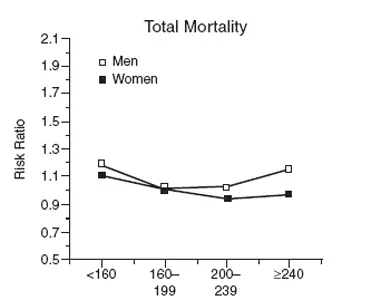
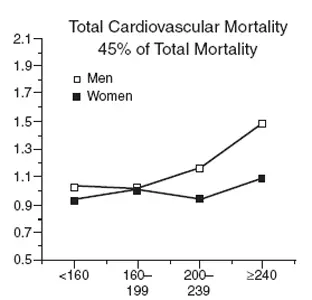
The relationship between blood cholesterol (horizontal axes) and all deaths (total mortality) or just heart disease deaths, as reported in a 1990 NIH conference.
In an alternate interpretation, both ends of the cholesterol distribution are treated identically. Whether high or low, either our cholesterol levels directly increase mortality or they’re a symptom of an underlying disorder that itself increases our risk of disease and death. In both cases, diet leads to disease, although whether it does so directly, via its effect on cholesterol, or through other mechanisms would still be an open question. In this interpretation, what a cholesterol-lowering diet does to cholesterol levels, and what that in turn does to arteries, may be only one component of the diet’s effect on health. So lowering cholesterol by diet might help prevent heart disease for some individuals, but it might also raise susceptibility to other conditions—such as stroke and cancer—or even cause them. This is what had always worried those investigators who were skeptical of Keys’s hypothesis. “Questions should be pursued about biological mechanisms that might help explain low [total cholesterol]: disease associations,” noted the report from the 1990 NHLBI workshop. Nonetheless, public-health recommendations to eat low-fat diets and lower cholesterol would remain inviolate and unconditional.