Chapters (40)
- Cover Page
- Title Page
- Dedication
- Prologue A Brief History of Banting
- Part One
- Chapter 1
- Chapter 2
- Chapter 3
- Chapter 4
- Part Two
- Chapter 5
- Chapter 6
- Chapter 7
- Chapter 8
- Chapter 9
- Chapter 10
- Chapter 11
- Chapter 12
- Chapter 13
- Part Three
- Chapter 14
- Chapter 15
- Chapter 16
- Chapter 17
- Chapter 18
- Chapter 19
- Chapter 20
- Chapter 21
- Chapter 22
- Chapter 23
- Chapter 24
- Epilogue
- Notes
- Bibliography
- Acknowledgments
- Illustration Credits
- A Note About the Author
- Also by Gary Taubes
- Footnotes
- Copyright
Using the MRFIT data, however, it is possible to see how large or small that benefit might be (see chart, below). For every one thousand middle-aged men who had high cholesterol—between, say, 240 and 250 mg/dl—eight could expect to die of heart disease over any six-year period. For every thousand men with cholesterol between 210 and 220, roughly six could expect to die of heart disease. These numbers suggest that reducing cholesterol from, say, 250 to 220 would reduce the risk of dying from a heart attack in any six-year period from .8 percent (eight in a thousand) to .6 percent (six in a thousand). If we were to stick rigorously to a cholesterol-lowering diet for thirty years—say, from age forty to seventy, at which point high cholesterol is no longer associated with an increased risk of heart disease—we would reduce our risk of dying of a heart attack by 1 percent.
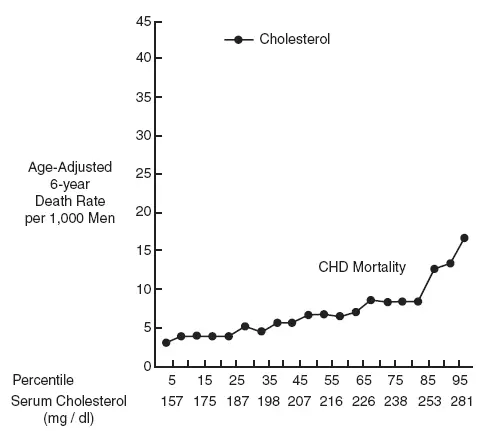
The data from the MRFIT trial showing the relationship between heart-disease mortality and cholesterol levels in the blood.
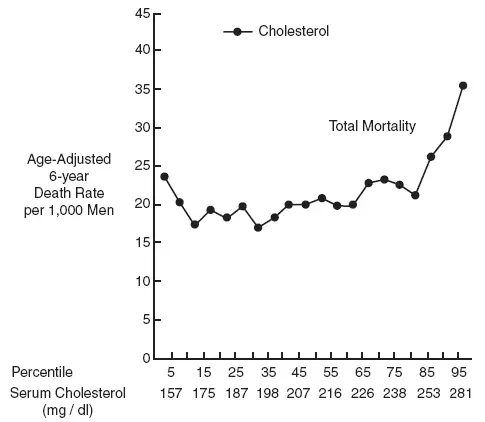
The data from the MRFIT trial showing the relationship between total mortality—i.e., death by all causes—and cholesterol levels in the blood.
Whether we would actually live longer by lowering our cholesterol is, of course, a different question. People die from myriad causes. Though Stamler neglected to include total mortality data in his JAMA article, a second group of MRFIT investigators did include it in an article published in The Lancet just a month earlier.
Their data revealed that for every thousand men with cholesterol around 240 to 250 mg/dl, twenty to twenty-three would likely die of any cause within six years. For those whose cholesterol was approximately 220, between nineteen and twenty-one were likely to die. In other words, for every thousand middle-aged men who successfully lower their cholesterol by diet from, say, 250 to 220, at most four (although perhaps none) can expect to avoid death during any six-year period. Nineteen or twenty of these men can expect to die whether they diet or not. For the remaining 98 percent, they will live regardless of their choice. Moreover, lowering cholesterol further would not help. The death rate for men whose cholesterol is below 200 appears little different from that of men whose cholesterol falls between 200 and 250. Only for those men whose cholesterol is above 250 mg/dl does it appear that lowering cholesterol might improve the chances of living longer.
There is another way to interpret this statistical association between cholesterol, heart disease, and death. The association, as documented by Framingham, MRFIT, and other studies, only says that, the higher our cholesterol, the greater our risk of heart disease. It does not tell us whether the benefit from lowering cholesterol is shared by the entire population or only by a small percentage. The latter is the implicit assumption of the above analysis. But what if the benefit of lowering cholesterol is indeed shared democratically among all who do it? Perhaps we may all live longer by lowering our cholesterol. But how much longer?