Chapters (40)
- Cover Page
- Title Page
- Dedication
- Prologue A Brief History of Banting
- Part One
- Chapter 1
- Chapter 2
- Chapter 3
- Chapter 4
- Part Two
- Chapter 5
- Chapter 6
- Chapter 7
- Chapter 8
- Chapter 9
- Chapter 10
- Chapter 11
- Chapter 12
- Chapter 13
- Part Three
- Chapter 14
- Chapter 15
- Chapter 16
- Chapter 17
- Chapter 18
- Chapter 19
- Chapter 20
- Chapter 21
- Chapter 22
- Chapter 23
- Chapter 24
- Epilogue
- Notes
- Bibliography
- Acknowledgments
- Illustration Credits
- A Note About the Author
- Also by Gary Taubes
- Footnotes
- Copyright
Several clinical conditions also demonstrate this phenomenon of local lipophilia. Benign fat masses a few inches in diameter characterize a condition known as lipomatosis, and there are fatty tumors known as lipomas. In both cases, these masses of fat appear unaffected by any weight loss by the patients themselves; whatever it is that causes fat to accumulate in localized masses seems to be independent of the fat content of the body itself. There’s also a rare condition known as lipodystrophy, characterized by the inability to store fat in subcutaneous tissue. Those who suffer from it appear abnormally emaciated; lipodystrophy, too, can be localized, and even progressive. In one case reported in 1913, a ten-year-old girl first lost fat from her face; then, over the next three years, this emaciation gradually extended down her trunk and arms. “Adiposity of the lower body,” as the report described it, began at age fifteen and eventually became “lower body obesity.” By the time she was twenty-four, the patient, who was five foot four and weighed 185 pounds, had effectively all of her body fat localized below her waist.
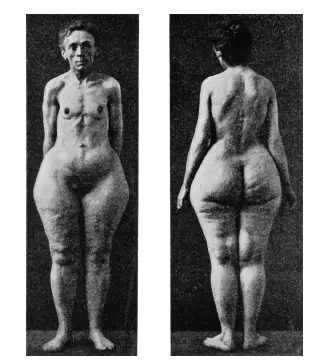
A case of progressive lipodystrophy with lower-body obesity. If emaciation above the waist is followed by obesity below it, can the quantity of calories consumed have anything to do with it?
Bergmann and Julius Bauer, the “noted Vienna authority on internal diseases,” as the New York Times called him, were the two most prominent proponents of the lipophilia hypothesis, but only Bauer wrote about the hypothesis in English, attempting to influence how obesity would be perceived by physicians in the United States. Bauer’s expertise was in the application of genetics and endocrinology to clinical medicine, a field he arguably pioneered in a 1917 monograph entitled Constitution and Disease. Bauer had taken case histories from 275 obese patients and reported that nearly 75 percent had one or both parents who were also obese. He considered this compelling evidence that the condition had a genetic component, which in turn implied the existence of genetically determined hormonal and metabolic factors that would bestow a constitutional disposition to put on excessive fat. “The genes responsible for obesity,” Bauer wrote, “act upon the local tendency of the adipose tissue to accumulate fat (lipophilia) as well as upon the endocrine glands and those nervous centers which regulate lipophilia and dominate metabolic functions and the general feelings ruling the intake of food and the expenditure of energy. Only a broader conception such as this can satisfactorily explain the facts.”