Chapters (40)
- Cover Page
- Title Page
- Dedication
- Prologue A Brief History of Banting
- Part One
- Chapter 1
- Chapter 2
- Chapter 3
- Chapter 4
- Part Two
- Chapter 5
- Chapter 6
- Chapter 7
- Chapter 8
- Chapter 9
- Chapter 10
- Chapter 11
- Chapter 12
- Chapter 13
- Part Three
- Chapter 14
- Chapter 15
- Chapter 16
- Chapter 17
- Chapter 18
- Chapter 19
- Chapter 20
- Chapter 21
- Chapter 22
- Chapter 23
- Chapter 24
- Epilogue
- Notes
- Bibliography
- Acknowledgments
- Illustration Credits
- A Note About the Author
- Also by Gary Taubes
- Footnotes
- Copyright
The Pima Indians of southwestern Arizona are now infamous for having the highest rates of obesity and diabetes in the United States. Today the standard explanation for obesity among the Pima is that they have succumbed, as we all have, to prosperity and the toxic environment of American life. Over the last century, the Pima supposedly experienced a nutrition transition—an exaggerated version of the changing-American-diet story. Farmers and hunters became relatively sedentary wage-earners, while their diet changed from one very low in fat and high in fiber-rich carbohydrates and vegetables to a modern high-fat, high-sugar American diet. “As the typical American diet became more available on the reservation after the [Second World] war,” according to an NIH report entitled The Pima Indians: Pathfinders for Health, “people became more overweight.” “If the Pima Indians could return to some of their traditions,” explained one NIH authority, “including a high degree of physical activity and a diet with less fat and more starch, we might be able to reduce the rate, and surely the severity, of unhealthy weight in most of the population.”
The problem with this version of the Pima history is that obesity and overweight had been evident a century ago, when the relevant nutrition transition was from relative abundance to extreme poverty. From November 1901 to June 1902, the Harvard anthropologist Frank Russell lived on the Pima reservation south of Phoenix studying the tribe and its culture. Many of the older Pima, Russell noted in a report of the Bureau of American Ethnology, “exhibit a degree of obesity that is in striking contrast with the ‘tall and sinewy’ Indian conventionalized in popular thought.”
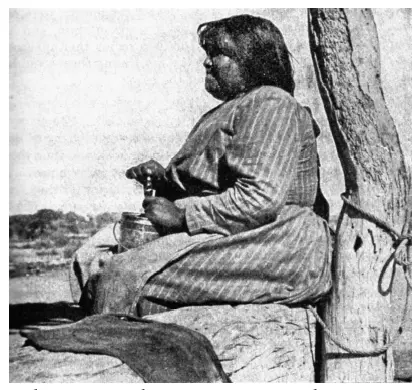
Obesity among the Pima is not a new phenomenon, as demonstrated by this photo of “Fat Louisa” taken in 1901 or 1902 by the Harvard anthropologist Frank Russell.
Russell’s assessment of the Pima’s relative corpulence was then confirmed by the anthropologist and physician Aleš Hrdli ka, who visited the Pima reservation in 1902 and 1905. “Especially well-nourished individuals, females and also males, occur in every tribe and at all ages,” Hrdlika reported, “but real obesity is found almost exclusively among the Indians on reservations.”
For perhaps two millennia, the Pima had lived as both hunter-gatherers and agriculturalists. Game was abundant in the region, as were fish and clams in the Gila River. When the Jesuit missionary Eusebio Kino arrived among the Pima in 1787, the tribe was already raising corn and beans on fields irrigated with Gila River water. In the decades that followed, they took to raising cattle, poultry, wheat, melons, and figs. They also ate mesquite beans, the fruit of the saguaro cactus, and a mush of what Russell later called “unidentified worms.” In 1846, when a U.S. Army battalion passed through Pima lands, the battalion’s surgeon John Griffin described the Pima as “sprightly” and in “fine health.” He also noted that the Pima had “the greatest abundance of food, and take care of it well, as we saw many of their storehouses full of pumpkins, melons, corn &c.”