Chapters (40)
- Cover Page
- Title Page
- Dedication
- Prologue A Brief History of Banting
- Part One
- Chapter 1
- Chapter 2
- Chapter 3
- Chapter 4
- Part Two
- Chapter 5
- Chapter 6
- Chapter 7
- Chapter 8
- Chapter 9
- Chapter 10
- Chapter 11
- Chapter 12
- Chapter 13
- Part Three
- Chapter 14
- Chapter 15
- Chapter 16
- Chapter 17
- Chapter 18
- Chapter 19
- Chapter 20
- Chapter 21
- Chapter 22
- Chapter 23
- Chapter 24
- Epilogue
- Notes
- Bibliography
- Acknowledgments
- Illustration Credits
- A Note About the Author
- Also by Gary Taubes
- Footnotes
- Copyright
Cleave had identified one of the fundamental flaws of modern nutrition and chronic-disease epidemiology. Greater affluence inevitably takes populations through a nutrition transition that represents a congruence of fundamental changes in diet. Meat consumption tends to increase, and so saturated fat increases as well. Grain consumption decreases, and so carbohydrate consumption as a whole decreases. But the carbohydrates consumed are more highly refined: white rice replaces brown, white flour replaces wholemeal; sugared beverages and candy spark a dramatic increase in sugar consumption. As a result, whenever investigators tested the hypothesis that chronic disease was caused by high fat intake or even high animal-fat intake or low carbohydrate intake, the refinement of the carbohydrates would confound the results. The changing-American-diet story led Ancel Keys and others to insist that fat caused heart disease and to advise eating low-fat, high-carbohydrate diets because, as the diagnosis of coronary heart disease increased over the century, carbohydrate consumption apparently decreased, while the total fat available for each American increased from 100 pounds per person per year to almost 130 pounds.*34 But the greatest single change in the American diet was in fact the spectacular increase in sugar consumption from the mid-nineteenth century onward, from less than 15 pounds a person yearly in the 1830s to 100 pounds by the 1920s and 150 pounds (including high-fructose corn syrup) by the end of the century. In effect, Americans replaced a good portion of the whole grains they ate in the nineteenth century with refined carbohydrates.
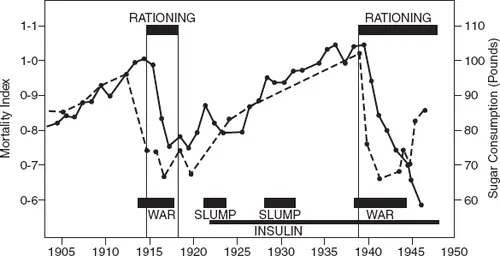
Peter Cleave’s chart showing the relationship between diabetic mortality rate (with the 1938 rate equal to 1) and the amount of sugar consumed per capita in England and Wales. The dotted line is sugar consumption. The solid line is diabetes mortality.
Despite the century of debate in the United Kingdom on the merits of white flour and wholemeal flour and the potential evils of sugar, it wouldn’t be until the 1990s that epidemiologists began to delineate between refined and unrefined carbohydrates in their dietary analyses. Even in 1989, when the National Academy of Sciences published its seven-hundred-page Diet and Health report, the authors made little attempt to differentiate refined carbohydrates from unrefined, other than occasionally to note studies in which sugar intake by itself was studied.
When Keys linked the low-fat, high-carbohydrate diet of the Japanese in the late 1950s to the extremely low incidence of heart disease, he paid no attention to sugar consumption. Fat consumption in Japan was extremely low, as were heart-disease rates, and so he concluded that the lower the fat the better. But the consumption of sugars in Japan was very low, too—less than forty pounds per person per year in 1963, and still under fifty pounds in 1980—equivalent to the yearly per-capita consumption recorded in the United States or in the United Kingdom a century earlier.