Behind Closed Doors
Chapters (17)
Cover
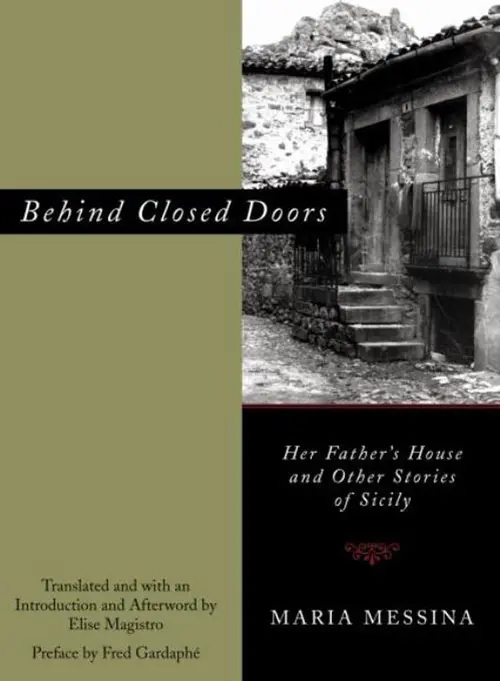
Title Page
Behind Closed Doors

Her Father’s House and Other Stories of Sicily
by
MARIA MESSINA
Translated from the Italian and with an Introduction and Afterword by Elise Magistro
Preface by Fred Gardaphé

The Feminist Press
at the City University of New York
New York
Preface
Preface
Sicily has been the setting for many foundational myths of physical violence, including those in Homer’s Illiad and Odyssey. Between those master narratives and contemporary mythology about the Mafia’s violence lies the reality of Sicilian culture, much of which is still invisible. Early in the last century Sicily provided the United States with a large number of immigrants who have come to be called Italian Americans, and whose lives were seemingly founded on and ruled by still another mythology, that of destinu or destiny.
Leonardo Sciascia and other notable writers and intellectuals have written of Sicily’s controlling narrative as a psychological paura storica, or history of fear, believed fundamental to Sicilian character and also to an important Sicilian school of Italian literature, composed of such writers as Giovanni Verga, Luigi Priandello, Giusseppe di Lampedusa, and Elio Vittorini. For all these writers, the male narrative self is subservient to the voices of others; the self rarely dominates others; the narrative mask enables the “true” self to remain flexible and hidden behind the story’s characters. This is a safe stance for these male authors who sometimes had to survive during turbulent political times.
Maria Messina, a contemporary of Verga, Pirandello, and Lampedusa, challenged these dominant narratives in her time by writing from the perspective of women. Through Messina, we are able to see the effects of a patriarchal system that forces women at all social levels to acquiesce to the men in their lives. Her stories show us what happens inside misperceived silences and explains just how different this notion of destiny was for women compared to men. She takes us into another side of Sicilian irrationality that Sciascia described: “The history of Sicily is one of defeats: defeats of reason, defeats of reasonable men…. From that however comes skepticism, that is not, in effect, the acceptance of defeat, but a margin of security, of elasticity, through which the defeat, already expected, already rationalized, does not become definitive and mortal. Skepticism is healthy though. It is the best antidote to fanaticism” (6). Messina’s artistry turns irrationality into skepticism and serves as a form of self-empowerment in a land often constricted by the spirit-killing rationality of industrial capitalism, which ultimately sent thousands of Sicilians away from the island forever.