Behind Closed Doors
Cover
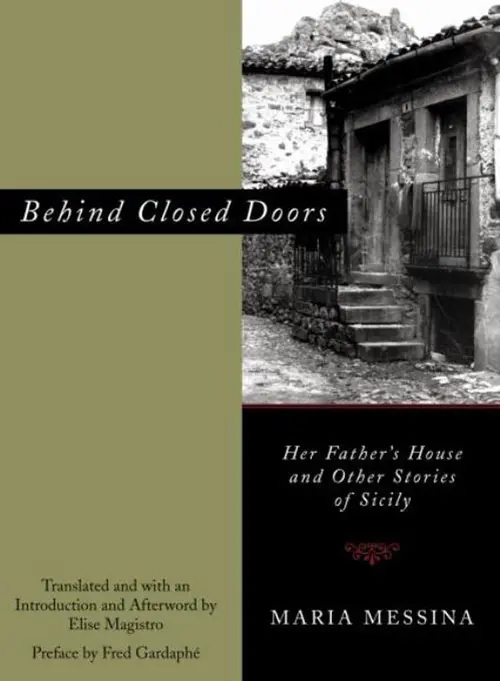
Title Page
Behind Closed Doors

Her Father’s House and Other Stories of Sicily
by
MARIA MESSINA
Translated from the Italian and with an Introduction and Afterword by Elise Magistro
Preface by Fred Gardaphé

The Feminist Press
at the City University of New York
New York
Preface
Preface
Sicily has been the setting for many foundational myths of physical violence, including those in Homer’s Illiad and Odyssey. Between those master narratives and contemporary mythology about the Mafia’s violence lies the reality of Sicilian culture, much of which is still invisible. Early in the last century Sicily provided the United States with a large number of immigrants who have come to be called Italian Americans, and whose lives were seemingly founded on and ruled by still another mythology, that of destinu or destiny.
Leonardo Sciascia and other notable writers and intellectuals have written of Sicily’s controlling narrative as a psychological paura storica, or history of fear, believed fundamental to Sicilian character and also to an important Sicilian school of Italian literature, composed of such writers as Giovanni Verga, Luigi Priandello, Giusseppe di Lampedusa, and Elio Vittorini. For all these writers, the male narrative self is subservient to the voices of others; the self rarely dominates others; the narrative mask enables the “true” self to remain flexible and hidden behind the story’s characters. This is a safe stance for these male authors who sometimes had to survive during turbulent political times.
Maria Messina, a contemporary of Verga, Pirandello, and Lampedusa, challenged these dominant narratives in her time by writing from the perspective of women. Through Messina, we are able to see the effects of a patriarchal system that forces women at all social levels to acquiesce to the men in their lives. Her stories show us what happens inside misperceived silences and explains just how different this notion of destiny was for women compared to men. She takes us into another side of Sicilian irrationality that Sciascia described: “The history of Sicily is one of defeats: defeats of reason, defeats of reasonable men…. From that however comes skepticism, that is not, in effect, the acceptance of defeat, but a margin of security, of elasticity, through which the defeat, already expected, already rationalized, does not become definitive and mortal. Skepticism is healthy though. It is the best antidote to fanaticism” (6). Messina’s artistry turns irrationality into skepticism and serves as a form of self-empowerment in a land often constricted by the spirit-killing rationality of industrial capitalism, which ultimately sent thousands of Sicilians away from the island forever.
Messina wrote at a time when nearly one-third of the island’s population left in search of better lives, but the stories they left behind took almost a century to surface in history and fiction. Since most immigrants could not write, they told their stories in Italian or in a more obscure dialect few Americans or other Italians could understand. Often their stories died untold, even to their children who were busy becoming Americans. Or, if told, they were dwarfed by the giant myths of men. Through her stories, Messina becomes a firsthand witness, especially to the stories of those who stayed behind, mainly women, and the stories of those who returned brokenhearted, incapacitated, and ready to die.
Inside Messina’s stories, alongside peasant life and work and the desire to escape to places like the United States, we also find middle-class daughters forced by convention to remain hidden in their father’s houses, isolated in a world they did not create and that they cannot control. These are the stories we have not known, filled with sorrows invisible to those of us celebrating the success of Italian Americans. These stories, repressed by generation after generation and maintained by silence, come to us now through deserved reconsideration of Messina’s artistry. They connect us to a past that will change the ways in which we characterize Italian life and immigration.
I heard only vague references, when I was a kid, to those who were left behind or kept behind. I had seen women like the ones in these stories in my Little Italy neighborhood, but I never understood what they may have experienced until I read Messina’s stories. As my grandmother used to say, whenever I’d ask her something that obviously pained her, “Why do you want to know about those things; it was miseria and we should forget about it.” But Messina records what no man had ever recorded—the misery of women whose lives were sacrificed to fear; and the misery of some who left Sicily for the United States; and the misery of others who could not leave—and she does it in a way that makes all that miseria matter.
Messina’s stories provide a link between women’s imagination and women’s history, both missing from the historical and literary record. The pure sadness here ultimately transcends that emotion to provide a view of real life in process. Less romantic than Helen Barolini’s Umbertina and more earthy than the late Tina DeRosa’s Paper Fish, Messina’s stories unleash closely observed realism. Ideas of destiny, figura, omerta—a man’s honor and how a woman reflects it—combine in these stories to reveal and challenge a mythic family structure oppressive to women and ultimately demeaning to men as well, and for too long the basis of the ways in which we have consumed and used Sicilian culture.
These stories, along with more of Messina’s work, have gone unread by audiences outside of Italy because, even today, translating the literature of Italian women writers into English has rarely been regarded as important. Magistro’s informative Introduction and Afterword situate these beautiful stories historically and aesthetically, opening up possibilities for English readers to investigate what it meant to be a Sicilian woman in the early twentieth century. Magistro has thus rendered a great service by enhancing our understanding of the complexities of female life in Sicily. By taking us inside and beyond the women dressed in black who have for too long represented Sicilian women in literature, Maria Messina, with Magistro’s aid, has diversified the dominant portraits of this island and, in turn, helped to dispel one of the many myths of the Mediterranean.
Fred Gardaphé
Stony Brook University
April 2007
Introduction
Introduction
In the early twentieth century, Sicily was as deeply divided socially and economically as it had been for much of its long and painful history. While the island’s ancient wonders and the splendor of its capital city had made Sicily a de rigueur stop on an eighteenth-century Grand Tour, a fascination with Sicily’s rich past belied the appalling conditions in which most Sicilians had lived for centuries. Day laborers and peasants with negligible holdings accounted for more than three-quarters of the island’s inhabitants, many of whom worked small plots beyond their hillside towns. Others toiled on the vast latifondi (ex-feudal estates) of Sicily’s remote interior. For these impoverished peasants, life followed an immutable course, governed by the rhythms of the agricultural cycle and punctuated only by births, deaths, epidemics, and ritual celebrations. Bt the time of national unification in 1861, illiteracy on the island still hovered at a staggering 87 percent (Briggs 1978, 38), dropping only to 58 percent by 1911, numbers that were unparalleled elsewhere in Western Europe (Astorita 2005, 288).
The deep-rooted pessimism that permeated Sicily’s peasant class was the result of centuries of neglect and exploitation by foreign rulers. National unification offered guarded hope for meaningful change. Citizens of the new Italy residing in the north-central regions of the country were aware of the political divide that had long separated them from their southern neighbors. Few, however, had any realistic conception of the degree of Sicily’s backwardness or the desperation of its people. In four hundred years of Spanish Bourbon rule, the uncontested power of the land barons, coupled with the conspicuous absence of an educated middle class, had perpetuated southern poverty beyond any imaginable measure. Emissaries dispatched to the region after unification were shocked by what they considered the cultural and moral disparity between North and South, their prejudices evidenced in the discriminatory language of their official correspondence (Moe 1992).
Exacerbating Sicilian disillusionment in the post-Unification years was the government’s decision to favor northern industrial interests at the expense of the southern masses. Rome’s failure to deliver on political promises strengthened the mafia’s hold, provoked hostility among impatient Sicilians, and incited violence across the island that horrified even the most sympathetic northern Italian observers. The brutal suppression of Sicilian workers’ movements (i fasci siciliani) and subsequent imposition of martial law in 1894, capped male estrangement from the political order. As late as 1912, nearly 70 percent of Sicilian men were still ineligible to vote due to land ownership and literacy requirements (Astorita 2005, 287). Understandably, a sense of fatalism or destino, dominated the Sicilian psyche, a reflection of ordinary Sicilians’ inability to control the direction of their lives.
On the surface, the formal abolition of feudalism in 1806 and the dissolution of church holdings in 1860 had aimed at a more equitable distribution of lands. However, a new landed elite, anxious to expand their holdings, blocked attempts to redistribute this wealth. Savvy alliances between local landowners and government officials in Rome ensured that little would change despite ostensibly comprehensive reforms. Taxes remained disproportionately high for those least able to pay, and usury was rampant. Owners of smaller plots, shopkeepers, and artisans (the most frequent subjects in Maria Messina’s artistic lens), feared losing their financial footing in a climate resistant to social change.
Historian Denis Mack Smith estimates that the average provincial town of 10,000 residents at the turn of the century contained approximately one hundred families of galantuomini, gentlemen property owners who constituted the resident ruling class (1968, 427). Mistretta, which serves as the backdrop for a number of Messina’s short stories, was typical in this regard. As Smith notes, these men took the title of don, spent their days at gentlemen’s clubs, and claimed membership in the civili, or “civilized class,” thus distinguishing themselves as individuals who made their living from the labor of others. Although a mutual dependency between landowners and the lower classes existed, maintaining social distance from their inferiors and keeping them uneducated remained two of the primary objectives of the civili (Foerester 1924, 100).
On the other hand, the compact structure of Sicilian hill towns made a certain degree of intermingling among the classes unavoidable. Regional Sicilian writing of the period offers a varied tapestry of provincial town life in which vendors hawk their wares through narrow streets, women knit and gossip on their doorsteps, and the elite stroll daily along the main corso. The case basse or low, street-level houses of the poor appear scattered amid more modest two-story dwellings and the multiroom residences of the civili. With neighborhoods less rigorously demarcated than Sicilian society itself, distinctive landmarks provided shared communal space. In this respect, Mistretta was representative but also more aesthetically appealing, with its imposing Norman fortress (il Castello), graceful Pia Fountain, and public gardens of the Villa Châlet. By way of contrast, author Emanuele Navarro della Miraglia details the bleaker physical aspects of a prototypical Sicilian town in the opening paragraphs of his short story, “Paese” (The Village), written in 1885:
The town I would like to tell you about is one that you might find anywhere in Sicily, but that you would search for in vain on any map. It is called Gibelmoro…. It boasts two thousand residences and ten thousand inhabitants, nine tenths of which are peasants. There are very few well-to-do citizens and not many artisans. The town is spread out across the ridge of a mountain, encircled by fertilizer mounds and prickly pears that scent the surrounding air. It has twenty churches, more than fifty priests—five monasteries for men and three for women.
Theatres, hospitals, homes for the elderly? There are none…. Gibelmoro has a road that has been under construction for more than twenty years now, and that will probably not be completed before the new century. For the moment, the town is only accessible by horse, when the river torrents permit, and when the rains have not completely worn away the paths. The internal streets are steep, torturous and narrow, paved with rough white stones or not paved at all. (Navarro della Miraglia 1974, 71–76)
By the turn of the century, more enterprising Sicilians, frustrated with the status quo, began to look beyond Sicily’s shores for a long-term solution to their discontent.1 While many migrated to the North in search of seasonal work, most responded to La Mèrica’s increasing demand for both skilled and unskilled labor. Although Sicilians were among the last to leave in the great migration out of Italy between 1880 and 1920, the ultimate intensity of their movement exceeded that of all other regions. What began with a handful of resourceful individuals determined to improve their economic lot mushroomed rapidly into an exodus of staggering proportions, transforming the island into a venue of collective grief. So marked, in fact, was this movement out of Sicily that in 1906 alone 127,000 of Italy’s 200,000 departing emigrants were Sicilian (Foerester 1924, 104). By 1913, an astounding 1 million of the island’s 3.5 million residents had departed for foreign shores. While official policy insisted that emigration provided a safety valve for those most affected by a downturn in the southern economy, chiefly disenfranchised day laborers and peasants, more recent scholarship has concluded that others, “who were a little better off and feared themselves to be slipping down the social ladder,” were leaving the island as well, draining the South of its most enterprising individuals (Lopreato 1970, 35).
As brother called for brother and father for son, the resulting unprecedented “chain migration” left countless women, children, and elderly parents either temporarily or permanently abandoned. While Mistretta did not suffer the 50 percent male emigration rate experienced by still more depressed areas in Sicily, official registers reflect the phenomenon’s impact on small, urbanized centers scattered across the island. Between 1903 and 1909, years that coincided with Maria Messina’s residence in Mistretta, 1,517 of its estimated 15,000 citizens departed for American cities, a figure that would reach nearly one-third of the town’s population by 1924 (“Centonove” 2006).
For all of its tragic consequences, emigration on a grand scale spurred profound and decidedly positive changes in certain segments of Sicilian society. Cash remittances from across the Atlantic bolstered the flagging economy and facilitated upward mobility for families of emigrants (Cinel 1984, 59–60). Demands for basic education also soared, as wives and daughters of emigrants emerged from the strict confines of domestic life during their husbands’ absence. Activities that a mere generation earlier would have been inconceivable for any proper Sicilian woman were now considered necessity rather than choice. Running small shops, paying taxes, purchasing supplies, and managing more than a family budget, all required basic literacy and mathematical skills. Education—historically considered the realm of the elite and viewed with suspicion by the working classes for its associations with leisure—was now seen as key to socioeconomic advancement (Reeder 1998, 106).
Despite these positive steps, Sicilian society as a whole remained deeply entrenched in its old ways well into the first decades of the century. Birthright and land ownership had always been the visible cornerstones of prestige, and the pursuit of the latter along with solidifying social barriers continued to be the chief preoccupation of civili families, few of whom emigrated. It is within this historic context that one may understand why Sicilians of Maria Messina’s day, and particularly those of her own struggling class, set great store on outward appearances. In provincial towns, cut off from the social life of urban centers and lacking both a vibrant economy and well-educated citizenry, one’s public persona—how one dressed, the venues one frequented, the company one kept, and the relationships one established—was the ultimate barometer of respectability. Most important, the respect one commanded greatly enhanced opportunities to further one’s interesse, or prospects for one’s family’s future (Bell 1979, 77–78).
Maintaining an appropriate level of respectability was a contest of self-preservation in Sicily’s petit bourgeoisie, a class that included clerks, bureaucrats, teachers, clerics and professionals, many of whom lacked the earning capital to solidify their economic position (Briggs 1978, 16).2 In a bad year, a small proprietor’s land might not produce, a vineyard could be lost to creditors, and debt could rapidly accumulate, making outward appearances difficult to maintain. Any hint of a progressive slide into poverty threatened to erase the respectability a family had painstakingly earned, and its members were acutely aware of possible social consequences. The stigma of poverty and its inevitable association with the lower classes was the driving force behind Sicilians’ obsession with appearances, even in the face of devastating misfortune. Families with little more than their dignity intact thus struggled to hide growing economic hardship behind the outer trappings of respectability.3
Historically, Sicilian women of all classes were important to this mercurial economic equation, and they suffered disproportionately the consequences of financial hardship. Respectability was quantifiable for Sicilians, and a well-brought up daughter—her conduct, her sobriety, her modesty, her readiness for marriage—were principle indicators of a family’s honor. Not surprisingly, parents diligently monitored their daughters’ movements in the public sphere, cognizant that any chance encounter with a member of the opposite sex cast suspicion on a daughter’s behavior and ultimately compromised her worth. Even the daughter of a modest farmer rarely ventured out unaccompanied, and surveillance was more extreme among the middle class. Young women of the basso popolo, (lower class) who worked in the service of others, were more vulnerable to unsolicited advances, and their honor more easily compromised, since the exigencies of their daily lives brought them into frequent contact with men.
If uncertainty about the future loomed above all else in Sicilian society, this sentiment was magnified for Sicilian women about whose lives we know little.4 The sanctity of the family, primacy of motherhood, and cult of domesticity were deeply entrenched values in the conservative South, as was uncontested male authority, guaranteeing that women rarely received any education beyond the four years of state mandated instruction. Many, apparently, had no schooling at all. Figures from the 1901 census confirm that 77 percent of all Sicilian women were still illiterate at the turn of the century (“Ministero di Agricoltura” 1903, 276–319), leaving most in a position of total dependence on their families. With an exception made for a small number of women who earned a teaching certificate—a sign of social status among middle-class families—Sicilian parents discouraged their daughters from seeking employment of any kind outside the home as this was assumed to signal a family’s economic need.5
Singular testimony that Sicily remained a stronghold of patriarchy in early-twentieth-century Europe comes to us from Elvira Mancuso, a writer and self-proclaimed feminist from a modest background who went on to direct prestigious scholastic institutions in her native Caltanissetta. Mancuso waged a lonely and highly unusual battle against the misogynist practices of her Sicilian society, documented in her unpublished memoir and the 1906 novel, Vecchia storia … inverosimile (An Unlikely, Old Story). In choosing not to marry rather than resigning herself to marriage, Mancuso defied conventional norms with the explicit intent of freeing herself both culturally and economically from the fate of “domestic tyranny” (Nigro 1990, 164). Mancuso was an anomaly in her conservative, provincial world, an unflinching rebel who provoked scandal by insisting on her right “to discuss with men those topics that have absolutely nothing to do with keeping a house, doing the laundry, or any such related activity” (168).
A rare, anthropological study conducted in 1928 by Margaret Chapman reaffirms Mancuso’s revelations of Sicilian society’s oppressive attitudes toward women. In Milocca: A Sicilian Village, Chapman describes how fundamental matters pertaining to female autonomy—choices regarding education, relationships, marriage, proscribed behavior—had changed little over time in Sicily (Chapman 1971, 30–49).6 Citing a proverb recorded by Sicilian ethnographer Giuseppe Pitrè, “Blessed is the door out of which goes a dead daughter, and the older she is, the greater the comfort,” Chapman explains that such a harsh, if exaggerated, expression of the Sicilian mind-set about females was rooted in the monetary difficulties families experienced in providing dowries for their marriageable daughters (30). Because all families invested in a daughter’s dowry and because the family’s collective welfare was paramount in all discussions relating to marriage, parents maintained the right to arbitrate the terms of a proposal or to refuse it outright. Although this was particularly true in smaller towns such as Milocca, where the tradition was well established, arranged marriages in one form or another were the norm at all levels of Sicilian society well into the twentieth century (95–96).7
The Story Continues on BooksBarbecue!
Enjoyed this preview? ❤️ Do not stop here!
Read the complete book free online → 🔗
Continue reading now on BooksBarbecue and discover every page!
Love reading? Bookmark BooksBarbecue.com for more amazing books!
Happy Reading!