A Small Hotel
Chapters (86)
- Title Page
- Dedication
- Family Tree
- Part One: The Fisherman in Love
- July 1941
- To Look at Her with Intention
- A Swell Dame
- The Harvey Girls
- A Match to the Side
- Like a Gentleman
- Needly in the Water
- South American Way
- Illegal in Summertime
- Aix-les-Bains
- Kind Lady Lives Here
- The World Wasn’t Enough
- Pass the Salt
- Fiskare
- Fiskfika
- A Small Hotel
- What Are Uncles For?
- A Flair For the Dramatic
- A Better Man For It
- The Bender
- November 1944
- A Damn to Give
- Emil’s One
- Horse’s Neck
- Good Enough
- Part Two: The Fisherman at War
- December 1944
- Captain Who?
- I Might Kill Someone Tomorrow
- Civilian Terror
- The Eighty-Eight That Kills You
- Holy Schmitt
- Grand and Casual
- Extraordinary Soldiers
- January 1945
- To Kill For Friends
- Say His Name
- Strong Letter to Follow
- Now
- Goose Egg
- Close as Any Man and Woman
- Something to Someone
- February-April 1945
- Nothing For It
- Hungry
- A Different Breed of Brothers
- Everything a Father Could
- The Resurrection and the Life
- Fish Hook
- Part Three: The Fisherman Adrift
- May 1945
- True Hunger
- Shadows and Burrs
- Keeper of the Flame
- The Barrel
- Hangman’s Coming
- Part Four: The Fisherman Back Home
- August 1945
- The Monastery
- Angels of the River
- I Had a Lover
- September 1945
- Trade Secrets
- Home
- Minor Mine
- Our Greatest Weapon
- Bra Som Guld
- Erik
- A Bit of an All Right
- Jacques’ Trap
- Still a Sort of Fisherman
- Guarding the Perimeter
- October 1945
- Juicy Fruit
- The Way He Wrote It
- June 1947
- All Here
- Acknowledgments
- In Tribute
- In Imagination: Kennet’s Unit
- About the Author
- Also by Suanne Laqueur
Title Page

Dedication
For my mother, Carol,
also known as Goldee because she is bra som guld.
Good as gold.
And for my dad, Bernie,
research assistant, bottomless font of trivia,
and recaller of necessary historical details.
And for Amy Burke Mastin,
whose loved ones met her at the station far too early.
Family Tree
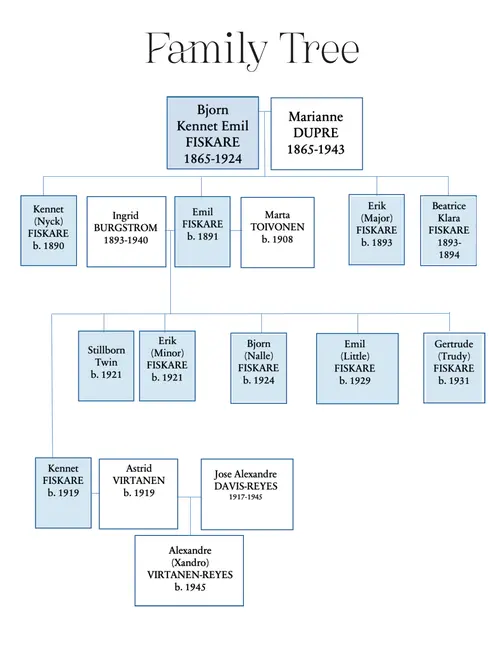
“O boating on the rivers,
The voyage down the St. Lawrence, the superb scenery, the steamers,
The ships sailing, the Thousand Islands, the occasional timber-raft
and the raftsmen with long-reaching sweep-oars,
The little huts on the rafts, and the stream of smoke when they cook
supper at evening.”
—Walt Whitman,
“A Song of Joys,” from Leaves of Grass
Part One: The Fisherman in Love

“There’s a small hotel
With a wishing well
I wish that we were there together.”
—Rodgers & Hart
July 1941

To Look at Her with Intention

Long ago, on the shores of the St. Lawrence River, there was a small hotel.
It was built at the turn of the century and named for the family who owned and ran it: the Fiskares. Fisk is the Swedish word for fish. Fiskar is the plural. One fisk. Two fiskar. Add an E to a school of fish and you make a profession: fiskare means fisherman.
The river folk had no trouble pronouncing Fiskare, yet they couldn’t seem to attach the surname to the new inn on Clayton’s waterfront. From the start, the locals called it the Fisher Hotel. Rather than correct their neighbors, the Fiskares simply repainted the sign:
The Fisher Hotel
Clayton, New York
Est. 1895
Built in the shape of an L, the hotel’s short end, with its double veranda, faced the river. Over the wide front steps, a large wooden fish was suspended by two chains.
“The fish was carved from wood salvaged from a shipwreck,” the guests were told. “Legend says a gold coin is in the fish’s belly, and Swedish tradition says wishes made on gold always come true. So touch the tail and make a wish.”
Over the years, both the fish tail and the fish tale grew smooth, the varnish worn away from countless wishes and countless tellings.
On a July day in 1941, the school of Fiskares went together to meet the train from Watertown. This simply meant crossing the street, for the Fisher Hotel was situated kitty-corner to the Clayton station.
Gathered on the platform, they made a handsome clan. The patriarch, the widowed Emil Fiskare, stood with his brother, Major. Neither man was tall, but each stood straight with arms crossed, chins jutting a bit and gazes squinted over the river. When still, they seemed immutable as two pillars, but when walking, each man limped. Major had been stricken in the polio outbreak of 1894, while Emil’s lame leg carried a load of shrapnel from the French front.