A Small Hotel
Title Page

Dedication
For my mother, Carol,
also known as Goldee because she is bra som guld.
Good as gold.
And for my dad, Bernie,
research assistant, bottomless font of trivia,
and recaller of necessary historical details.
And for Amy Burke Mastin,
whose loved ones met her at the station far too early.
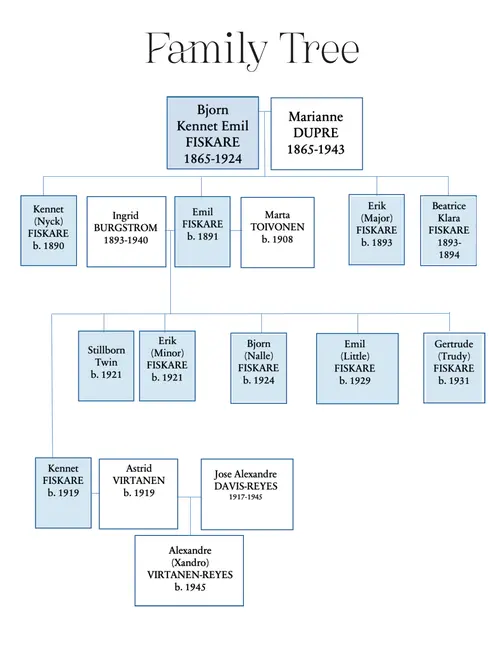
Family Tree
“O boating on the rivers,
The voyage down the St. Lawrence, the superb scenery, the steamers,
The ships sailing, the Thousand Islands, the occasional timber-raft
and the raftsmen with long-reaching sweep-oars,
The little huts on the rafts, and the stream of smoke when they cook
supper at evening.”
—Walt Whitman,
“A Song of Joys,” from Leaves of Grass
Part One: The Fisherman in Love

“There’s a small hotel
With a wishing well
I wish that we were there together.”
—Rodgers & Hart
July 1941

To Look at Her with Intention

Long ago, on the shores of the St. Lawrence River, there was a small hotel.
It was built at the turn of the century and named for the family who owned and ran it: the Fiskares. Fisk is the Swedish word for fish. Fiskar is the plural. One fisk. Two fiskar. Add an E to a school of fish and you make a profession: fiskare means fisherman.
The river folk had no trouble pronouncing Fiskare, yet they couldn’t seem to attach the surname to the new inn on Clayton’s waterfront. From the start, the locals called it the Fisher Hotel. Rather than correct their neighbors, the Fiskares simply repainted the sign:
The Fisher Hotel
Clayton, New York
Est. 1895
Built in the shape of an L, the hotel’s short end, with its double veranda, faced the river. Over the wide front steps, a large wooden fish was suspended by two chains.
“The fish was carved from wood salvaged from a shipwreck,” the guests were told. “Legend says a gold coin is in the fish’s belly, and Swedish tradition says wishes made on gold always come true. So touch the tail and make a wish.”
Over the years, both the fish tail and the fish tale grew smooth, the varnish worn away from countless wishes and countless tellings.
On a July day in 1941, the school of Fiskares went together to meet the train from Watertown. This simply meant crossing the street, for the Fisher Hotel was situated kitty-corner to the Clayton station.
Gathered on the platform, they made a handsome clan. The patriarch, the widowed Emil Fiskare, stood with his brother, Major. Neither man was tall, but each stood straight with arms crossed, chins jutting a bit and gazes squinted over the river. When still, they seemed immutable as two pillars, but when walking, each man limped. Major had been stricken in the polio outbreak of 1894, while Emil’s lame leg carried a load of shrapnel from the French front.
Emil’s children clustered in three distinct groups. The youngsters, Little and Trudy, stood close to the tracks, craning their necks down the line. They had put copper pennies on the iron rails, and checked frequently on their placement.
The eldest sons, Kennet and Minor, stood together, as they always did. Kennet was twenty-two that summer, Minor two years younger, yet they were alike as twins—trim, blond and amiable with blue eyes and suntanned skin. They were not tall men either, and from their father and uncle they’d learned how to arrange their posture and demeanor so they appeared bigger than they were.
Nalle, the middle fish, sat alone on a bench. He’d always stood apart from his siblings in looks: dark-haired among their blond heads, brown-eyed against their blue gazes. It was as if every gene of the Fiskares’ French-Canadian ancestors saw in Nalle a chance to survive, and swarmed his cells like ants on a melon rind.
When it came to character, the family regarded Nalle as their superlative: the smartest, the kindest, sweetest and finest. That day at the depot, he was also the saddest. He’d had a hard time of it since his mother’s death, six months prior. He’d been Ingrid’s favorite, and her loss shattered him. Even now he retained the air of one rebuilding from the ruins and wanting to be let alone as he did.
Standing in the middle of the Fiskares was Marta Toivonen. Not a Fiskare by blood—she’d come to them in 1931 as a cook and housekeeper, but then became so essential, she was considered family. When she told Little and Trudy to step far back from the tracks now, they obeyed instantly.
The train the Fiskares waited for was bringing Marta’s cousin, Astrid, for an extended visit. This distant relative had come a long way: steamship from Rio de Janeiro to Florida, then another ship to New York City, and finally the train journey to Clayton.
Trudy came by Kennet and took his hand, dancing lightly from foot to foot. “Will she speak English?”
“Only a little,” Kennet said. “But she speaks Swedish. She’ll fit right in.”
All the Fiskares spoke English in the world, Swedish at home, and French if they had to.
Unable to get Kennet to dance, Trudy next tried Marta, who wanted none of it. Marta was dressed in her best, quivering in both anxiety and anticipation. Excited to meet her longtime pen-pal in the flesh and eager to make a good impression.
“You’ll see to the baggage?” she said to Kennet and Minor.
“Of course,” Kennet said cheerfully, as if she hadn’t asked four times already.
“Don’t forget to tip the porter.”
“Marta, we’ve been meeting trains since we could walk,” Minor said. “We know how it’s done.”
“I know, but—”
“You want everything to be just right,” Kennet said. “And it will be.”
He kept his voice calm, though his heart kicked up a few beats when he heard the muted blare of the train’s horn in the distance.
Astrid was coming.
It was ridiculous how Kennet’s nerves crackled at her imminent arrival. After all, she was nobody to him. They’d never met. She lived on the other side of the earth. What he knew was from stories Marta told, bits Marta read from Astrid’s regular letters, and two photographs displayed in the sitting room. For ten years, Kennet had been walking past those photographs, often for no other reason than to note how Astrid’s eyes followed him.
One picture was Astrid at age twelve, sitting in a chair, composed and serene, a faint smile touching one corner of her closed lips as her gaze broke the fourth wall of the frame. The other photograph showed Astrid, dazzling at eighteen, turned almost entirely away from the camera and looking back over her shoulder. A wide, toothy smile this time. Infectious, anticipatory joy in her eyes, as if the picture were taken moments before she entered a ballroom. Like her younger image, her gaze broke through the flat plane of the picture frame and laid a hand on the viewer.
I know you, she seemed to say.
Sometimes Kennet came to look at her with intentions. When he was befuddled with a problem, smarting with rejected affection, feeling like a chump or raw with the grief of missing his mother, he stood before young Astrid and stared into her calm, compassionate gaze until he felt better. When he successfully sorted a problem, or his ardor was reciprocated and he felt accomplished, confident and pleased with himself, he took his deeds to the young woman and basked in her praise. Sometimes, if his mood was especially proud, and he was sure no one could see, he put his back to the picture, then looked over his shoulder, mirroring Astrid’s pose.
He’d ask silently: And what do you think of that?
He liked to imagine that Astrid’s eyes crinkled just the tiniest bit, along with her nose.
I knew you could do it, she said to him. I know you.
It was silly, but he rather liked knowing that wherever he went, whatever he did and however he felt, Astrid was watching. Astrid’s back was against his and every now and then they’d look over shoulders at each other, smiling with a shared secret.
Now, after ten years of such covert and stupid games, Astrid was coming. She was an actual, honest-to-God person and she was actually, honest-to-God coming to Clayton. Kennet was finally going to meet her. See her. Talk to her.
He felt exhilarated, as if standing on a precipice with a panoramic view of the world. His life lay spread out before him, but one step toward it could result in a screaming spiral down to death.
Minor yawned, which Kennet took personally. He knew he was being a boring romantic, or a romantic bore. He didn’t need his smart-aleck brother’s clairvoyant confirmation right now, thank you very much. He’d gone far out of his way to keep his little infatuation with Astrid a strictly guarded secret. It was the kind of thing Minor loved to pounce on and tease to shreds. He was always exposing Kennet’s musings for the maudlin crap they were, but never more so than when Kennet was musing about a girl. In that regard, the devilishly handsome Minor was a curse. He only had to glance in a girl’s direction to win her besotted attention. If Minor detected a mere whiff of feminine intrigue coming off Kennet right now, with Astrid mere yards away, he’d open the throttle on his irresistible charm and ruin everything, the bastard.
The whistle of the train, closer this time, made Kennet’s stomach coil. He had no idea why he felt this absurd way, any more then he knew how he could look at Astrid’s photograph and feel like he knew her. But he did. And when she arrived, he might discover it was all a bunch of hooey and Astrid didn’t know him from a pebble on the sidewalk, nor would she even want to.
And might is being mighty generous about it, fat-head.
It wouldn’t be the end of the world, he thought. But when a fellow carried a little story in his fat head for ten years, crafting and embellishing and, on occasion, comforting himself with it, you couldn’t blame him for being reluctant to see it end. Kennet knew he’d probably built Astrid into something akin to a movie star: both knowable and untouchable at the same time. She played a role he himself had scripted, always saying and doing the right thing, acting according to his direction. On the silver screen, today would end like Sleeping Beauty, with Kennet kissing the dream into reality.
It won’t be anything of the kind, he told himself. You’re going to shake hands and help with the baggage. And if the past is any indication, she’ll fall in love with Minor and pine for him the whole visit.
Bastard.
“Why are you looking at me like that?” Minor said, raising his voice above the approach of the train.
Kennet blinked. “Like what?”
“Like I owe you money.”
“I’m just mad at you for something you haven’t done yet.”
“You and everyone else.”
The train was pulling in. Time seemed to slow down for Kennet Fiskare, whose feet inched a little closer to the edge, the book of his life opened below, a licked fingertip poised to turn a page.
The story either begins today or ends today, he thought.
Like a dragon, the train hissed out a cloud of steam. The station agent set out his little step. Marta moved forward, peering along the windows of the passenger cars. Emil and Major Fiskare followed, hats in hand, each favoring a leg.
Trudy waved at everyone and no one. Little stuck his hands in his pockets and moved closer to Nalle, which he did when he was feeling shy. Nalle ruffled Little’s head and smiled a sad smile.
“Ready?” Minor said, dropping his cigarette and stepping on the butt.
Have at me, Kennet thought, regarding the hulking, snorting train.
Time, already slowed, began to pull apart in places, stick together in others, as if Kennet were trying to simultaneously participate up close and observe at a distance. A girl began to descend the steps, reaching gloved fingers to the station agent’s proffered hand.
It’s her.
Astrid, slender as a church spire in a pale blue dress. Laughing as she hugged Marta. The wind off the river blew the skirt of her dress into swirls. She held the crown of her hat down with one palm as she turned to shake hands with Emil, then with Major. She bent from the waist to extend a hand to Trudy, rose a bit to shake with Little, then straightened all the way up to be greeted by the tall Nalle. Nalle tucked a hand under her elbow and led her toward Kennet and Minor.
Children of hotel proprietors are trained from birth to welcome strangers and put them at ease. Kennet had an array of polite conversation at his disposal, but as Astrid Virtanen came nearer, he felt all of it dissolve and drain away. He had no script. The pages of his book were blank.
“This is my brother, Minor,” Nalle said.
Minor sighed. “I have a first name, you know.” He put out a hand. “I’m Erik Fiskare. So nice to meet you.”
Kennet seethed behind a smile. Minor rarely, practically never introduced himself by his proper name. Not unless the person was special. It was happening already. Minor’s undefeatable good looks and charisma would win the day. They always did. It was over, and Kennet was about to slam the book of his life shut when Astrid turned to him, looking up from beneath the brim of her hat, which she still held by the crown.
The curls waving around her ears were blonde, but Kennet knew that already, from her picture. Under smooth, arched brows, her eyes were grey. He hadn’t known that.
Something—perhaps his mother’s exasperated spirit from beyond the grave—made him put out a hand and say politely, “I’m Kennet Fiskare.”
Her gloved hand went into his and the pretty smile she’d given Minor turned into something to rival the sun.
“I know,” she said, looking him full in the face.
They went on shaking hands, and while Kennet had no immediate plans to move from this spot, he knew if he did, Astrid’s silvery gaze would follow, just as her photograph’s eyes tracked him from a frame.
She was here.
She saw him.
And she knew him.
Kennet turned a page in his heart, stepped from the edge and began the fall into love.
A Swell Dame

Kennet’s mother, Ingrid Fiskare, had never been a beautiful woman. Nothing was displeasing about her appearance, but nothing about it was memorable. She was tall and angular, more function than form. Hair of no particular color, not quite blonde, not quite brown (she herself used the word råttfärgat: rat-colored). Her eyes were a rather uninteresting, pale shade of blue, with no variation or depth, and framed by thin, almost unnoticeable lashes. Her mouth had the unfortunate habit of resting naturally in a downward curve. When she smiled, it was a tall smile that showed more gums than teeth. Handsome was the most generous term one could use for Ingrid Fiskare and even Kennet, who was a stickler for picking the right words and considered handsome to be a masculine term, had to agree.
Kennet observed all the mothers he knew, analyzed, compared and contrasted, and got a few things straightened away in his head. Ingrid was smart, shrewd, practical, frugal, industrious, generous and a host of other admirable adjectives that made her a pillar of the community and made the Fisher Hotel the heart of Clayton. Ingrid was not, however, outwardly affectionate, and her expression seemed completely devoid of any spontaneity or humor. She didn’t romp with her children or tease them, didn’t kiss and hug Emil, at least not in Kennet’s sight. Ingrid didn’t even joke around with other adults. Her laughter always seemed carefully measured out, as if she had only so many chuckles allotted per day.
Kennet loved her. But he often wished she were softer.
“Your mother’s a swell dame,” Major Fiskare said, one day in 1928 when Kennet was nine and Minor was seven. “When it comes to marriage, looks don’t mean bushwa.”
“How do you know?” Minor asked. “You’re not even married.”
Major snorted. “I don’t have to be hitched to know when a chick is berries.”
Much to their mother’s despair, Kennet’s and Minor’s vocabulary was peppered with words they’d learned from Major, who called wonderful things darb, swell, hotsy-totsy, jakes, the cat’s pajamas, or—Kennet’s particular favorite—berries.
Everything Major did was berries. How he looked, how he dressed, how he lit a cigarette. How the rolled-up sleeves of his shirt showed his ropy forearms and their down of golden hairs. How he nonchalantly turned his hand to check the time on his silver wristwatch. (Wristwatches were a piece of men’s fashion that became popular after the war, but people said, “That Fiskare swell was wearing one before the Armistice was signed.”)
Most berries of all was how Major talked.
When he wanted a kiss, he said, “Give me some cash.”
“You’re pulling my leg,” he said, when he didn’t believe something.
“Tell it to Sweeney,” he said, when he thought someone was pulling his leg.
He said, “I’m going to iron my shoelaces,” instead of saying he going to the bathroom.
“Bullshit,” he’d say in masculine company. “Bushwa,” if ladies were present. He referred to ladies he liked as chicks, dames and dishes. Men he liked were eggs and birds and cats. If Major really admired a man, he said, “That fellow knows his onions.”
If Kennet and Minor were good, Major called them pals. But if annoyed with his little nephews, Major would call them punks. Kennet tried to know his onions and not be a punk. While he loved his father with the unquestioning faith of water being wet and sugar being sweet, Kennet secretly believed the sun rose and set on his handsome and wild uncle.
“Major, why don’t you get married?” Minor asked. “You’re always surrounded by a bushel of tomatoes, why don’t you pick one?”
Major grinned. “I’m too busy. Besides, I’m like the Lone Ranger. Apart from my drinking, smoking and colorful language. Anyway, we’re talking about your mother, who’s a fine lady. A little severe, maybe, but… Well, look at her face when she’s around Nalle. You can see her whole heart in her eyes.”
This was true. Whenever a crack formed in Ingrid’s stern, Scandinavian facade, letting a bubble of spontaneous joy escape, it was usually for four-year-old Nalle. He was her favorite. Everyone knew it and no one begrudged it. After the difficult, dangerous birth of Minor and his stillborn twin, every doctor in Clayton, Alexandria Bay and Watertown told Ingrid she was done having children. Nalle proved them wrong.
“She brought that boy home like he was an Olympic gold medal,” Major said. “I’ll never forget the day because it was the first and only time I heard Ingrid swear.”
Kennet and Minor nearly fell over. “You heard her what?” They crowded the arms of Major’s chair like two news reporters after a scoop. “She said a swear? What? What did she say? What?”
Major blew smoke at the rafters of the porch. “Oh, I never tell tales out of school, my little fish.”
The nephews begged, cajoled, wheedled their uncle and finally bribed him with their stash of penny candy. By his own admission, Major was a sucker for a sucker.
“Now tell us,” the boys demanded.
“Well,” Major said, carefully unwrapping a Tootsie roll. “She was sitting on the porch with Nalle. And I sat down by her and lit a cigarette, gave her a smile and said, ‘Well, my dear, Doc Jensen’s eating a big dish of crow tonight.’ Jensen was the one who couldn’t shut up about how she’d never have another baby. Anyway, Ingrid didn’t blink an eye or turn a hair as she said, ‘That quack can kiss my ass.’”
“Tell it to Sweeney,” Minor cried. “She did not.”
“I don’t believe you,” Kennet said, trying to shape his mother’s voice around the words. It was like trying to put a coat on a snake.
“Sure as I’m sitting here,” Major said around the bulge of chocolate in his teeth. “Swearing and slang in one sentence. Telling you, pals, I laughed so hard, I fell off the porch.” He jabbed the two fingers holding his cigarette at the boys. “Marry a dame like that, hear me? One who doesn’t take bushwa from anyone. A dame who surprises you when you least expect it.”

Ingrid thumbed her nose at the doctors and easily had another baby in 1929, a boy they named Emil, whom everyone called Little. Then came the Crash, and life got very different in Clayton. Not right away. The Crash happened in October (an event young Nalle took literally, spending weeks looking for pieces of whatever thing had crashed), after the Thousand Islands’ season had ended and the hotels and summer homes closed up. Nothing seemed terribly amiss that winter and spring. But then summer came and the closed hotels on the islands didn’t open again. People didn’t return to their cottages. Kennet, who was eleven in 1930, became aware of a growing sense of unease among the adults in his world. His parents looked grim as they went over their ledgers and papers. No amount of candy could get the worry out of Major’s face. In the Fisher Hotel, more and more rooms stood empty and idle, and there was less mail for Kennet to sort into pigeonholes. Trains rolled through Clayton and only a few travelers stepped from the passenger cars, but dozens of rumpled, disheveled men hopped furtively from the freight cars and gathered around the depot, looking for work, for food, for anything.
The Story Continues on BooksBarbecue!
Enjoyed this preview? ❤️ Do not stop here!
Read the complete book free online → 🔗
Continue reading now on BooksBarbecue and discover every page!
Love reading? Bookmark BooksBarbecue.com for more amazing books!
Happy Reading!