Where Late the Sweet Birds Sang
Chapters (36)
- Cover
- Where Late the Sweet Birds Sang
- Where Late The Sweet Birds Sang
- Introduction
- PART ONEWhere Late the Sweet Birds Sang
- Chapter 1
- Chapter 2
- Chapter 3
- Chapter 4
- Chapter 5
- Chapter 6
- Chapter 7
- Chapter 8
- Chapter 9
- PART TWOShenandoah
- Chapter 10
- Chapter 11
- Chapter 12
- Chapter 13
- Chapter 14
- Chapter 15
- Chapter 16
- Chapter 17
- Chapter 18
- Chapter 19
- PART THREEAt the Still Point
- Chapter 20
- Chapter 21
- Chapter 22
- Chapter 23
- Chapter 24
- Chapter 25
- Chapter 26
- Chapter 27
- Chapter 28
- Epilogue
Cover
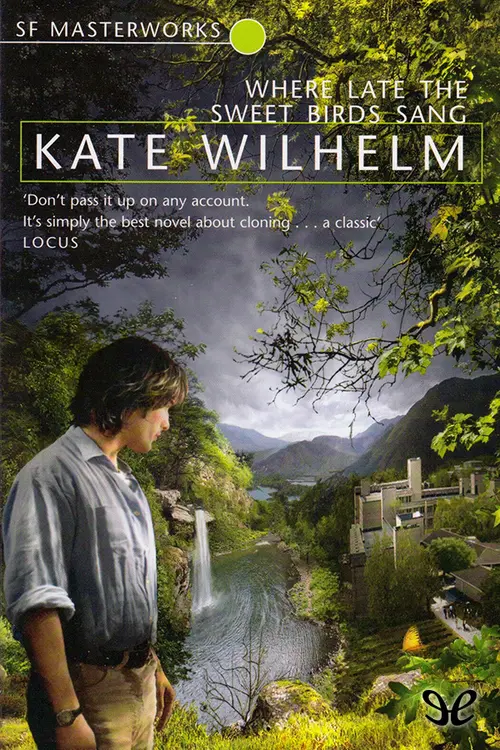
The Sumner family can read the signs: the droughts and floods, the blighted crops, the shortages, the rampant diseases and plagues and, above all, the increasing sterility all point to one thing.
Their isolated farm in the Appalachian Mountains gives them the ideal place to survive the coming breakdown and their wealth and know - how gives them the means. Men and women must clone themselves for humanity to survive. But what then?

Kate Wilhelm
Where Late the Sweet Birds Sang
SF Masterworks - 67
ePub r1.1
Watcher 17-04-2021
Original title: Where Late the Sweet Birds SangWhere Late The Sweet Birds Sang
Kate Wilhelm, 1976
Digital editor: Watcher
ePub base r2.1


Where Late The Sweet Birds Sang
Kate Wilhelm
Introduction
Although she was inducted into the Science Fiction Hall of Fame in 2003, and won the Solstice Award for her lifetime contribution to the field in 2009, Kate Wilhelm has never received the level of acclaim, or wider readership, that she deserves.
One reason was suggested by John Clute, in his entry about the author in The Encyclopedia of Science Fiction: arguing that her finest work was to be found in the shorter fiction she produced since the late 1960s, and that she was less happy writing novels than she was ‘at the commercially unpopular novella length,’ he suggested this ‘made her career an object lesson in the costs and benefits of the market.’ Novels, of course, always sell better than short story collections.
However, although she has continued to write short stories (appreciated by the discerning but shrinking band of folks who still read SF magazines), since the early 1990s Kate Wilhelm has become better known for her mystery and suspense novels, particularly the Barbara Holloway series, and is now more likely to be associated with that genre, especially with her backlist of thoughtful and original speculative fiction out of print.
Readers of contemporary SF can’t be expected to be familiar with every significant writer of the past, but many will know that writers of the New Wave transformed the field in the 1960s and ‘70s, and may be able to name some of the most influential and experimental of those writers, including J.G. Ballard, Michael Moorcock. Thomas Disch, Harlan Ellison… so why not Kate Wilhelm?
Although of the same generation, Kate Wilhelm is seldom spoken of as a New Wave writer. I suspect it is because she didn’t call attention to herself, eschewed obvious stylistic pyrotechnics, and could appear traditional in her approach to story. She is usually included in lists of the writers who changed the previously male-dominated field so profoundly in the 1970s, but too often gets no more than a mention, her feminism described as “soft”, and critical attention focused on seemingly more radical works by Joanna Russ, Ursula Le Guin, Suzy McKee Charnas and James Tiptree, Jr.