Where Late the Sweet Birds Sang
Cover
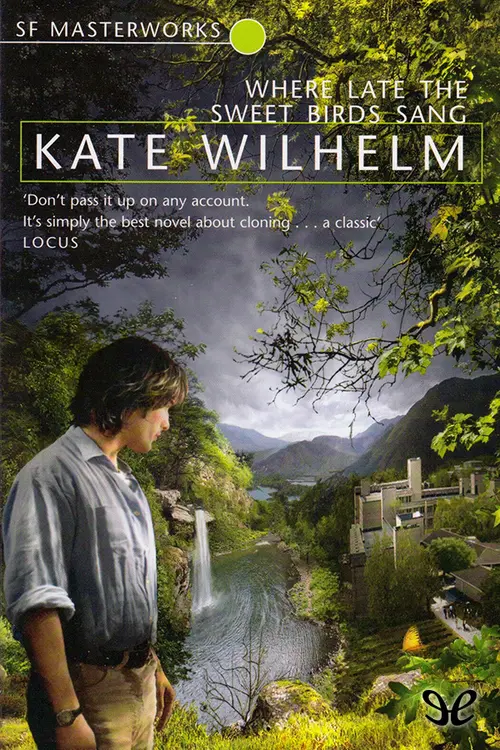
The Sumner family can read the signs: the droughts and floods, the blighted crops, the shortages, the rampant diseases and plagues and, above all, the increasing sterility all point to one thing.
Their isolated farm in the Appalachian Mountains gives them the ideal place to survive the coming breakdown and their wealth and know - how gives them the means. Men and women must clone themselves for humanity to survive. But what then?

Kate Wilhelm
Where Late the Sweet Birds Sang
SF Masterworks - 67
ePub r1.1
Watcher 17-04-2021
Original title: Where Late the Sweet Birds SangWhere Late The Sweet Birds Sang
Kate Wilhelm, 1976
Digital editor: Watcher
ePub base r2.1



Where Late The Sweet Birds Sang
Kate Wilhelm
Introduction
Although she was inducted into the Science Fiction Hall of Fame in 2003, and won the Solstice Award for her lifetime contribution to the field in 2009, Kate Wilhelm has never received the level of acclaim, or wider readership, that she deserves.
One reason was suggested by John Clute, in his entry about the author in The Encyclopedia of Science Fiction: arguing that her finest work was to be found in the shorter fiction she produced since the late 1960s, and that she was less happy writing novels than she was ‘at the commercially unpopular novella length,’ he suggested this ‘made her career an object lesson in the costs and benefits of the market.’ Novels, of course, always sell better than short story collections.
However, although she has continued to write short stories (appreciated by the discerning but shrinking band of folks who still read SF magazines), since the early 1990s Kate Wilhelm has become better known for her mystery and suspense novels, particularly the Barbara Holloway series, and is now more likely to be associated with that genre, especially with her backlist of thoughtful and original speculative fiction out of print.
Readers of contemporary SF can’t be expected to be familiar with every significant writer of the past, but many will know that writers of the New Wave transformed the field in the 1960s and ‘70s, and may be able to name some of the most influential and experimental of those writers, including J.G. Ballard, Michael Moorcock. Thomas Disch, Harlan Ellison… so why not Kate Wilhelm?
Although of the same generation, Kate Wilhelm is seldom spoken of as a New Wave writer. I suspect it is because she didn’t call attention to herself, eschewed obvious stylistic pyrotechnics, and could appear traditional in her approach to story. She is usually included in lists of the writers who changed the previously male-dominated field so profoundly in the 1970s, but too often gets no more than a mention, her feminism described as “soft”, and critical attention focused on seemingly more radical works by Joanna Russ, Ursula Le Guin, Suzy McKee Charnas and James Tiptree, Jr.
Much as I admired other contemporary writers - Dick, Disch and Ellison in particular - for me, finding my voice as a writer in the early ‘70s, the paradigm-shifting novel was Kate Wilhelm’s Margaret and I. It was that book, published in 1971 (four years before The Female Man) that made me see that women’s experiences were valid material, and that a good SF novel could be both idea- and character-driven.
Science fiction writers were rarely praised for their ability to create believable characters (sometimes that’s OK), and even now the psychological and emotional complexity Kate Wilhelm demonstrated in her writing, her ability to combine intellectual excitement with real feeling, remains exceptional.
I would love to see both Margaret and I and The Clewiston Test (a modern gothic shocker about the life of a woman scientist) recognized as ‘masterworks’ and brought back into print, but, in the meantime, it’s good to have Where Late the Sweet Birds Sang in the canon.
It’s a classic story that begins with a powerful (inevitably male dominated) group taking steps to survive the global catastrophe they are wise enough to anticipate, and who are determined to keep humankind alive by reproducing themselves, regardless of cost. Forced reproduction as a natural imperative was attacked by Joanna Russ in her 1977 novel We Who Are About To…, but Wilhelm does not take a polemical or particularly feminist stance here. What she has done is to combine the pleasures of an atmospheric, evocatively-written, character-driven novel with the intellectual rigour of a thought-experiment. Although Where Late the Sweet Birds Sang offers some of the attractions of the ‘cosy catastrophe’ it goes deeper than many stories about what might happen after the fall of civilization, to raise issues that are both fascinating and disturbing.
Human cloning became a hot topic in the 1970s, yet treatment of the subject in fiction tended to be unrealistic, played for laughs or horror. Only a few SF writers addressed the matter seriously, and while Kate Wilhelm’s imagined families of identical, empathically linked sextuplets is scarcely the last word on the subject, Where Late the Sweet Birds Sang remains probably the best novel ever written about human cloning (Kazuo Ishiguro’s Never Let Me Go, hardly science fiction, is the only contender).
Unsurprisingly, this haunting novel was received with much acclaim, winning not only the Hugo, but also the Jupiter and the Locus Award for Best Novel in 1977. It is a powerful work and displays its author’s particular strengths, her ability to create complex, flawed, believable characters, her ability to evoke a strong sense of place, the muscular. unfussy, yet atmospheric prose, and a story that engages both the intellect and the emotions.
The most surprising thing may be that a novel reflecting contemporary anxieties of the mid-1970s is still so relevant today. Apart from a few minor details revealing that the catastrophe must have taken place before 1980, it might have been written this year. At this time of concern about global warming, economic meltdown, and all the other problems of the world, Wilhelm’s warning about what could happen feels more urgent and prescient than ever.
Lisa Tuttle
PART ONE
Where Late the Sweet Birds Sang
Chapter 1
What David always hated most about the Sumner family dinners was the way everyone talked about him as if he were not there.
"Has he been eating enough meat lately? He looks peaked."
"You spoil him, Carrie. If he won't eat his dinner, don't let him go out and play. You were like that, you know."
"When I was his age, I was husky enough to cut down a tree with a hatchet. He couldn't cut his way out of a fog."
David would imagine himself invisible, floating unseen over their heads as they discussed him. Someone would ask if he had a girl friend yet, and they would tsk-tsk whether the answer was yes or no. From his vantage point he would aim a ray gun at Uncle Clarence, whom he especially disliked, because he was fat, bald, and very rich. Uncle Clarence dipped his biscuits in his gravy, or in syrup, or more often in a mixture of sorghum and butter that he stirred together on his plate until it looked like baby shit.
"Is he still planning to be a biologist? He should go to med school and join Walt in his practice."
He would point his ray gun at Uncle Clarence and cut a neat plug out of his stomach and carefully ease it out, and Uncle Clarence would ooze from the opening and flow all over them.
"David." He started with alarm, then relaxed again. "David, why don't you go out and see what the other kids are up to?" His father's quiet voice, saying actually, That's enough of that. And they would turn their collective mind to one of the other offspring.
As David grew older, he learned the complex relationships that he merely accepted as a child. Uncles, aunts, cousins, second cousins, third cousins. And the honorary members—the brothers and sisters and parents of those who had married into the family. There were the Sumners and Wistons and O'Gradys and Heinemans and the Meyers and Capeks and Rizzos, all part of the same river that flowed through the fertile valley.
He remembered the holidays especially. The old Sumner house was rambling with many bedrooms upstairs and an attic that was wall-to-wall mattresses, pallets for the children, with an enormous fan in the west window. Someone was forever checking to make certain that they hadn't all suffocated in the attic. The older children were supposed to keep an eye on the younger ones, but what they did in fact was to frighten them night after night with ghost stories. Eventually the noise level would rise until adult intervention was demanded. Uncle Ron would clump up the stairs heavily and there would be a scurrying, with suppressed giggles and muffled screams, until everyone found a bed again, so that by the time he turned on the hall light that illuminated the attic dimly, all the children would seem to be sleeping. He would pause briefly in the doorway, then close the door, turn off the light, and tramp back down the stairs, apparently deaf to the renewed merriment behind him.
Whenever Aunt Claudia came up, it was like an apparition. One minute pillows would be flying, someone would be crying, someone else trying to read by flashlight, several of the boys playing cards by another flashlight, some of the girls huddled together whispering what had to be delicious secrets, judging by the way they blushed and looked desperate if an adult came upon them suddenly, and then the door would snap open, the light would fall on the disorder, and she would be standing there. Aunt Claudia was very tall and thin, her nose was too big, and she was tanned to a permanent old-leather color. She would stand there, immobile and terrible, and the children would creep back into bed without a sound. She would not move until everyone was back where he or she belonged, then she would close the door soundlessly. The silence would drag on and on. The ones nearest to the door would hold their breath, trying to hear breathing on the other side. Eventually someone would become brave enough to open the door a crack, and if she were truly gone, the party would resume.
The smells of holidays were fixed in David's memory. All the usual smells: fruit cakes and turkeys, the vinegar that went in the egg dyes, the greenery and the thick, creamy smoke of bayberry candles. But what he remembered most vividly was the smell of gunpowder that they all carried at the Fourth of July gathering. The smell that permeated their hair and clothes lasted on their hands for days and days. Their hands would be stained purple-black by berry picking, and the color and smell were one of the indelible images of his childhood. Mixed in with it was the smell of the sulfur that was dusted on them liberally to confound the chiggers.
If it hadn't been for Celia, his childhood would have been perfect. Celia was his cousin, his mother's sister's daughter. She was one year younger than David, and by far the prettiest of all his cousins. When they were very young they promised to marry one day, and when they grew older and it was made abundantly clear that no cousins might ever marry in that family, they became implacable enemies. He didn't know how they had been told. He was certain that no one ever put it in words, but they knew. When they could not avoid each other after that, they fought. She pushed him out of the hayloft and broke his arm when he was fifteen, and when he was sixteen they wrestled from the back door of the Winston farmhouse to the fence, fifty or sixty yards away. They tore the clothes off each other, and he was bleeding from her fingernails down his back, she from scraping her shoulder on a rock. Then somehow in their rolling and squirming frenzy, his cheek came down on her uncovered chest, and he stopped fighting. He suddenly became a melting, sobbing, incoherent idiot and she hit him on the head with a rock and ended the fight.
Up to that point the battle had been in almost total silence, broken only by gasps for breath and whispered language that would have shocked their parents. But when she hit him and he went limp, not unconscious, but dazed, uncaring, inert, she screamed, abandoning herself to terror and anguish. The family tumbled from the house as if they had been shaken out, and their first impression must have been that he had raped her. His father hustled him to the barn, presumably for a thrashing. But in the barn his father, belt in hand, looked at him with an expression that was furious, and strangely sympathetic. He didn't touch David, and only after he had turned and left did David realize that tears were still running down his face.
In the family there were farmers, a few lawyers, two doctors, insurance brokers and bankers and millers, hardware merchandisers, other shopkeepers. David's father owned a large department store that catered to the upper-middle-class clientele of the valley. The valley was rich, the farms in it large and lush. David always supposed that the family, except for a few ne'erdo-wells, was rather wealthy. Of all his relatives his favorite was his father's brother Walt. Dr. Walt, they all called him, never uncle. He played with the children and taught them grown-up things, like where to hit if you really meant it, where not to hit in a friendly scrap. He seemed to know when to stop treating them as children long before anyone else in the family did. Dr. Walt was the reason David had decided very early to become a scientist.
David was seventeen when he went to Harvard. His birthday was in September and he didn't go home for it. When he did return at Thanksgiving, and the clan had gathered, Grandfather Sumner poured the ritual before-dinner martinis and handed one to him. And Uncle Warner said to him, "What do you think we should do about Bobbie?"
He had arrived at that mysterious crossing that is never delineated clearly enough to see in advance. He sipped his martini, not liking it particularly, and knew that childhood had ended, and he felt a profound sadness and loneliness.
The Christmas that David was twenty-three seemed out of focus. The scenario was the same, the attic full of children, the food smells, the powdering of snow, none of that had changed, but he was seeing it from a new position and it was not the wonderland it had been. When his parents went home he stayed on at the Wiston farm for a day or two, waiting for Celia's arrival. She had missed the Christmas Day celebration, getting ready for her coming trip to Brazil, but she would be there, her mother had assured Grandmother Wiston, and David was waiting for her, not happily, not with any expectation of reward, but with a fury that grew and caused him to stalk the old house like a boy being punished for another's sin.
When she came home and he saw her standing with her mother and grandmother, his anger melted. It was like seeing Celia in a time distortion, as she was and would be, or had been. Her pale hair would not change much, but her bones would become more prominent and the almost emptiness of her face would have written on it a message of concern, of love, of giving, of being decisively herself, of a strength unsuspected in her frail body. Grandmother Wiston was a beautiful old lady, he thought in wonder, amazed that he never had seen her beauty before. Celia's mother was more beautiful than the girl. And he saw the resemblance to his own mother in the trio. Wordlessly, defeated, he turned and went to the rear of the house and put on one of his grandfather's heavy jackets because he didn't want to see her at all now and his own outdoor clothing was in the front hall closet too near where she was standing.
He walked a long time in the frosty afternoon, seeing very little, and shaking himself from time to time when he realized that the cold was entering his shoes or making his ears numb. He should turn back, he thought often, but he walked on. And he found that he was climbing the slope to the antique forest that his grandfather had taken him to once, a long time ago. He climbed and became warmer, and at dusk he was under the branches of the tiers of trees that had been there since the beginning of time. They or others that were identical to them. Waiting. Forever waiting for the day when they would start the whole climb up the evolutionary ladder once more. Here were the relicts his grandfather had brought him to see. Here was a silverbell, grown to the stature of a large tree, where down the slopes, in the lower reaches, it remained always a shrub. Here the white basswood grew alongside the hemlock and the bitternut hickory, and the beeches and sweet buckeyes locked arms.
"David." He stopped and listened, certain he had imagined it, but the call came again. "David, are you up here?"
He turned then and saw Celia among the massive tree trunks. Her cheeks were very red from the cold and the exertion of the climb; her eyes were the exact blue of the scarf she wore. She stopped six feet from him and opened her mouth to speak again, but didn't. Instead she drew off a glove and touched the smooth trunk of a beech tree. "Grandfather Wiston brought me up here, too, when I was twelve. It was very important to him that we understand this place."
David nodded.
She looked at him then. "Why did you leave like that? They all think we're going to fight again."
"We might," he said.
She smiled. "I don't think so. Never again."
"We should start down. It'll be dark in a few minutes." But he didn't move.
"David, try to make Mother see, will you? You understand that I have to go, that I have to do something, don't you? She thinks you're so clever. She'd listen to you."
He laughed. "They think I'm clever like a puppy dog."
Celia shook her head. "You're the one they'd listen to. They treat me like a child and always will."
David shook his head, smiling, but he sobered again very quickly and said, "Why are you going, Celia? What are you trying to prove?"
"Damn it, David. If you don't understand, who will?" She took a deep breath and said, "Look, you do read the newspapers, don't you? People are starving in South America. Most of South America will be in a state of famine before the end of this decade if they aren't helped almost immediately. And no one has done any real research in tropical farming methods. Practically no one. That's all lateritic soil and no one down there understands it. They go in and burn off the trees and underbrush, and in two or three years they have a sunbaked plain as hard as iron. Okay, they send some of their bright young students here to learn about modern farming, but they go to Iowa, or Kansas, or Minnesota, or some other dumb place like that, and they learn farming methods suited to temperate climates, not tropical. Well, we trained in tropical farming and we're going to start classes down there, in the field. It's what I trained for. This project will get me a doctorate."
The Wistons were farmers, had always been farmers. "Custodians of the soil," Grandfather Wiston had said once, "not its owners, just custodians."
Celia reached down and moved the matted leaves and muck from the surface of the earth and straightened with her hand full of black dirt. "The famines are spreading. They need so much. And I have so much to give! Can't you understand that?" she cried. She closed her hand hard, compacting the soil into a ball that crumbled again when she opened her fist and touched the lump with her forefinger. She let the soil fall from her hand and carefully pushed the protective covering of leaves back over the bared spot.
"You followed me to tell me good-bye, didn't you?" David said suddenly, and his voice was harsh. "It's really good-bye this time, isn't it?" He watched her and slowly she nodded. "There's someone in your group?"
"I'm not sure, David. Maybe." She bowed her head and started to pull her glove on again. "I thought I was sure. But when I saw you in the hall, saw the look on your face when I came in… I realized that I just don't know."
"Celia, you listen to me! There aren't any hereditary defects that would surface! Damn it, you know that! If there were, we simply wouldn't have children, but there's no reason. You know that, don't you?"
She nodded. "I know."
"For God's sake! Come with me, Celia. We don't have to get married right away, let them get used to the idea first. They will. They always do. We have a resilient family, you and me. Celia, I love you."
The Story Continues on BooksBarbecue!
Enjoyed this preview? ❤️ Do not stop here!
Read the complete book free online → 🔗
Continue reading now on BooksBarbecue and discover every page!
Love reading? Bookmark BooksBarbecue.com for more amazing books!
Happy Reading!