Wedding Song
Chapters (12)
Cover
Title Page
Copyright

AN ANCHOR BOOK
PUBLISHED BY DOUBLEDAY
A division of Bantam Doubleday Dell Publishing Group, Inc. 666 Fifth Avenue, New York, New York 10103
ANCHOR BOOKS, DOUBLEDAY, and the portrayal of an anchor are trademarks of Doubleday, a division of Bantam Doubleday Dell Publishing Group, Inc.
All of the characters in this book are fictitious, and any resemblance to actual persons, living or dead, is purely coincidental.
This English translation was first published by The American University in Cairo Press in 1984. First published in Arabic as Afrah al-Qubbah in 1981. Protected under the Berne Convention.
The Anchor Books edition is published by arrangement with The American University in Cairo Press.
Library of Congress Cataloging-in-Publication Data
Maḥfūẓ, Najīb, 1911–
[Afrāḥ al-qubbah. English]
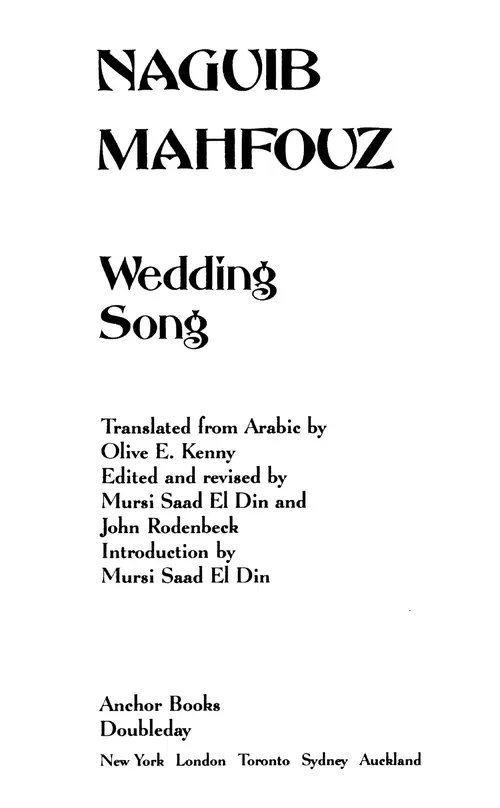
Wedding song / Naguib Mahfouz; translated from Arabic by Olive E. Kenny; edited and revised by Mursi Saad El Din and John Rodenbeck; introduction by Mursi Saad El Din.
1st Doubleday ed.
p. cm.
Translation of: Afrāḥ al-qubbah.
I. Saad El Din, Mursi. II. Rodenbeck, John. III. Title.
[PJ7846.A46A6913 1989] 89-7893
892′.736—dc20
ISBN 0-385-26463-1 ISBN 0-385-26464-X (pbk.)
eBook ISBN 9780525431701
Copyright © 1984 by The American University in Cairo Press
ANCHOR BOOKS EDITION: 1989
v4.1
a
FOREWORD
The English title Wedding Song is an attempt to preserve some of the multiple ironies in the Arabic title Afrah al-Qubbah. Literally, Afrah al-Qubbah might be interpreted as meaning something like “wedding festivities at the saint’s tomb.” This is a Cairene tale, however, and in this instance al-qubbah refers to a palace that was one of the official residences of the former khedives of Egypt. Naguib Mahfouz explained to me that the weddings of the khedivial family were marked by processions with singing and dancing, and that songs sung on these occasions, popularly repeated, came to be known as afrah al-qubbah. Hence Wedding Song.
O.E.K.
INTRODUCTION
Naguib Mahfouz is regarded as the leading Arabic novelist and one of the few of world stature. He is therefore one of the most translated Egyptian writers, matched in this respect only by Tawfik el-Hakim. The translation of his works remains a brave venture, however, not just because Arabic in general abounds with nuances but also because Mahfouz in particular has a style that poses a special challenge to translators, however accomplished they might be.
Afrah al-Qubbah is among the latest of his books. First published in 1981, it reflects the most recent phase in the development of this remarkable writer, who has produced more than twenty-five novels and several collections of short stories. Born in 1911 in the picturesque Gamaliyya quarter of Cairo, Mahfouz pursued philosophical studies from early youth onward, obtaining his B.A. at Cairo University (then Fouad University) in 1934. An avid reader in both English and French, he translated James Baikie’s Ancient Egypt from English while still an undergraduate. This book became the inspiration of two early historical romances, Radobis and Kifah Tibu (The Struggle of Thebes), published in 1943 and 1944.