Wedding Song
Cover
Title Page
Copyright

AN ANCHOR BOOK
PUBLISHED BY DOUBLEDAY
A division of Bantam Doubleday Dell Publishing Group, Inc. 666 Fifth Avenue, New York, New York 10103
ANCHOR BOOKS, DOUBLEDAY, and the portrayal of an anchor are trademarks of Doubleday, a division of Bantam Doubleday Dell Publishing Group, Inc.
All of the characters in this book are fictitious, and any resemblance to actual persons, living or dead, is purely coincidental.
This English translation was first published by The American University in Cairo Press in 1984. First published in Arabic as Afrah al-Qubbah in 1981. Protected under the Berne Convention.
The Anchor Books edition is published by arrangement with The American University in Cairo Press.
Library of Congress Cataloging-in-Publication Data
Maḥfūẓ, Najīb, 1911–
[Afrāḥ al-qubbah. English]
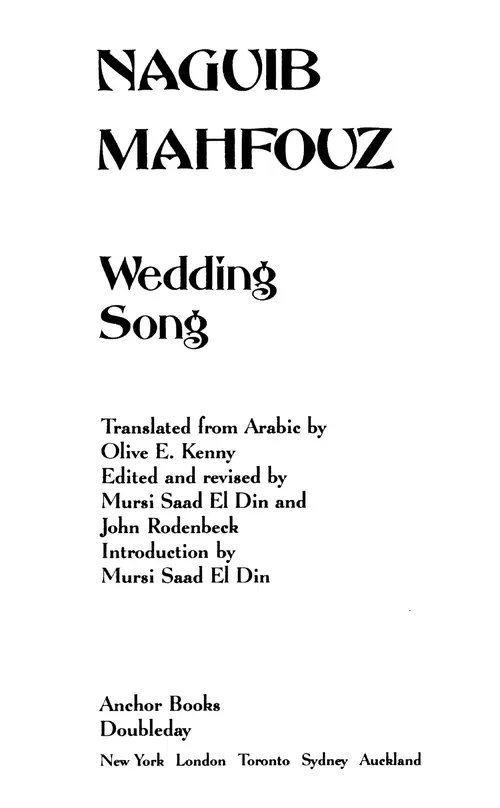
Wedding song / Naguib Mahfouz; translated from Arabic by Olive E. Kenny; edited and revised by Mursi Saad El Din and John Rodenbeck; introduction by Mursi Saad El Din.
1st Doubleday ed.
p. cm.
Translation of: Afrāḥ al-qubbah.
I. Saad El Din, Mursi. II. Rodenbeck, John. III. Title.
[PJ7846.A46A6913 1989] 89-7893
892′.736—dc20
ISBN 0-385-26463-1 ISBN 0-385-26464-X (pbk.)
eBook ISBN 9780525431701
Copyright © 1984 by The American University in Cairo Press
ANCHOR BOOKS EDITION: 1989
v4.1
a
FOREWORD
The English title Wedding Song is an attempt to preserve some of the multiple ironies in the Arabic title Afrah al-Qubbah. Literally, Afrah al-Qubbah might be interpreted as meaning something like “wedding festivities at the saint’s tomb.” This is a Cairene tale, however, and in this instance al-qubbah refers to a palace that was one of the official residences of the former khedives of Egypt. Naguib Mahfouz explained to me that the weddings of the khedivial family were marked by processions with singing and dancing, and that songs sung on these occasions, popularly repeated, came to be known as afrah al-qubbah. Hence Wedding Song.
O.E.K.
INTRODUCTION
Naguib Mahfouz is regarded as the leading Arabic novelist and one of the few of world stature. He is therefore one of the most translated Egyptian writers, matched in this respect only by Tawfik el-Hakim. The translation of his works remains a brave venture, however, not just because Arabic in general abounds with nuances but also because Mahfouz in particular has a style that poses a special challenge to translators, however accomplished they might be.
Afrah al-Qubbah is among the latest of his books. First published in 1981, it reflects the most recent phase in the development of this remarkable writer, who has produced more than twenty-five novels and several collections of short stories. Born in 1911 in the picturesque Gamaliyya quarter of Cairo, Mahfouz pursued philosophical studies from early youth onward, obtaining his B.A. at Cairo University (then Fouad University) in 1934. An avid reader in both English and French, he translated James Baikie’s Ancient Egypt from English while still an undergraduate. This book became the inspiration of two early historical romances, Radobis and Kifah Tibu (The Struggle of Thebes), published in 1943 and 1944.
Between 1945 and 1957 Mahfouz published what one can describe as “realist” novels, including Khan el-Khalili, Midaq Alley, The Mirage, The Beginning and the End, and the Cairo Trilogy, for which he was awarded the State Prize for Literature in 1957. Since 1959 Mahfouz’s novels have taken a different turn, making use of symbolism and allegory to achieve fresh philosophical and psychological dimensions. Critics regard much of his more recent work as experimental.
Any novelist learns from his predecessors. The novel is young in Arabic and Mahfouz has perforce absorbed the work of many non-Arab writers. Chief among them, according to his own testimony, are Flaubert, Balzac, Zola, Camus, Tolstoy, and Dostoyevsky, all of whom he has read in French. Perhaps the most important Western influence, however, has been that of Proust. As a university student Mahfouz made a special study of the philosophy of Henri Bergson, Proust’s cousin, who had codified elements that would later become central to Proust’s work; and his subsequent intensive reading of A la Recherche du Temps Perdu has had a lasting impact, especially on his idea of time.
Time is a constant theme in all his novels and a constant preoccupation of his characters. Mahfouz’s works are typically laced with sentences—such as “Time is a terrible companion,” “What has time done to my friend? It has imposed a hideous mask on his face”—that suggest almost a horror temporis.
In this novel we are prompted to see how time works changes, transforming love into hate, beauty into ugliness, loyalty into treachery, idealism into debauchery, leaving its marks on Tariq Ramadan, Karam Younis, Halima al-Kabsh, Abbas Karam Younis, and even on the old house where Abbas grew up. Like all the novels of Mahfouz, Wedding Song may thus be regarded in part as a history of time and its impact on character. Avoiding such commonplace information as the age of the protagonists, Mahfouz gives us instead an evocation of what has happened to their features, their bodies, the looks in their eyes, the despair in their hearts. The techniques he favors for such evocation—stream of consciousness and interior monologue—lead to narratives in the first person. Each of his main characters thus tells his or her own story, supplies us with only a personal interpretation, creates in effect his or her own theatrical drama out of the raw materials of life. The future of each may be unknown, lost in the intricacies of present and past, which are woven by each character into a single dark strand that he or she follows alone, but even Abbas, despite his success, momentarily believes that death is, sooner or later, the only future for him, as well as for all mankind.
Ultimately, however, what interests us in Wedding Song is not this forbidding motif or the plight of mankind, but how four very different kinds of minds and temperaments apprehend and deal with the realities that surround them. There is reason to believe that Abbas’s sense of triumph at the end of the book is by no means illusory. Unlike the other characters, he has been able to transform his own life; and he has also transformed theirs, through a creative power exercised almost unawares. It is his dawning consciousness of this power, which Mahfouz describes in the last pages of the book’s final section, that provides us with a masterful portrait of the mind of an artist.
It is this portrait, which undoubtedly includes elements of Mahfouz’s own vision of himself, that the translator has sought above all to liberate from the limitations imposed by barriers of culture and language.
MURSI SAAD EL DIN
TARIQ RAMADAN THE ACTOR
September. The beginning of autumn. The month of preparations and rehearsals. In the stillness of the manager’s office, where the closed windows and drawn curtains allow no other noise to intrude but the soft hum of the air conditioner, the voice of Salim al-Agrudy, our director, erupts, scattering words and ideas, sweeping through the scaffolding of our silent attentiveness. Before each speech his glance alerts the actor or actress who will be playing the part and then the voice goes on, sometimes soft, sometimes gruff, taking its cue from whether the part is a man’s or a woman’s. Images of stark reality rush forth, overwhelming us with their brutal directness, their daunting challenge.
At the head of an oblong table with a green baize top, Sirhan al-Hilaly, our producer, sits in command, following the reading with his hawklike features fixed in a poker face, staring at us while we crane in al-Agrudy’s direction, his full lips clamped around a Deenwa cigar. The intensity of his concentration makes any interruption or comment impossible; the silence with which he ignores our excitement is so arctic that it compels us to repress it.
Doesn’t the man understand the significance of what he’s reading to us?
The scenes that unroll before my imagination are tinged with bloodshed and brutality. I’d like to start talking with someone to break the tension, but the thick cloud of smoke in the room deepens my sense of alienation; and I am sodden with some kind of fear. To hold back panic, I pin my eyes to the impressive desk in the rear of the room or a picture on the wall—Doria as Cleopatra committing suicide with the viper, Ismail as Antony orating over the body of Caesar—but my mind shows me the gallows. I feel devils inside me carousing.
Salim al-Agrudy utters the words “Final curtain,” and all heads turn toward Sirhan al-Hilaly in bewilderment, as he says, “I’d like to know what you think of it.”
Doria, our star, smiles and says, “Now I know why the author didn’t come to the reading.”
“Author?” I venture, convinced that somehow the world has come to an end. “He’s nothing but a criminal. We ought to hand him over to the public prosecutor.”
“Watch yourself, Tariq!” al-Hilaly barks at me. “Put everything out of your mind except the fact that you’re an actor.” I start to object, but he cuts me off irritably—“Not a word!”—and turns back to Salim, who murmurs, “It’s an alarming play.”
“What do you mean?”
“I’m wondering what kind of impact it’ll have on the public.”
“I have approved it and I feel confident.”
“But the shock is almost too much.”
Ismail, the male star of the troupe, mutters, “My role is disgusting.”
“No one is crueler than an idealist,” says al-Hilaly. “Who’s responsible for all the carnage in this world? Idealist. Your role is tragic in the highest dimension.”
“The murder of the baby,” Salim al-Agrudy interjects. “It will destroy any sympathy the audience might have had for him.”
“Let’s not bother with details now. The baby can be left out. Not only has Abbas Younis persuaded me at last to accept a play of his, but I also have a feeling that it will be one of the biggest hits in the history of our theater.”
Fuad Shalaby, the critic, says, “I share your opinion,” and adds, “But we must cut out the baby.”
“This is no play!” I exclaim. “It’s a confession. It’s the truth. We ourselves are actually the characters in it.”
“So what?” al-Hilaly retorts, dismissing my objection. “Do you suppose that escaped me? I recognized you, of course, just as I recognized myself. But how is the audience going to know anything?”
“One way or another, the news will leak out.”
“Let it! The one who’ll suffer most is the author. For us, it can only mean success. Isn’t that right, Fuad?”
“I’m sure that’s true.”
“It must be presented,” al-Hilaly says, smiling for the first time, “with the utmost subtlety and propriety.”
“Of course. That goes without saying.”
“The public,” Salim al-Agrudy mutters. “How will it go down with them?”
“That’s my responsibility,” replies al-Hilaly.
“Fine. We’ll begin at once.”
The meeting is over, but I stay behind to be alone with al-Hilaly. On the strength of the fact that we’re old friends and comrades as well as former neighbors, I take the liberty of urging him to put the matter before the public prosecutor.
“Here’s an opportunity for you,” he says, ignoring my agitation, “to portray on the stage what you have actually experienced in real life.”
“Abbas Younis is a criminal, not an author!”
“And it’s an opportunity that could make you an important actor. You’ve played supporting roles for so long.”
“These are confessions, Sirhan. How can we let the criminal get away with it?”
“It’s an exciting play. It’s bound to attract audiences and that’s all that matters to me, Tariq.”
Anger and bitterness well up inside me; past sorrows, with all their attendant regrets and failures, spread over my consciousness like a cloud. Then a thought comes to me: now I’ll have a chance to get back at my old enemy. “How do you know all this?” “Pardon me, but we’re going to be married.”
“What are you going to do?” says Sirhan al-Hilaly.
“My primary concern is to see that the criminal gets what he deserves.”
“Better make it your primary concern to learn your part.”
I give in. “I won’t let this chance slip by me.”
At the sight of the coffin, a sense of defeat overwhelms me, and to everyone’s astonishment, as if it were the first coffin I’ve ever seen, I burst into tears. It is neither grief nor contrition I suffer, but temporary insanity. The contemptuous expressions of the other mourners waver like water snakes in my tear-filled eyes, and I avoid looking at them, afraid my sobbing will turn to hysterical laughter.
What melancholy engulfs me as I plunge into the crowd—the men, women, and children, the dust and the din—at Bab al-Shariya!*1 I haven’t gone near it for years, this district of piety and depravity, where everything under the clear autumn sky seems draped in contempt and depression. My memories of this place—bringing Tahiya here for the first time, her arm gaily tucked in mine—disgust and pain me, as much as the way I live now, mixing with scum, crouching under Umm Hany’s wings. Damn the past and the present. Damn the theater. Damn its bit parts. Damn my hopes of success in a lead role—at my age, over fifty, in a play by my enemy, who is a criminal! I walk down the narrow serpentine length of the gravel merchants’ market, past its ancient brooding gates and its two apartment buildings, stark and new, to the place where the old house, a dark and bloody past locked up inside it, still lurks.
Some changes have been made, though: the ground-floor reception room has been converted into a shop where watermelon seeds are roasted and sold, and Karam Younis sits in it ready for business, with his wife, Halima, beside him. Prison has transformed them completely. Their faces incarnate resentment and at the very time their son’s star is on the rise they seem to have sunk into total despair.
The man catches sight of me, the woman looks in my direction, and their gazes are neither affectionate nor even cordial. I raise my hand in greeting to Karam, but he ignores it. “Tariq Ramadan!” he rasps. “What brings you here?” Hardly expecting a better reception, I pay no attention to his brusqueness. She jumps to her feet, then immediately sits down again on her straw-bottomed chair. “The first visit we’ve had since our return to the face of the earth!” she says coldly. Her features still clutch at some memory of beauty and he seems to have his wits about him in spite of what he’s been through—this pair who have engendered the criminal author.
Feeling that I should say something to soften the situation, I remark that the world is full of trouble and that I am merely one of the lost.
“You’re like a nightmare,” says Karam.
“I’m no worse than anyone else.” Since neither invites me to sit down in the shop, I have to stand there like a customer, which makes me more determined to stick to the purpose of my visit.
“Well?” Karam barks at me.
“I have bad news.”
“Bad news doesn’t mean a thing to us,” says Halima.
“Even if it’s about Mr. Abbas Younis?”
Her eyes become apprehensive. “You’ll always be his enemy,” she spits at me, “right to the end!”
“He’s a devoted son. When I refused to return to my old job at the theater, he set us up in this little shop.”
“And his play’s been accepted,” Halima adds proudly.
“It was read to us yesterday.”
“I am sure it’s a marvelous piece of work.”
“It’s horrible. Do you know anything about it?”
“Nothing.”
“He couldn’t tell you.”
“Why?”
“Why?! Because his play takes place in this house of yours! It tells exactly what went on inside. He exposes a crime. And it throws new light on everything that’s happened!”
Karam is suddenly concerned. “What do you mean?” he asks.
“You’ll see yourselves in it, just as the rest of us do. He shows everything. Everything! Don’t you want to hear about it?”
“Even prison?”
“Even prison—and Tahiya’s death. It shows who betrayed you to the police, and it shows that Tahiya didn’t just die. She was murdered.”
“What kind of nonsense is this?”
“It’s Abbas, or the one who represents him in the play, who kills her.”
“What do you mean?” Halima screeches in sudden fury. “You hate Abbas!”
“I’m one of his victims, and so are you.”
“Isn’t it just a play?” says Karam.
“It leaves no doubt about who squealed on you or who the murderer is.”
“Nonsense!”
“Abbas can explain everything,” Halima says.
“Go see the play for yourselves.”
“You crazy fool! You’ve been blinded by hate!”
“Not by hate. By the crime.”
“You’re nothing but a criminal yourself. And it’s only a play.”
“It’s the truth.”
“You’re a spiteful lunatic! My son may be stupid, but he’s neither an informer nor a murderer.”
“He’s an informer and a murderer, and not at all stupid.”
“That’s what you want to believe.”
“Tahiya’s murderer must be brought to justice!”
“The same old spite. How did you treat Tahiya when she was with you? Did you treat her right?”
“I loved her, that’s enough.”
“Yes, the love of a layabout.”
“I’m a better man than your husband or your son!” I shout.
“Just what do you want?” Karam growls, his voice harsh with loathing.
“A piaster’s worth of melon seeds!”
“Go to hell!”
As I wade back through a swarm of children and women, my thoughts are fixed on the play. I am certain that Abbas has not revealed the plot of his play to his parents, which in itself is a proof of his guilt. But why should he divulge such a dark secret when nobody dreamt of suspecting it? Yearning for success at any price? Will he be rewarded with fame, I wonder, rather than the gallows? “Tariq! What can I say? It’s fate. And luck!” At the corner where the road meets Sharia al-Gaysh, I turn to the left in the direction of al-Ataba, walking toward the apartment building down a street that over the years has become shadowy, pockmarked, and constricted.
Tahiya, you got what was coming to you. If the man who killed you is the one you left me for, that’s justice. Soon it’ll be so crowded that people will start eating each other. If it weren’t for Umm Hany, I’d be a derelict. The height of your glory, Abbas, will be the hangman’s noose. And what about me? The only distinction I have is virility. My failure is otherwise indelible. Is there any meaning in the life of a third-rate actor?
—
Lust was my teacher in the good old days and it was lust that educated me in the sweet talk of a perfect man-about-town. Our affair was born backstage: I got Tahiya’s first kiss while the others were onstage plotting the death of Rasputin.
“Tahiya, you deserve to be a star, not a second-rate actor like me.”
“Do you really think so? You’re exaggerating, Mr. Tariq.”
“Not at all. It’s the voice of experience.”
“Or the eye of approval?”
“Even love doesn’t color my judgment.”
“Love!”
We’d been walking after midnight along Sharia Galal, oblivious to the biting cold, intoxicated by the warmth of our dreams. “Of course,” I answered. “Shall we take this taxi?”
“It’s time for me to go home.”
“Alone?”
“There’s no one else in my little flat.”
“Where do you live?”
“Sharia al Gaysh.”
“We’re almost neighbors. I have a room at Bab al-Shariya, in Karam Younis’s house.”
“The prompter?”
“Yes. Are you going to ask me up to your flat, or shall I invite you to my place?”
“What about Karam and Halima?” I laughed, and she smiled. “There’s no one else in the house?”
“They’ve only got one kid. He’s a student.” She was pretty. She had a flat. And her salary was the same as mine.
—
Why has Sirhan al-Hilaly sent for me in the middle of rehearsals? Leaning across the conference table in the warm sunlight, he speaks before I have a chance to say anything: “You’ve asked to be excused from rehearsals twice, Tariq?” I say nothing, and he goes on: “Don’t mix friendship with work. Isn’t it enough that you have driven Abbas into hiding?”
“Perhaps the reason he fled is that he’s been exposed.”
“Are you still clinging to those strange ideas of yours?”
“He’s a criminal. No doubt about it.”
“It’s a play. And you’re an actor, not a public prosecutor.”
“But he’s a criminal. And you know it as well as I do!”
“Your judgment is blinded by hate.”
“I don’t bear any grudge.”
“Haven’t you recovered yet from unrequited love?”
“Our rehearsing is going to bring success to a criminal!”
“It will be our success—and your chance after years of obscurity to be seen in the limelight.”
“Please, Sirhan, life….”
“Don’t talk to me about life. Don’t start philosophizing! I hear that stuff onstage every night and I’m sick of it. You’ve neglected your health. Sex, drugs, and the wrong kind of food. In that play about the female martyr you took the role of the Imam*2 when you were drunk, without the slightest twinge of conscience.”
“You’re the only one who knew it.”
“There was more than one member of the faithful out front who could smell your breath. Are you going to force me to….”
“Don’t treat the friendship of a lifetime as if it were nothing,” I break in, alarmed.
“And you recited a verse from the Koran incorrectly. That’s unpardonable.”
“Nothing happened.”
“I beg you, please. Forget this obsession of yours, this prying and spying, and concentrate on learning your part. It’s the chance of a lifetime.” As I leave the room he adds, “And you’d do well to treat Umm Hany better. If she leaves you, you’ll really be in a bad way.”
The Story Continues on BooksBarbecue!
Enjoyed this preview? ❤️ Do not stop here!
Read the complete book free online → 🔗
Continue reading now on BooksBarbecue and discover every page!
Love reading? Bookmark BooksBarbecue.com for more amazing books!
Happy Reading!