War with Russia
Chapters (60)
- Cover
- Dedication
- Foreword
- Preface
- Prologue
- PART ONE
- Kharkiv, Ukraine
- The President’s weekly defense and foreign policy meeting, The Kremlin, Moscow
- Comprehensive Crisis Operations Management Center (CCOMC), Supreme Headquarters Allied Powers Europe (SHAPE), Belgium
- Briefing Room, Boryspill Air Force Base, Ukraine
- The Kremlin, Moscow
- Washington, D.C.
- Residence of DSACEUR La Belle Alliance, Erbisoeul, Belgium
- North Atlantic Council Conference Room, NATO Headquarters, Brussels
- Banks of River Daugava, Riga, Latvia
- Ādaži Training Camp, Latvia
- Riga, Latvia
- National Defense Control Center, Moscow
- Ādaži Training Camp, Latvia
- NATO Headquarters, Brussels
- National Armed Forces Joint HQ, Riga, Latvia
- Supreme Headquarters Allied Powers Europe (SHAPE), Mons, Belgium
- Central European Time 1600 hours, Eastern Standard Time, The White House, Washington, D.C.
- Lielvārde Air Base, Latvia
- Lielvārde Air Base, Latvia
- Camp David, Catoctin Mountains, Maryland
- British Embassy, 5, J.Alunana Street, Riga, Latvia
- The Russell Arms, Butler’s Cross, Buckinghamshire
- HMS Queen Elizabeth Middle Slip Jetty, HM Naval Base, Portsmouth
- National Defense Control Center, Moscow
- Comprehensive Crisis Operations Management Center (CCOMC) SHAPE headquarters, Mons, Belgium
- Somewhere in the forest, Gauja National Park, Latvia
- 10 Downing Street, Whitehall, London
- HMS Queen Elizabeth in the Baltic Sea
- Control Room, Kilo Class submarine Krasnokamensk, Baltic Sea
- PART TWO
- Prime Minister’s Office, House of Commons, London
- The Presidential Dacha Barvikha, Odintsovsky District of Moscow Oblast
- The White House, Washington, D.C.
- NATO Headquarters, Brussels, Belgium
- Gauja National Park Forest, Latvia
- PART THREE
- “The Tank,” Pentagon, Washington, D.C.
- North Atlantic Council NATO Headquarters, Brussels
- Government Communications Headquarters (GCHQ), Cheltenham, England
- GCHQ, Cheltenham, England
- Forest south of Pravdinsk, Kaliningrad, Russia
- Headquarters, Kaliningrad Special Region, Kaliningrad
- The President’s Office, The Kremlin, Moscow
- Forest south of Pravdinsk, Kaliningrad, Russia
- Comprehensive Crisis Operations Management Center (CCOMC) SHAPE headquarters, Mons, Belgium
- Command Bunker, Iskander Missile Battery Pravdinsk, Kaliningrad
- Over Wroclaw, Poland
- Forest north of Pravdinsk Iskander Battery, Kaliningrad
- 25,000 feet above Kaliningrad
- Close to the Pravdinsk Iskander Battery, Kaliningrad
- Epilogue
- Glossary
- Acknowledgments
- Notes
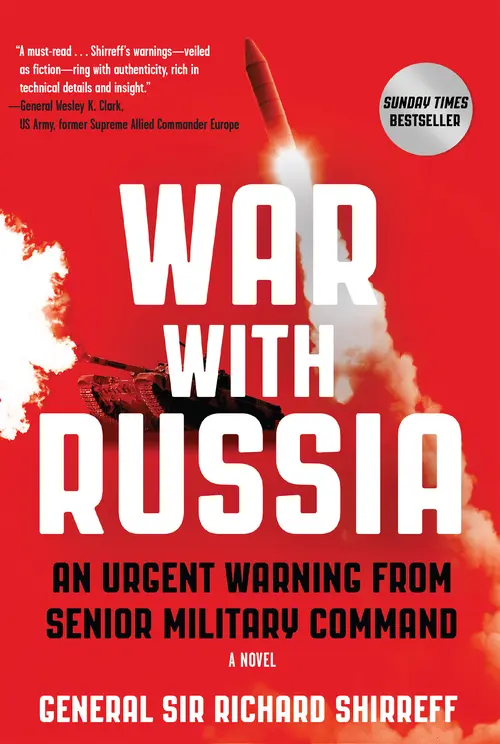
Cover
Dedication
To my friends in Latvia, Estonia, and Lithuania. Men and women who understand the price of freedom.
Foreword
Admiral James Stavridis, US Navy (Retired), former Supreme Allied Commander Europe
AT HIS CONFIRMATION hearing in the summer of 2015, General Mark Milley, the new Chief of US Army Staff, was asked by the Senate Armed Services Committee what was the greatest threat to the American—and Western—democratic way of life. He answered, “I would put Russia right now as the number one threat . . . Russia is the only country on earth that retains a nuclear capability to destroy the United States. That is an existential threat.” General Joe Dunford, the new Chairman of the Joint Chiefs, expressed the same view to the same committee during his confirmation hearings.
I fully agree with that assessment. It is also an assessment shared by a select group of top military leaders; people whose experience puts them in the best position to know the facts of the case. In particular, I applaud my former comrade-in-arms and Deputy Supreme Allied Commander at NATO, General Sir Richard Shirreff, for laying out the risks America and the West currently face in this brave, timely and important book.
As the Strategic Commander of NATO, the North Atlantic Treaty Organization, I saw Russian aggression firsthand. Of all the challenges America faces on the geopolitical scene in the second decade of the twenty-first century, the most dangerous is the resurgence of Russia under President Putin. Yes, Islamic jihadists pose a massive threat to our security but, until the jihadists can defeat us on the battlefield, they cannot destroy our nation. The Russians are different—and this is the truly terrifying bit—as they appear to be prepared to use nuclear weapons, based on recent, very public comments by Vladimir Putin.
Under President Putin, Russia has charted a dangerous course that, if it is allowed to continue, may lead inexorably to a clash with NATO. And that will mean a war that could so easily go nuclear. As the Prussian general Carl von Clausewitz once said, “War has its own grammar but not its own logic.” I would add that it has its own dynamic. If American and NATO soldiers find themselves in direct combat with Russian troops, that conflict will escalate. And that means the ultimate option will be on the table: the use of nuclear weapons. This book describes brilliantly how this horrific scenario could develop “on the ground.” These are the sort of scenarios that many senior civilians, and especially politicians, throughout history have consistently failed to understand or have wished away.
But this dynamic can be stopped and war averted if NATO, under the leadership of America, shows the necessary resolve and determination. It is a war that can be prevented, but only if the Russians believe we are serious about being prepared to fight to defend our freedoms and those of our allies.