Vauxhall
Chapters (30)
- Cover
- Title
- Part One
- The Sari
- Overcrowding
- Blue Rose Orange
- Frost
- Underneath the Arches
- The Taste of Black Jack
- Penny for the Guy
- Winning The Pools
- Blood Brothers
- Grey Blue Green
- Custard Out of a Tin
- Looking for Monkeys Up in the Zoo (Je t’aime ... moi non plus)
- Sunday, Sunday
- The Thames
- Lambeth Walk
- Susan
- The Face of God
- Off to See the Wizard ...
- In the Dead of Night
- Whitsun
- Part Two
- Cowboys and Indians
- Tribal Scars
- China Walk
- Tired of Fighting
- Cat and Mouse
- In the Ruins
Cover
Title
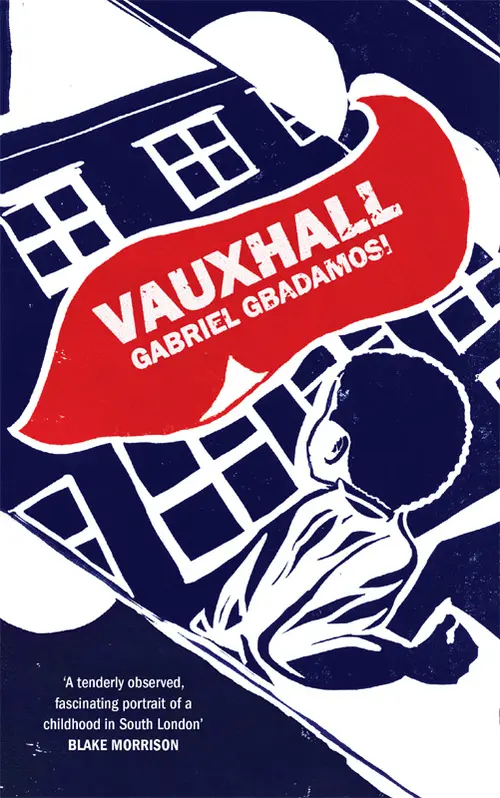
Vauxhall
Gabriel Gbadamosi
TELEGRAM
Gabriel Gbadamosi is an Irish-Nigerian poet, playwright and essayist born in London. He was AHRC Creative and Performing Arts Fellow at the Pinter Centre, Goldsmiths, and a Judith E. Wilson Fellow for creative writing at Cambridge University. His plays include Shango, Hotel Orpheu and for radio The Long, Hot Summer of ’76 (BBC Radio 3), which won the Richard Imison Award. He has presented Night Waves on BBC Radio 3 and Art Beat on the World Service. Vauxhall is his first novel.
‘Only a poet could have written Vauxhall. I can hear Yeats and Joyce in it ... Gbadamosi paints a vivid portrait of 1970s multicultural London, giving that time in our recent history its own music, voice and clear light. Vauxhall is written in the way that English should be written – clean, swift and with flashes of lightning.’
Bonnie Greer, author of Hanging by her Teeth
‘A tenderly observed, fascinating portrait of a childhood in South London, as it moves from post-war darkness into an uncertain new era.’
Blake Morrison, author of South of the River
‘Immediately appealing, this is a quite an odyssey through the maelstrom that London was in the 1970s. A remarkable achievement.’
Brian Chikwava, author of Harare North
‘An impressive feat of memory and skill ... the streets, the fraught encounters, the sense of family and growing understandings of youth are winningly brought to life in a series of deft, artful vignettes.’
Diran Adebayo, author of Some Kind of Black
For my children
Ninu ilé Baba mi, ọpọlọpọ ibùgbé ni o wà
John 14.2
Part One
The Sari
Her forehead was crumpled on the pavement.
‘She made a grab for the wire as she fell,’ someone said.
I looked up at the telegraph pole, its wires reaching out in a spiral overhead to all the houses in the street.
Her mother stood crying into a fold of the sari she held across her mouth, to stop the truth leaking out. She was talking in another language. It was grief. She wanted the girl to get up out the puddle of blood. She wanted her to fly up to the hand-hold of the wire. To fly backwards in time, up to the windowsill on the top floor, and press her hands and face against the coldness of the glass. But she wouldn’t. She was out of reach – the girl whose name I didn’t know, who never went to school and never waved back.