Chapters (25)
- Cover
- Title Page
- Valley, Uncanny
- The Hospitality of Strangers
- One Hundred Days in the Cave
- The Other Asterion, or, The Minotaur’s Sacrifice (A Story)
- Exactly Like You
- Harness
- Orphan: The Plural Form
- The Error of Blood Relation
- I Will Make an Example
- The Limit Case
- In the Other Future
- Like a Second Person inside Us
- Autoclonography
- Unalloyed
- Paradise
- Replication
- My Singularity
- Notes
- References
- Illustration Credits
- Acknowledgments
- Funder Acknowledgments
- About the Author
The Sphinx was a cyborg, a hybrid monster. She was obsessed with men, made his life a riddle.
Antigone, the envoy of ghosts. Antigone the enhanced, her life everywhere at once, outside and inside the palace, with her brother’s body aboveground, her parents and other brother below. Like a god she is ubiquitous.
Many of us know something about transgression. Something is wrong about us. What can we do but embrace the makeshift, assemble ourselves as we go, sometimes the punishment exceeding the crime.
Antigone doesn’t actually exist. She is not the hero of the play named after her. She is in flight, she drags a machinery of re-territorialization with her like a kind of harrow, digging a long narrow grave behind her. She is invisible, transparent, already dead the minute she walks onto the stage.
During the one and only performance of Antigone during Sophocles’s time, she was not even a woman. Men in their wigs and masks and high heels. Pity and fear. Catharsis. Women play women now. Antigone is more woman than woman, more man than man. She is a machine pretending to be a disobedient girl.
When I think of myself as mostly machine, my disobedience becomes completely natural. Tiresias was at one time a woman, and now he sees everything. He remembers the future.
In the play, we never meet Antigone in the underworld. We are only with her until she is sealed up in the cave (bridal chamber, labor-and-delivery room, funeral parlor, tomb).
She is excessive. She is eternal. Hybrid of life and death.
A disobedient woman. A machine at home.
Predictably, Asia functions in Blade Runner as the alluring and foreign “other” of the West, the normal, and the present: it is the extra kick that makes the near future look like “New York on a bad day” to quote the director—dirty, overcrowded, full of freaks, the poor, and people of color. Yet not so predictably, this “other” also is linked with the morally ambiguous hero (and yes, Deckard is a replicant).
—Jane Chi Hyun Park, on her book Yellow Future: Oriental Style in Hollywood Cinema in a November 20, 2011, interview in Rorotoko
I want to see [the Voight-Kampff empathy test] work on a person. I want to see it work on a negative before I provide you with the positive.
—Dr. Eldon Tyrell, Blade Runner
In the Other Future
In the Other Future
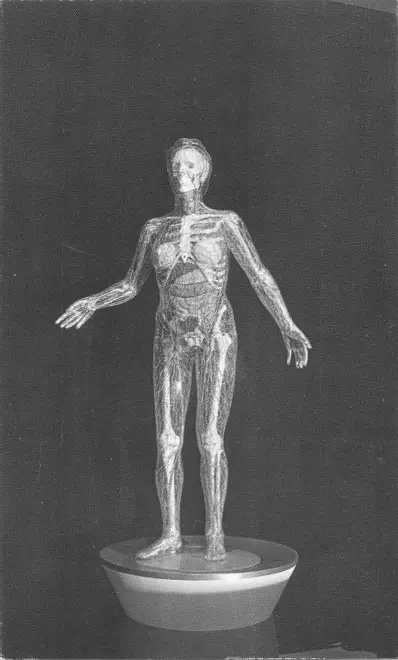
1. As a child there were many field trips to the Robert Crown Center for Health Education in Hinsdale, Illinois. I remember nothing except Valeda, the TAM (Transparent Anatomical Manikin); she lived there on a platform on a stage in a dark room. She was made by a German medical artist. There were others of her around the country and in Europe. I only ever met her, not the others.