Chapters (25)
- Cover
- Title Page
- Valley, Uncanny
- The Hospitality of Strangers
- One Hundred Days in the Cave
- The Other Asterion, or, The Minotaur’s Sacrifice (A Story)
- Exactly Like You
- Harness
- Orphan: The Plural Form
- The Error of Blood Relation
- I Will Make an Example
- The Limit Case
- In the Other Future
- Like a Second Person inside Us
- Autoclonography
- Unalloyed
- Paradise
- Replication
- My Singularity
- Notes
- References
- Illustration Credits
- Acknowledgments
- Funder Acknowledgments
- About the Author
Born thirteen years after  Park Chung-hee seized power in a coup d’état and two years after he instituted military rule declaring himself president for life. Three months and two days after our birthday: assassination. Uncompleted. He was missed but not his wife. Stray bullet, enter me and destroy me. Later that day, she died.
Documented
9 p.m. on January 20, 1975, at the Holt Office in Seoul, Korea. Processed at the Shin-Kyo Police Station.
 (Shin)
Knocked loose.
Family of one.
At seven months old, I become the chief and sole member of (my new branch of) the Shin family.
“Shin is a Korean family name. It is cognate to the Chinese family names Shen and Xin. According to the 2000 census in South Korea, there were 911,556 people carrying the Shin surname.”7

“No Record”
Orphan  (hojuk). In her article “Our Adoptee, Our Alien: Transnational Adoptees as Specters of Family and Foreignness in Korea,” Eleana Kim explains how the “orphan hojuk” and the legal “orphanization” process reconstitutes the adoptee socially in Korea. Within “the context of Korean law, she becomes a person with the barest of social identities, and in the context of Korean cultural norms, she lacks the basic requirements of social personhood—namely, family lineage and genealogical history.”
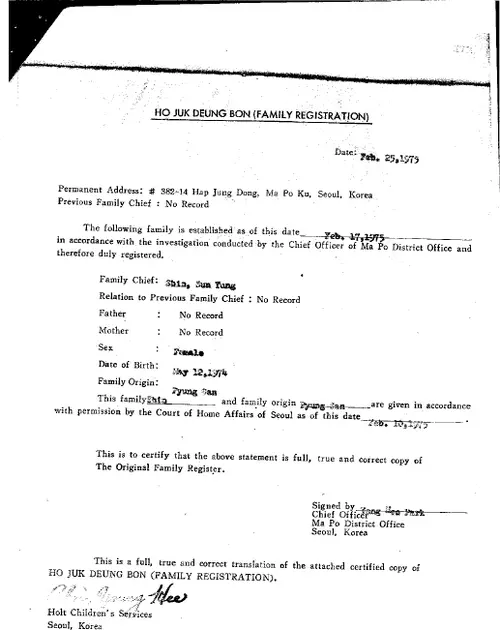
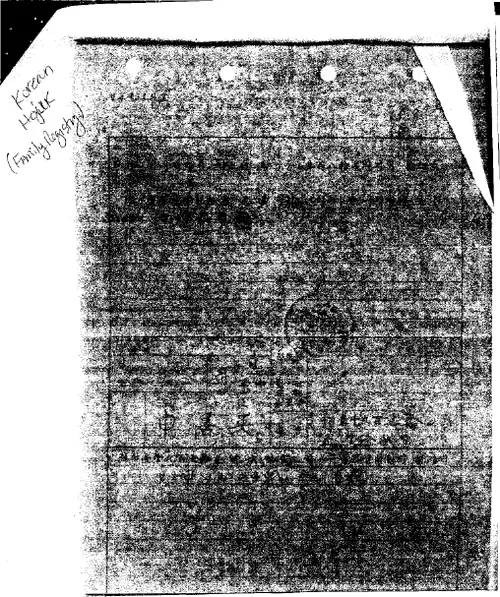
The “orphan hojuk,” or the family registry created so that we could be separated legally from our Korean family and made available for intercountry adoption. The first is an English translation of the second. What we have is a hasty and terrible photocopy, dark and illegible, the Korean original. Yet, an original of what?
Deformation, a defamation in a home country. An ill report, rumor, scandal. A secret.
We are a copy and an original.
We will make a record.
In these copies, light escapes at the corners.
Sudden
We are a colony of one.
Though the  katastrofón, catastrophes of war were over, mothers were still compelled to leave their children in the forest eat send their children far across the sea.
 An overturning. To turn down. To trample on.
A sudden end.
Ride
Dark forest and beyond / steal fire from skulls. Mother dead, her gift of a magic talking doll deep in our trembling pocket. Cotton wool silent mouth. Beautiful Vassalisa. Our broom, enigma, to sweep thought from every corner.
All day she walked on. Towards evening she came to a glade. She looked into the glade and saw a hut; all round it was a fence made from human bones.
On the fence were human skulls; human legbones served instead of a gate, there were hands instead of bolts, and sharp teeth acted as the lock. At this sight the girl was terrified: she stood rooted to the ground.
Suddenly a horseman rode past; he was dressed entirely in black, was riding a black horse, and the horse’s harness, too, was black. He galloped up to the gate and vanished as if he had been swallowed into the earth. Night came on.8