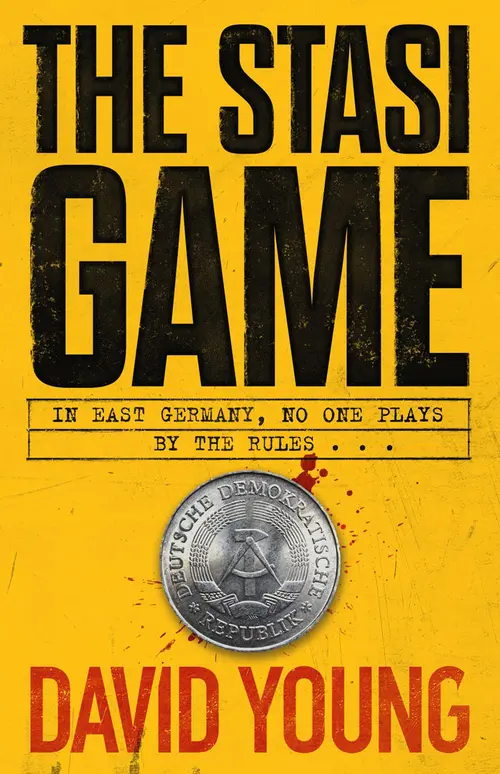
The Stasi Game
Chapters (60)
- Cover
- Dedication
- Introduction
- Prologue
- Chapter 1
- Chapter 2
- Chapter 3
- Chapter 4
- Chapter 5
- Chapter 6
- Chapter 7
- Chapter 8
- Chapter 9
- Chapter 10
- Chapter 11
- Chapter 12
- Chapter 13
- Chapter 14
- Chapter 15
- Chapter 16
- Chapter 17
- Chapter 18
- Chapter 19
- Chapter 20
- Chapter 21
- Chapter 22
- Chapter 23
- Chapter 24
- Chapter 25
- Chapter 26
- Chapter 27
- Chapter 28
- Chapter 29
- Chapter 30
- Chapter 31
- Chapter 32
- Chapter 33
- Chapter 34
- Chapter 35
- Chapter 36
- Chapter 37
- Chapter 38
- Chapter 39
- Chapter 40
- Chapter 41
- Chapter 42
- Chapter 43
- Chapter 44
- Chapter 45
- Chapter 46
- Chapter 47
- Chapter 48
- Chapter 49
- Chapter 50
- Chapter 51
- Epilogue
- Glossary
- Author’s Note
- Acknowledgements
- About the Author
Cover
Dedication
A huge thank you to all my readers in the UK and beyond.
This book is dedicated to you all.
Introduction
Introduction
This novel is set in communist East Germany, the German Democratic Republic (Deutsche Demokratische Republik, or DDR) in 1982, at a time when the first cracks were starting to appear in the Soviet bloc – thanks to the Solidarity movement in Poland. In December 1981, the Polish prime minister, General Wojciech Jaruzelski, had begun a crackdown against the movement, declaring martial law.
Nevertheless, there was no real inkling at the time that East Germany itself would within nine years cease to exist, and that the hated Berlin Wall – or Anti-Fascist Protection Rampart as it was known in the DDR – would be torn down even sooner.
East Germany has come to be identified with its feared Ministry for State Security (MfS), more commonly known as the Stasi, a contraction of its official German name. It was one of the most extensive security networks in the world, where friends reported on friends, neighbours on neighbours and even family members or lovers on each other.
But there was more to East Germany than the Stasi, many things that are still mourned by its former citizens. The sense of community, excellent childcare facilities, and one of the highest standards of living in the Eastern Bloc. What always rankled though, even for those who didn’t fall foul of the Stasi, was the lack of freedom – particularly freedom to travel to the west (unless, of course, you were a pensioner).
Criminal investigations were generally the preserve of the People’s Police (Volkspolizei) and in particular its CID division (the Kriminalpolizei – Kripo or K for short), but those with significant political overtones could be taken over by the Stasi. Former detectives who served with the People’s Police have always insisted to me that they operated like regular policemen, ‘just like at your Scotland Yard’, and had little or nothing to do with the Stasi (even though many People’s Police officers were unofficial Stasi informants). But many DDR citizens regarded the Volkspolizei and the Stasi as being little different at their core – both were organs of the state.
For the sake of authenticity, I’ve retained the German ranks for the police, which followed military lines. My main character, Karin Müller, has in this book been reduced in rank to Hauptmann, or captain. For other ranks and an explanation of occasional German words in the text, please see the Glossary at the back of the book.
As things stand, this is likely to be the last story of the series. It’s a separate case, and so can be read and enjoyed without having read the previous books in the series.
DY, July 2020
Prologue
Prologue
Bastei, Bezirk Dresden, East Germany
March 1982