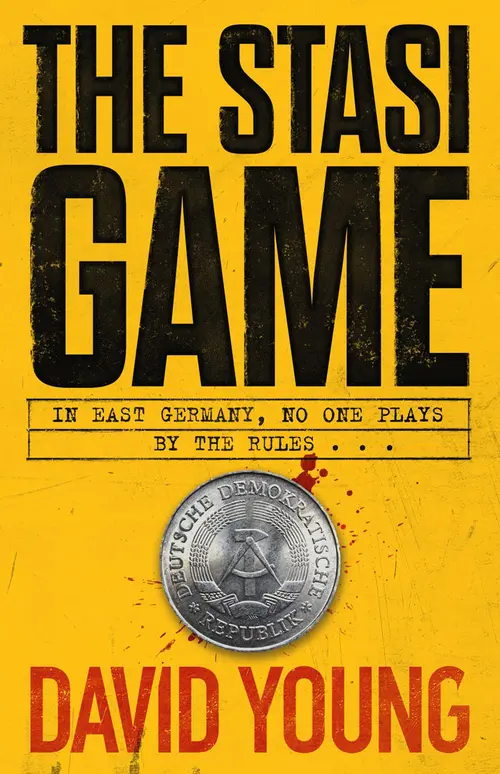
The Stasi Game
Cover
Dedication
A huge thank you to all my readers in the UK and beyond.
This book is dedicated to you all.
Introduction
Introduction
This novel is set in communist East Germany, the German Democratic Republic (Deutsche Demokratische Republik, or DDR) in 1982, at a time when the first cracks were starting to appear in the Soviet bloc – thanks to the Solidarity movement in Poland. In December 1981, the Polish prime minister, General Wojciech Jaruzelski, had begun a crackdown against the movement, declaring martial law.
Nevertheless, there was no real inkling at the time that East Germany itself would within nine years cease to exist, and that the hated Berlin Wall – or Anti-Fascist Protection Rampart as it was known in the DDR – would be torn down even sooner.
East Germany has come to be identified with its feared Ministry for State Security (MfS), more commonly known as the Stasi, a contraction of its official German name. It was one of the most extensive security networks in the world, where friends reported on friends, neighbours on neighbours and even family members or lovers on each other.
But there was more to East Germany than the Stasi, many things that are still mourned by its former citizens. The sense of community, excellent childcare facilities, and one of the highest standards of living in the Eastern Bloc. What always rankled though, even for those who didn’t fall foul of the Stasi, was the lack of freedom – particularly freedom to travel to the west (unless, of course, you were a pensioner).
Criminal investigations were generally the preserve of the People’s Police (Volkspolizei) and in particular its CID division (the Kriminalpolizei – Kripo or K for short), but those with significant political overtones could be taken over by the Stasi. Former detectives who served with the People’s Police have always insisted to me that they operated like regular policemen, ‘just like at your Scotland Yard’, and had little or nothing to do with the Stasi (even though many People’s Police officers were unofficial Stasi informants). But many DDR citizens regarded the Volkspolizei and the Stasi as being little different at their core – both were organs of the state.
For the sake of authenticity, I’ve retained the German ranks for the police, which followed military lines. My main character, Karin Müller, has in this book been reduced in rank to Hauptmann, or captain. For other ranks and an explanation of occasional German words in the text, please see the Glossary at the back of the book.
As things stand, this is likely to be the last story of the series. It’s a separate case, and so can be read and enjoyed without having read the previous books in the series.
DY, July 2020
Prologue
Prologue
Bastei, Bezirk Dresden, East Germany
March 1982
She decided to approach the rendezvous point from the high sandstone plateau above the Elbe Valley, instead of climbing up from the spa town of Rathen – the usual route. It felt more like a dull November day than the start of spring, an incessant drizzle falling through the mist, with visibility reduced to a hundred metres or so. She knew the magnificent vista of the Elbe was there somewhere, snaking past Rathen itself and the other spa towns on its banks, but for now it was hidden by the greyness. The only shapes in that grey screen were those of trees, looming like featureless giants – as though they had come to watch what transpired.
Hauptmann Karin Müller hunched down into her People’s Police overcoat, trying to protect herself as well as she could. The only sounds were her own footsteps on the track and the doleful drips of water from the tree canopy. She felt a frisson of fear, but then she always did when she was meeting agents of this particular Ministry of the Republic.
The Ministry for State Security.
The Stasi.
One of the most feared secret services in the world. And probably one of the most effective.
As a captain with the People’s Police crime division, she and the Stasi men should be on the same side, fighting to defend the socialist Republic of Workers and Peasants. The smaller half of Germany. The half where making more money than your neighbour wasn’t the be all and end all of life. But too often she found that the organisation’s covert, underhand methods went right against the grain of regular police work. If the Stasi wasn’t her actual opponent, why did it so often seem to be? Was it something in her own character, her own way of doing things? Had she become a rebel almost involuntarily, even though she worked for an organ of the state? If so, her position was even more precarious than she’d realised.
All of a sudden, emerging from the gloom, were shapes other than trees. What looked like a restaurant, a union holiday home perhaps, the trappings of the Republic’s tourist infrastructure. They still appeared to be closed for winter. The only sounds remained constant: the drum beat of her own police boots, and the accompanying percussion of water drips – this time from the concrete buildings.
She checked her map, open at its page inside a cellophane wrapper to keep out the damp. According to this, just a few metres to go. Yet still she could see little through the mist.
Then – in an instant, as she reached the edge of the high plateau – the veil lifted. Here, the view was other-worldly, heart-stopping. She imagined this might be what it would be like to suddenly land on another planet. More gnarled, giant figures, but here hewn and weathered by nature from rock rather than grown from seed. Far below, the snaking waters of the Elbe. Between the two – the valley and plateau – swirled up columns of mist, dancing to their own silent tune and adding to the ethereal feel.
She saw him then. The man she was supposed to meet. Stasi Oberstleutnant Klaus Jäger. Jäger the Hunter. Yet when he’d contacted her asking for this meeting, his voice had held an unusual haunted tone, almost that of a frightened man. Like her, in the past few years he’d had to suffer the ignominy of a demotion of rank. But he was still a powerful man. Though at this moment it looked as though nature could overpower him in an instant, silhouetted as he was on the crenelated viaduct, spanning the sheer drop to the Elbe Valley below.
It took Müller a few minutes to reach him, winding down a circuitous path. Then she began the walk across the bridge itself. She knew it was him from his familiar haircut – the one that looked like that newsreader on the BRD’s nightly bulletin. A few years ago, in the early 1970s, that cut of shoulder-length, sandy-brown hair had been the height of fashion. Now it was distinctly passé, as – perhaps – was Jäger himself.
Only when she got nearer, and the man turned – no doubt hearing her footsteps echoing against the valley walls below – did she realise something was wrong. Very wrong.
This wasn’t Jäger. Just someone dressed exactly like him, probably wearing a wig from the Stasi’s disguise box. Instinctively, she began to reach to her shoulder holster.
‘Freeze!’ shouted the man, drawing his own handgun. A Makarov. She was close enough to recognise it. So even though it wasn’t Jäger, he almost certainly was a Stasi agent. ‘Put your hands above your head, Comrade Müller.’
She did as she was told, but at the same time glanced round to see if there was an escape route, back along the way she’d just come.
There wasn’t. Another man was blocking the other end of the bridge. And he too held a raised gun.
But this was someone she did recognise. The English businessman from the Interhotel in Dresden. Only clearly, he wasn’t a businessman at all.
Finally, the penny dropped.
She’d just walked into a trap.
She was in its jaws – both sides determined to stop her solving this case.
But there remained one important question to which she didn’t know the answer.
Was she the bait?
Or the prey?
Chapter 1
1
Dresden, East Germany
February 1982
Dawn had cracked, the sun edging above the skyline, suffusing the scene with a fierce orange glow. Those citizens who had already roused themselves to start their early shifts, those who were old enough to remember that day thirty-seven years earlier, they would be shivering. Not from the winter cold, but from a terrible knotted fear deep in their souls provoked by that amber sky, something they would live with for the rest of their lives.
The firestorm. When it seemed like the whole city was ablaze.
The silhouetted skyline still had its half-destroyed Baroque ruins, buildings erected when the kings here pranced around on gilded horses, marrying off their sons and daughters so they could seize control not just of Saxony, but of swathes of neighbouring Poland too. When the city’s glories were said to match those of Paris, Vienna, and Venice.
Then the Anglo-American bombers came, wreaking a terrible vengeance not just on Nazi Germany, but on all Germans, even those who’d already lost everything, driven from their homes further east by the relentless, ruthless advance of the liberating forces of the Red Army. Even on those who’d already come to see what Hitler really was – a megalomaniac bent on taking his country down with him.
They didn’t need to descend to Hell. The fires of hell rained down on them instead, turning the cellars where they sheltered into furnaces, sending a vicious superheated wind snaking through the underground tunnels, through the streets, consuming everything in its path, except a few rumps of stone façade.
The city would bear its terrible scars for ever more.
*
By the time Hauptmann Karin Müller reached the scene, the fiery orange had mellowed into a wan gold, and daylight was nearly upon them. She was fascinated by another grotesque silhouette right in front of her eyes. Not that of Dresden’s skyline; this was an arm, waving helplessly, but statically, like a snapshot of a drowning man at sea. Yet the sea his body was encased in was solid, and it was patently obvious he was beyond rescue.
Three workmen, supervised by uniformed People’s Police officers, were attempting to break up the ground around the outstretched arm with hydraulic jackhammers. You could see their bodies shaking as they tried to keep the machines on target, and the vibrations and hammering set Müller’s teeth on edge.
‘You’re sure it’s more than just the arm?’ she asked the uniformed captain nearest the entombed body part. There was a note of pathetic hope in her question, as though someone might have simply planted a severed limb there, though the thought of that was bad enough.
The officer knelt down and brushed some of the loosened concrete aside. She could now see locks of dark hair, matted with the newly dried concrete of the building site. Beneath them, the dome of a skull.
‘I’m sure, Comrade Hauptmann,’ the man replied, looking up at her with a thin smile. ‘The builders had already managed to break away some of the new concrete around the arm. That’s why they called us.’
‘Have you secured the scene, Comrade?’ asked Müller.
The captain gestured with his eyes. Müller followed his glance and could see a couple of Vopos marking out the perimeter of the incident site with red and white police tape. Beyond that, in the shadows of one of the half-finished apartment blocks of the Neu-Gorbitz district of Dresden, there was a group of what Müller at first took to be onlookers. They were dressed more casually than the detectives, with leather jackets de rigueur rather than winter overcoats. They could have been shift workers interrupting the walk to their factories to gawp. The giveaway was their studied, theatrical indifference. They wanted to appear like factory workers, but Müller knew they were not. She felt that familiar tingle in the back of the neck as her body hairs stood on end. They were almost certainly agents of the Ministry for State Security.
Concrete Man – and from what had been uncovered of the body so far it did indeed appear to be male – seemed to have attracted wider interest than simply that of her branch of the People’s Police, the Kriminalpolizei or Kripo.
She was distracted, and strangely relieved, by another arrival – or rather, another two arrivals. Her forensic officer, Kriminaltechniker Jonas Schmidt, heralded as always by the pungent smell of his wurst-breath, panted out as though he was in pain, and her deputy, Oberleutnant Werner Tilsner.
All three had been in disgrace for nigh on a couple of years now, but the one concession from their boss, Oberst Reiniger, after a case in which they’d shouldered the blame for the escape of a couple of Republikflüchtlinge, was that they could stay together as a team. Rather than the grand title they had before – the ‘Serious Crime Department’ – they were now simply a floating murder squad, sent wherever, and whenever, particular regions of the Republic were understaffed.
She watched Tilsner hold his hands over his ears and grimace, trying to shut out the machine-gun hammer of the pneumatic drills. His face was pale – perhaps the sound was too close a reminder of actual automatic weapons, the memories of what she knew he’d witnessed and taken part in as a teenager during the war.
‘You’ve already clocked our spectators, I expect,’ Tilsner shouted into her ear above the din.
She glanced towards the group of what they both assumed were Stasi officers, and nodded. Although for Tilsner, given his own close association with the MfS, perhaps it was less an assumption and more him recognising his colleagues from ‘the Firm’.
‘What shall I be getting on with, Comrade Hauptmann?’ asked Schmidt, the words uttered in a slightly staccato fashion, like the ubiquitous noise of the hammer drills. He was still out of breath from rushing to the site. ‘I don’t want to be treading on the toes of the local team.’
‘Don’t worry about that, Jonas. I’ll talk to them. To start with, get as many photographs from as many angles as you can. We need to try to establish whether he slipped into the new concrete by accident, which seems unlikely, or whether it was something more sinister.’
The uniformed captain overseeing the extraction of the body from the concrete base must have heard the exchange during a pause in drilling, because now he was beckoning her over.
‘There’s your answer, Comrade Hauptmann,’ he said, pointing at the skull of Concrete Man, which had now been exposed even further. Müller knelt amongst the dust and rubble to get a closer look. The uniformed officer waved his finger from side to side, a few millimetres above the man’s cranium. The hair there was not just matted by dried cement, but by something dark and congealed that looked a little like burnt oil. Both police officers knew what it really was – dried blood. ‘He’s suffered some sort of blow to the back of the head. And in that position, it doesn’t look like it was just some drunk falling over legless. It looks like someone’s attacked him, from behind.’
Müller raised her eyes from the victim’s skull, towards the group of leather-jackets chatting and laughing by the entrance to the neighbouring newly erected concrete high-rise. What this site would also become in a few weeks’ time, once Concrete Man had been extracted from his cement grave. One of the Stasi men caught her eye, smirked and shrugged.
The manner in which the victim had met his end was probably no surprise to that little group. The fact that they had gathered here so soon – apparently to oversee the police operation – indicated they already knew not just of the man’s demise, but probably how it came to pass too. In fact, it wouldn’t be a surprise to Müller if one of their number had directly, or indirectly, delivered the final blow.
Chapter 2
2
Oberhof, Bezirk Suhl, East Germany
January 1982
Snowdrifts several metres high, and bitter cold – Müller had experienced all this before some three years earlier on Rügen, during the case that had seen her demoted. But this time, despite the freezing weather, her heart was suffused with a warm glow as she watched Johannes and Jannika ski in front of her with neat parallel turns. They’d been staying with their adoptive grandmother, Rosamund, partly because of Müller’s new role as firefighting murder squad leader – called off to different parts of the Republic at a moment’s notice. But the main reason was a sadder one: Helga’s unexpected stroke. The twin’s natural great-grandmother – who they still called Oma and who was young enough to pass for their real gran – had been their main carer for several years in Berlin while different criminal cases took Müller herself away from the capital. Now that arrangement was at an end, and Rosamund had stepped up to help, for which Müller was eternally grateful, given their sometimes frosty relationship. Helga had returned to her own flat in Leipzig to be amongst friends. The outward effects of the stroke were now barely visible, but she still confused words, and had much less energy than before.
Energy was something the twins –especially Johannes – had in abundance. Heart in mouth, Müller watched as her son ducked into a schuss, ski poles raised at his sides, and headed for one of the smaller jumps formed from snow at the side of the piste. He was going too fast, surely? But he took the jump like an expert, then slid to a halt, his skis perfectly parallel. Not yet six years old, but already looking like a future expert. Not to be outdone, Jannika followed, though Müller’s daughter put in a few more turns before she ducked down and arrowed her skis straight ahead towards the mound of snow. She’d taken the jump slightly slower, but Müller noticed the trademark push just before the top of the mound, so that actually her daughter was airborne for longer. Like her brother she landed perfectly, then slid to a halt, as though it was nothing out of the ordinary for a child under six. Müller didn’t want to be outdone. She started from even higher than Johannes had done, racing down in her crouch, reminding herself of when she’d jumped for real as a schoolgirl – before her fear of heights had kicked in. That, and the fact that there were no official ski jump competitions for women, had shattered her dreams of becoming a winter sports star. She took the jump well, but on landing nearly lost her balance.
‘You need more practise, Mutti!’ shouted Johannes. ‘We’re better than you now,’ he added, cheekily.
Müller felt a flush of embarrassment. She’d been shown up by her five-year-old twins.
*
When they got back to the kitchen of the Bergpension Hanneli, her adoptive family’s small bed and breakfast hotel, there was a stranger sitting at the kitchen table alongside her adoptive mother.
‘Did you have a good ski?’ asked Rosamund, the woman who Müller had believed was her natural parent until just a few years earlier.
‘It was great, Oma,’ said Jannika, before Müller herself could say anything. ‘Johannes and I both did the jump, but Mutti nearly fell over when she tried.’
Rosamund looked at Müller in apparent surprise, and the man sitting next to her laughed. Müller felt strangely defensive.
‘I’m out of practice.’
‘You certainly are if you nearly fell over on the Fallbachhang. It’s not exactly Mount Everest.’ She turned to the man next to her. He was middle-aged, with the leathery, weathered tan of a ski instructor. ‘Have you met Herr Mayer before, Karin? He’s the ski trainer for the younger children at the Internat – the sports boarding school, here in Oberhof.’
The man got up from his chair and stretched his hand towards Müller. She tried to match his firm grip and smiled. ‘Pleased to meet you.’
‘I’m delighted to meet you, too, Frau Müller.’
Frau Müller. It had an odd ring. Very few people called her that. At work, it was just ‘Karin’ or ‘boss’ from Tilsner, and ‘Comrade Hauptmann’ from Schmidt. The irony of calling his female colleague ‘head man’ always seemed to be lost on her forensic scientist in his desire to be completely formal and correct.
‘Wolfgang already knows the twins,’ said Rosamund. ‘Where are your manners, Johannes and Jannika?’
Jannika smiled sweetly at the man. ‘Good afternoon, Herr Mayer.’
Mayer returned her greeting with a bow. ‘Good afternoon, Fräulein Müller.’
Johannes, for his part, played the grown man, extending his hand.
‘Herr Mayer.’
‘Herr Müller. Lovely to see you again. Did you and your sister put into practice any of the tips I gave you?’
‘For the jumps? Yes. We did them really well. Didn’t we, Mutti?’
‘Very well,’ said Müller. She couldn’t really disagree, given her own performance had been so woeful.
The five of them sat round the table, then Rosamund got up and busied herself at the stove. ‘Will you have another coffee, Wolfgang?’
Herr Mayer and Müller both opted for coffees, while the twins whined that they wanted hot chocolate. As Rosamund Müller prepared the drinks, she began to explain the reason for Herr Mayer’s visit.
‘He thinks both the twins have potential in winter sports, so he wants to take them under his wing and train them.’
‘That’s correct,’ added the man. ‘But would it be better to have this conversation out of the hearing of the little ones?’
Rosamund nodded. ‘Jannika, Johannes. Can you go into the playroom, please? The adults need to talk.’
‘About us?’ asked Jannika.
The Story Continues on BooksBarbecue!
Enjoyed this preview? ❤️ Do not stop here!
Read the complete book free online → 🔗
Continue reading now on BooksBarbecue and discover every page!
Love reading? Bookmark BooksBarbecue.com for more amazing books!
Happy Reading!