Chapters (59)
- Contents
- In Which We Find Ourselves in Hell, but Only Temporarily, So It’s Not All Bad News
- In Which We Learn a Little About How Hard It Is to Be in Love
- In Which We Delve Deeper into the Bowels of Hell, Which Is One of Those Chapter Headings That Make Parents Worry About the Kind of Books Their Children Are Reading
- In Which We Reacquaint Ourselves with Nurd, formerly “Nurd, The Scourge of Five Deities,” Which Was All Something of a Misunderstanding, Really
- In Which We Encounter Mr. Merryweather’s Dwarfs—or Elves—and Rather Wish We Hadn’t
- In Which Samuel Is Reunited with Boswell, and We Learn Why One Should Not Trust a Mirror
- In Which We Pay a Visit to Mrs. Abernathy’s House. Which Is Nice. Not.
- VIII
- In Which We Wonder Just How Smart Really Smart People Sometimes Are
- In Which Mr. Merryweather’s Elves Embark on a New Adventure
- In Which Mr. Merryweather’s Dwarfs Make an Unpleasant Discovery
- In Which Samuel Arrives, and Nurd Departs
- In Which Dozy Is the Bearer of Bad News
- XIII
- In Which We Meet a Ram, and Some Old Friends Are Reunited
- In Which the Forces of Law and Order Assert Themselves
- In Which Something of the Nature of this World Is Revealed Through Old Ram
- In Which Hell Gets Stranger, and the Scientists Grow More Curious
- XVII
- In Which the True Faces of the Conspirators Are Revealed, and an Ugly Bunch They Are Too
- XVIII
- In Which Those Who Will Be of Help to Samuel Begin to Come Together
- In Which We Encounter Some of the Other Unfortunate Residents of Hell
- In Which We Meet the Blacksmith
- In Which Nurd Considers Changing His Name to “Nurd, Unlucky in Numerous Dimensions”
- XXII
- In Which We Learn That There Is Always Hope, as Long as One Chooses Not to Abandon It
- XXIII
- In Which Mrs. Abernathy Loses Her Temper, and We Meet Up Again with an Unpleasant Personage from Earlier in Our Tale
- XXIV
- In Which We Speculate on What, If Anything, Might Be Worse Than Evil
- In Which a Familiar Odor Sends the Dwarfs’ Spirits Soaring
- XXVI
- In Which We Learn of the Difficulties in Re-creating the Taste of Something Truly Horrible
- XXVII
- In Which We Hear a Surprising Confession
- XXVIII
- In Which Everything Goes Horribly Wrong
- XXIX
- In Which Various August Personages Put Their Plans in Motion
- In Which the Watcher Is Torn
- XXXI
- In Which We Learn a Little of the Responsibilities of Command, and the Perils of Being Commanded
- XXXII
- In Which Samuel and Mrs. Abernathy Meet Again, Which Only Delights 50 Percent of Those Involved
- XXXIII
- In Which a Third Force Intervenes in the Conflict
- XXXIV
- In Which We Encounter Some Cunning Disguises
- XXXV
- In Which Battle Commences, and a Rescue Mission Is Mounted
- XXXVI
- In Which a Certain Someone Wakes Up with a Sore Head
- XXXVII
- In Which We Get to the “Happy Ever After” Part
- XXXVIII
- In Which We Discover the Limitations of the Term Happily Ever After
- Acknowledgments
And so the boy and his dog, each bearing some of the weight of the world upon his shoulders, made their way home, and had anyone taken the time to give them more than a passing glance, they might have noticed that both the boy and the dog kept their heads down as they went. They did not look in shop windows, and they avoided puddles. They did not seem to want to see themselves. It was as if they were frightened of their own reflections, or scared of being noticed.
People still occasionally shot funny looks at Samuel and indeed at Boswell, but not as often as they used to, or perhaps it would be more accurate to say that the funny looks they shot were of a general kind—“He’s an odd kid, and his dog makes me feel sad”—rather than the specific kind, such as, “There’s Samuel Johnson and his dog, who were involved with all of that demonic business that I’d rather not remember, thanks very much. Actually, now that I see them again, I feel a bit angry at them because I don’t want to be reminded of what happened, but by their presence here they remind me of it anyway, so I think I’ll just blame them for everything instead of the demons because it’s easier to be angry at a small boy and a smaller dog, and less likely to result in me being eaten, or whisked off to Hell, or some similarly horrible consequence.”
Or words to that effect.
Samuel had almost ceased to notice the reactions of other people to his presence, but that was not why he and Boswell kept their heads down. It was true to say that they did not want to be noticed, but it was not their neighbors in Biddlecombe who worried them. The individual who concerned them was much farther away.
Farther away, yet strangely close.
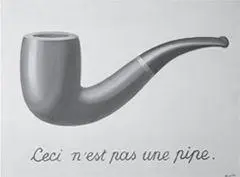
Most of us do not think very hard about the nature of mirrors. We see the reflection of a room, or of ourselves, in a glass and we think, “Oh, look, it’s the couch,” or “Oh, look, it’s me. I thought I was thinner/fatter/better-looking/uglier/a girl.”16 But it’s not your couch, and it’s not you. It’s a version of you, which is why the artist René Magritte could paint a picture of a pipe and write beneath it, in French, Ceci n’est pas une pipe, or “This is not a pipe.” Because it’s not a pipe: it’s an image of a pipe. As Magritte himself pointed out: “Could you stuff my pipe? No, it’s just a representation. So if I had written on my picture, ‘This is a pipe,’ I’d have been lying!”