Chapters (69)
- Title Page
- Copyright Page
- Dedication
- Chapter 1 - Napoleon
- Chapter 2
- Chapter 3 - Arthur
- Chapter 4
- Chapter 5 - Oropesa, 21 July 1809
- Chapter 6 - Talavera, 27 July 1809
- Chapter 7
- Chapter 8 - Napoleon
- Chapter 9
- Chapter 10
- Chapter 11 - Schönbrunn, 23 October 1809
- Chapter 12 - Fontainebleau, December 1810
- Chapter 13
- Chapter 14 - Arthur
- Chapter 15 - April 1810
- Chapter 16 - Busaco Ridge, 27 September 1810
- Chapter 17 - Lisbon, January 1811
- Chapter 18 - Napoleon
- Chapter 19
- Chapter 20 - Arthur
- Chapter 21 - Badajoz, 9 June 1811
- Chapter 22 - Paris, 2 December 1811
- Chapter 23 - Paris, January 1812
- Chapter 24
- Chapter 25 - Arthur
- Chapter 26
- Chapter 27 - Salamanca, 22 July 1812
- Chapter 28 - Napoleon
- Chapter 29 - Schivardino, 6 September 1812
- Chapter 30 - Moscow, 15 September 1812
- Chapter 31 - Arthur
- Chapter 32 - Burgos, 4 October 1812
- Chapter 33 - Tordesillas, 31 October 1812
- Chapter 34 - Napoleon
- Chapter 35 - 6 November 1812
- Chapter 36
- Chapter 37 - Molodetchna, 29 November 1812
- Chapter 38 - Arthur
- Chapter 39
- Chapter 40 - 21 June 1813
- Chapter 41 - Napoleon
- Chapter 42 - Dresden, 26 August 1813
- Chapter 43
- Chapter 44
- Chapter 45 - Arthur
- Chapter 46 - Villefranque, 10 December 1813
- Chapter 47
- Chapter 48 - Napoleon
- Chapter 49 - Arcis-sur-Aube, 20 March 1814
- Chapter 50 - Fontainebleau, 4 April 1814
- Chapter 51 - Arthur
- Chapter 52 - London, 24 June 1814
- Chapter 53 - Paris, November 1814
- Chapter 54 - Napoleon
- Chapter 55 - The Tuileries, Paris, 8 April 1815
- Chapter 56 - Arthur
- Chapter 57 - Fleurus, 8.00 a.m., 16 June 1815
- Chapter 58 - Ligny, 7.00 a.m., 17 June 1815
- Chapter 59 - Le Caillou, 9.00 p.m., 17 June 1815
- Chapter 60
- Chapter 61 - The Ridge of Mont-St-Jean, 1.30 p.m.
- Chapter 62
- Chapter 63 - La Belle Alliance, 6.30 p.m.
- Chapter 64 - On the road to Charleroi, 4 a.m., 19 June 1815
- Chapter 65 - Plymouth, 30 July 1815
- Author’s Note
As the fire spread the screams increased and cut through the night so that, even as exhausted as they were, few of the men on the ridge could sleep. Satisfied that there were no signs of a new attack being prepared by the enemy, Arthur made a quick tour of his command and offered words of encouragement to the gaunt figures he came across. Most of the men seemed too numb to continue the battle and when he returned to the ridge Arthur lay down on the ground and tried to rest. But his mind would not be still. When the morning came he had little doubt that his army would face another onslaught such as the one they had endured that day.
He rose just before dawn and stood, straining his eyes and ears for any indication that the French were preparing for another attack. As the eastern horizon grew more distinct the first bugles sounded from the French camp, and then the faint cries of command and the crack of whips as the artillery crews moved their guns.
The light continued to strengthen as Arthur tried to concentrate his thoughts on what needed to be done to prepare for the first attack. Then, as he stared towards the French positions, he frowned. The artillery batteries had gone. There were no lines of infantry and cavalry massing for attack. Only a handful of enemy horsemen remained on the far side of the Portina, keeping watch on the British line.
‘What the devil?’ For a moment Arthur was struck by a terrible anxiety as he wondered if the French were attempting to move through the hills to the north to try to cut him off from his lines of communication back to Portugal. Then, as the first rays of the sun filtered out across the landscape, he saw the French army. Dense columns of men, horses, cannon and wagons, marching to the east, back in the direction of Madrid. It was a while before his mind, dulled with exhaustion, finally grasped the truth.
‘They’re retreating . . . By God, they’re retreating,’ he muttered to himself. The British had won the battle after all. There was no elation in his heart. None. Only relief, and that soon faded as the morning light revealed the terrible cost of victory spread across the still smouldering lower slopes of the ridge and out on to the plain towards Talavera.
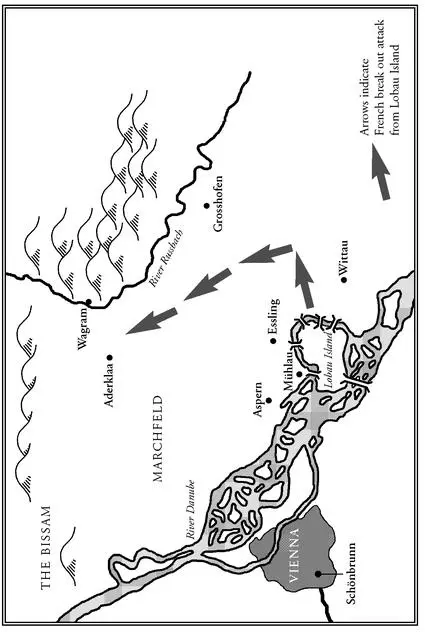
THE BATTLE OF WAGRAM
Chapter 8 - Napoleon
Chapter 8
Napoleon
Lobau island, July 1809
‘This will do,’ Napoleon nodded. ‘Mark it down, Masséna.’
‘Yes, sire.’ Masséna took his pencil from behind his ear and carefully noted the location on the folded map he was holding, then quickly tucked it away again before they attracted the attention of the Austrian sentries on the opposite bank, scarcely a hundred paces away. Napoleon and Masséna had borrowed the jackets and caps of two sergeants and set out without an escort in order not to provoke scrutiny of their reconnaissance work.