Chapters (42)
The names of colours are translated so that the progression from ‘red’ to ‘violet’ implies shorter wavelengths. In the Orthogonal universe this progression is accompanied by a decrease in the light’s frequency in time. In our own universe the opposite holds: shorter wavelengths correspond to higher frequencies.
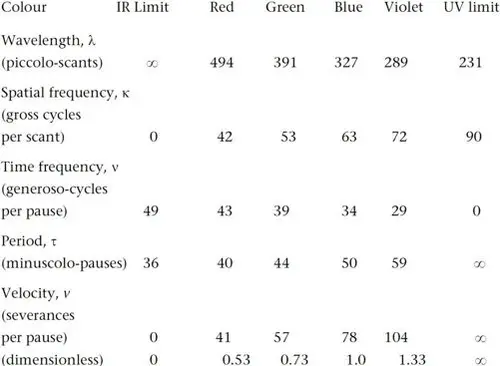
The smallest possible wavelength of light, λmin, is about 231 piccolo-scants; this is for light with an infinite velocity, at the ‘ultraviolet limit’. The highest possible time frequency of light, νmax, is about 49 generoso-cycles per pause; this is for stationary light, at the ‘infrared limit’.
Afterword
Gravitation and cosmology in the Orthogonal universe are governed by essentially the same equation that governs the geometry of our own universe: the relationship between the curvature of space-time and the density and flow of matter and energy that was proposed by Einstein in 1916. The solutions of Einstein’s equation that describe our universe have three dimensions of space and one of time, but the equation itself can easily accommodate four space-like dimensions.
As in our own universe, Newtonian gravity with its inverse-square law of attraction serves as a good approximation to the effects of mass on curvature. The only departures on the scale of planetary systems are in the very same subtle effects that were ultimately understood through general relativity in our own history – but here they are reversed. The precession of close orbits goes backwards in the Orthogonal universe, compared with the precession of Mercury’s orbit that Einstein’s theory explained. And where Einstein predicted twice as much deflection of starlight by the sun than would be expected under Newtonian gravity, the degree to which light is bent is less in Lila’s relativistic theory than in the classical version attributed here to Vittorio.
In cosmology, the solutions with and without a time dimension have much more radical differences. For example, there is no equivalent in our own universe of the kind of high-entropy state where the world lines of star clusters are equally likely to be pointing along any direction in all four dimensions, and the arguments in the novel over the inevitability or otherwise of the entropy gradient are very different from arguments over possible explanations for the low entropy of our own universe at the Big Bang.
But it’s the necessity for the Orthogonal universe to be finite in all directions that has the most striking consequences, requiring the entire history of the universe to return eventually to its initial state – wherever one starts from, and whichever direction in four-space is treated as ‘time’.
Also by Greg Egan from Gollancz
Also by Greg Egan from Gollancz:
AXIOMATIC
DISTRESS
LUMINOUS
PERMUTATION CITY
QUARANTINE
TERANESIA
DIASPORA
SCHILD’S LADDER
INCANDESCENCE
OCEANIC
ZENDEGI
THE CLOCKWORK ROCKET
THE ETERNAL FLAME
Copyright
Copyright
A Gollancz eBook
The right of Greg Egan to be identified as the author of this work has been asserted by him in accordance with the Copyright, Designs and Patents Act 1988.