Chapters (42)
‘I just had a visit from Lila and her student Pelagia,’ Agata replied. ‘The innovation block is well and truly over!’
‘Yeah?’ Tarquinia had probably been expecting to spend the whole visit trying to put the record straight about the inscription, but Agata’s mind was on something else entirely.
‘Pelagia’s settled the topology question,’ Agata proclaimed. ‘The cosmos is a four-dimensional sphere. It’s not a torus – it can’t be!’
‘This is from your work?’ Ramiro asked. ‘Pelagia found a way to complete the calculations?’
‘Not so much complete them as see into my blind spot,’ Agata explained. ‘Listen, it’s simple. A luxagen is described by a wave that changes sign when you rotate it by a full turn. That has no effect on any probability you calculate – so long as you apply the same rotation to everything in sight – because the probability comes from squaring the value of the wave. Minus one squared is one, so the change of sign makes no difference. It only shows up in more complicated experiments where you rotate some things and leave others unaltered.’
Tarquinia said, ‘I follow that much.’
‘Pelagia’s idea just replaces rotations with trips around the cosmos. Suppose the cosmos were a four-dimensional torus, and you carried a luxagen all the way around it in a giant loop. What happens to the sign of its wave? Does it come back unchanged, or does it come back reversed?’
Ramiro frowned. ‘I can tell that you want us to say “reversed” by analogy, but I thought there had to be perfect agreement around a loop.’
Agata buzzed. ‘I didn’t want you to give either answer. There could be perfect agreement, or the sign could be reversed: nothing rules out either possibility. If the sign’s reversed, that will be undetectable: everything you can measure locally will still be in perfect agreement.’
Tarquinia said, ‘Hang on, if the sign changes . . . where exactly does it change? What’s this special place on the torus where it flips over?’
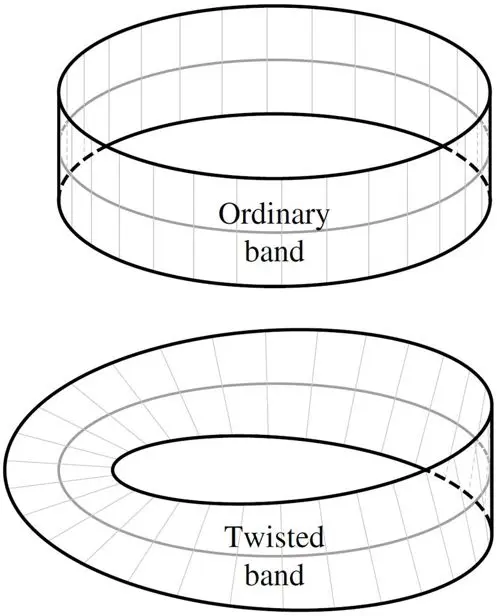
‘There is no special place,’ Agata insisted. ‘It’s like cutting open a band and rejoining the ends with a twist: once you’ve glued them together, there’s really nothing special going on at the join. The twist isn’t located there – or anywhere. It’s a property of the whole band.’
Agata began to form a sketch, but Ramiro saw that she was having trouble so he drew what she’d described on his own chest.
‘So you’re talking about the cosmos being some kind of . . . twisted torus?’ Tarquinia asked.
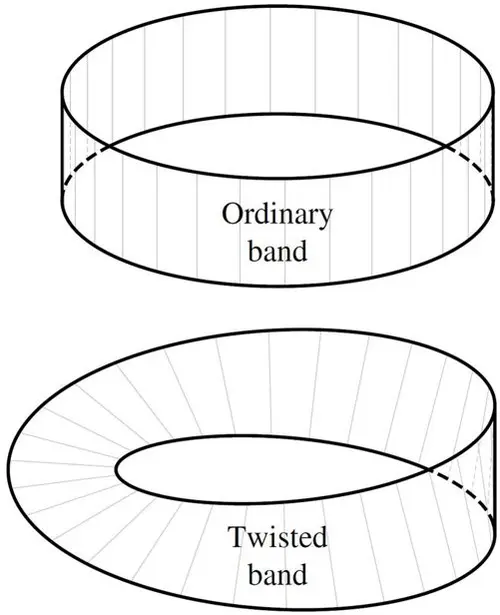
‘No, not the cosmos,’ Agata replied. ‘The two bands, twisted or not, both have identical circles as their midlines—’
Ramiro added the midlines to his diagram.