Chapters (42)
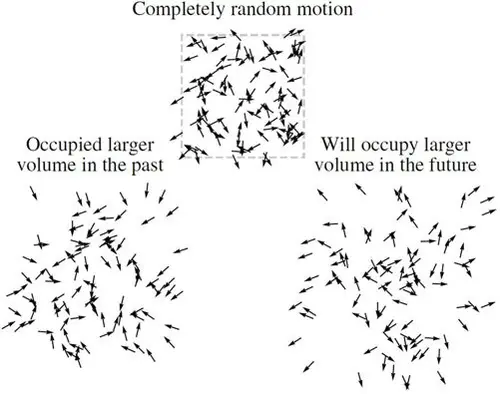
Agata thought for a while. ‘If you took a cubic stride of air at a certain temperature and pressure,’ she said, ‘and chose the direction of all its particles at random, then in the vast majority of cases the entropy of that system would increase if you followed it either forwards or backwards in time.’
She sketched an example.
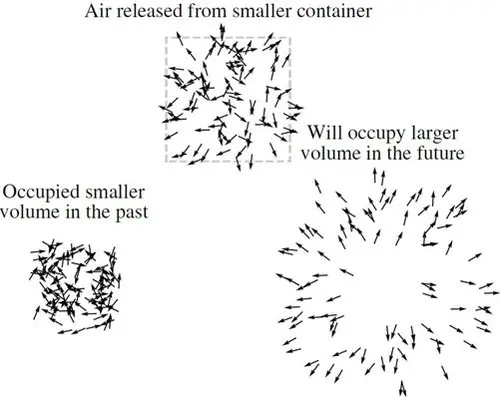
‘But the air we actually deal with every day might well have been released into that large container from a smaller one, which immediately tells us that it’s in an improbable state: one that would shrink of its own accord into a smaller volume if you followed it backwards in time.
‘Most cubic strides of gas – in a time-blind, mathematical sense of “most” – do not have that property! But the entropy minimum in our past makes it entirely reasonable that we encounter air in that state. The cosmos isn’t full of particles moving purely at random, or there wouldn’t be an entropy minimum at all.
‘But the entropy minimum is in our future as well as our past – and Esilio connects us to it in a way we’re not accustomed to. So we’re now in a situation where we might encounter a cubic stride of air that not only occupied a smaller volume in the past, but will occupy a smaller volume in the future.’
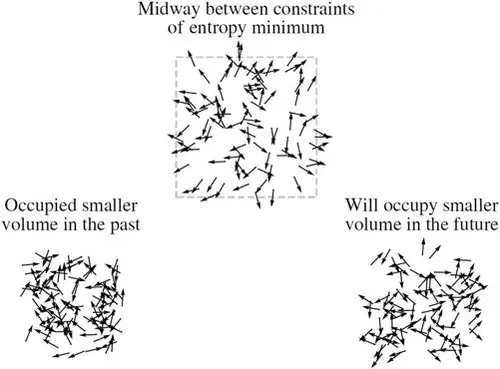
‘As a fraction of all the ways the particles could be moving, that’s even more improbable than before – but given where we are and the facts of cosmology, it’s not unreasonable.’
Ramiro accepted Agata’s logic, but it was difficult to see what it offered them in practice. ‘Tell us one thing that you’re sure won’t happen,’ he challenged her.
She said, ‘Two objects in thermal contact will not maintain different temperatures over a long period of time.’
‘Because . . . ?’
‘Because there are vastly more possibilities in which they share their thermal energy more equally. If you pick a possibility at random, it’s likely to be one of those. Fundamental physics might make the entropy minimum necessary – but we still expect the cosmos to be as random as it can be.’
Ramiro said, ‘Why am I not comforted by that?’
Agata buzzed. ‘I don’t mean rocks flying into the air and hitting you in the face for no reason. When individual particles are moving randomly, that makes large assemblies of them more predictable, not less. Most of the time, air will just be air, stone will just be stone, acting the way our instincts expect.’
‘And the rest of the time?’
Agata said, ‘We’ll just have to be prepared for the exceptions.’