Chapters (42)
‘Go ahead.’ Azelio was probably unswayable, but he was still interested in understanding her position.
‘If motion under gravity is due to curvature, rather than a force, it will obey an incredibly simple rule: the history of any object in free fall is just the shortest available path through four-space. In flat space, that’s a straight line. In the curved space around a star, it’s not.’
‘That’s simple in itself,’ Azelio allowed. ‘At the cost of making the geometry more complicated.’
‘But it’s more than just simple!’ Agata insisted. ‘It also fits perfectly with everything else we know about motion.’
‘In what way?’
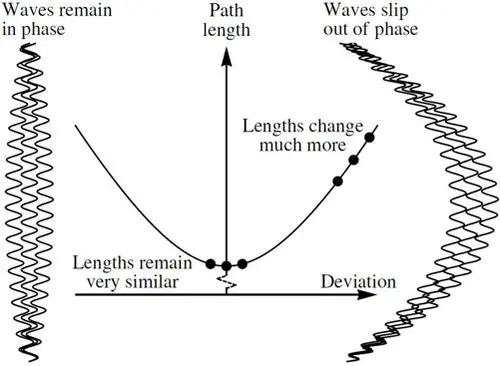
‘When light moves from place to place,’ she said, ‘you need to add up contributions from different paths between its starting point and its destination. Paths where it spends about the same time travelling all add together, because the waves will have stayed more or less in step, with their peaks arriving simultaneously. Paths where the travel time varies rapidly mix up peaks and troughs, so they cancel each other out.
‘Imagine a kind of mathematical valley that stretches across the landscape of all paths, where the length of each path determines the height of the landscape. The shortest path becomes the lowest point: the bottom of the valley. If you change the path there slightly, you barely change its length, because the bottom of a valley is horizontal. But if you’re far up on the side of the valley instead, the path isn’t just longer, it’s at a point where the valley slopes much more, so any change would change the length more – making the waves slip out of phase.’
Agata sketched an example on her chest, and had the corset display it on her console.
Azelio frowned, but then he remembered something. ‘We used that principle in our optics class: you can find the law of reflection by looking for the angle that light makes with a mirror that lets it arrive all in phase.’
‘Right! So now apply the same logic to starlight moving past Esilio’s sun. Suppose the light does bend. If four-space is flat, then the light won’t be following the shortest path, since in flat space that’s always a straight line. It will be on a path up on the valley’s slopes, where any tiny variation changes the length and throws the light out of phase. There are ways around that: we can postulate some mechanism that messes with the phase in exactly the right manner to favour the bent path – but that’s complicated, because as well as explaining what happens with the light, it needs to explain the force on an orbiting planet.