Chapters (42)
She had baulked at this, at first: a lone photon couldn’t turn into a pair of luxagens – each with just a third of the photon’s mass – because whatever the velocities of those luxagens, it would be impossible to satisfy the laws of conservation of energy and momentum. But she’d finally understood that each of the diagrams on its own was just a kind of fiction, expressing a narrow sliver of the true history, and any characters that came and went without being present at the start and end of each story were mere flights of fancy, subject to very different rules compared with those that endured. Every part was needed to make up the whole, but only the totality was real.
With any process the variations were endless, but the more complex the diagram the smaller its contribution, allowing the sum to remain finite. And in this scheme, the vacuum itself was simply the sum of all diagrams that started and ended with no particles at all, its energy due entirely to disturbances that came and went of their own accord, with no connection to anything persistent.
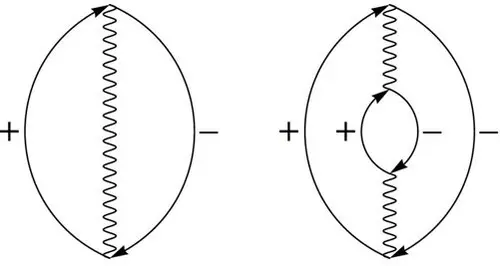
Agata had been gratified to discover that, in flat space at least, these diagrams rendered the vacuum manageable. But if the vacuum energy curved space, then flat space was actually impossible – and if curvature modified the vacuum energy, the two could only be in harmony at some elusive fixed point that remained beyond the reach of her methods.
Having come so far, she ached to complete the story. She wanted to return to the Peerless with everything solved: the vacuum energy tied to the curvature of space and the topology of the cosmos – determining once and for all whether the entropy gradient that had enabled life was a stupendously improbable fluke, or simply an unavoidable consequence of a few simple principles.
When she lifted her gaze up from her desk, the prospect of the Surveyor’s planetfall was glorious and thrilling, the purpose of their journey finally to be fulfilled. But when she looked down at her unfinished calculations, she thought: glorious – but please, not yet.
Gathered with the rest of the crew around Tarquinia’s console, Agata compared the two images on the screen. One was a grey disc faintly mottled with reds and browns, weakly but uniformly lit, grainy and poorly resolved as the photodetectors struggled at the limits of their sensitivity. The other was a disc of the same size, and two-thirds of it lay in the deepest black night, but the crescent of dayside revealed an impossibly vivid landscape of jagged grey mountains, dusty red plains and twisted brown valleys, sharp enough to touch.