Speak to the Winds
Chapters (1)
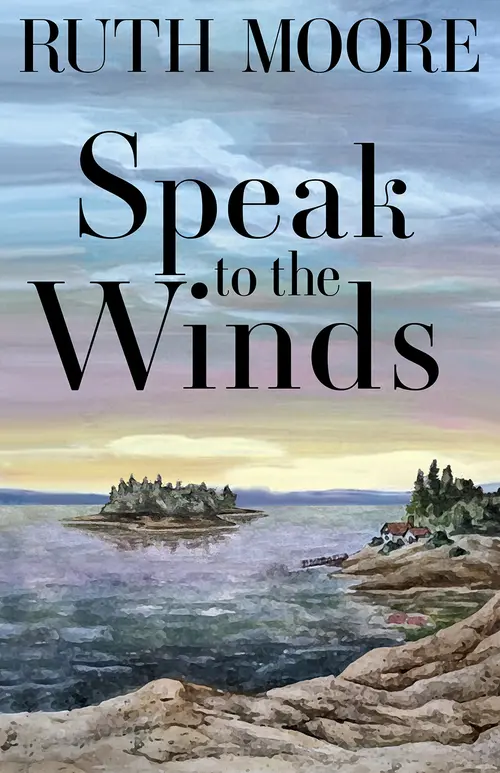
Speak to the Winds Interior
Speak to the
Winds
A Novel
Novels by Ruth Moore
The Weir (1943)
Spoonhandle (1946)
The Fire Balloon (1948)
Candlemas Bay (1950)
A Fair Wind Home (1953)
Speak to the Winds (1956)
The Walk Down Main Street (1960)
Second Growth (1962)
The Sea Flower (1965)
The Gold and Silver Hooks (1969)
“Lizzie” and Caroline (1972)
The Dinosaur Bite (1976)
Sarah Walked Over the Mountain (1979)
Collections of Poetry
Cold as a Dog and the Wind Northeast (1958)
Time’s Web (1972)
The Tired Apple Tree (1990)
Jim Nichols
Speak to the
Winds
Ruth moore
A Novel


Islandport Press
P.O. Box 10
Yarmouth, Maine 04096
Originally Published in 1956 by William Morrow & Co.
First Islandport Edition, June 2022
Copyright © 2022 The Estate of Ruth Moore
Print ISBN: 978-1-952143-37-3
ebook ISBN: 978-1-952143-43-4
LCCN: 2021946859
The background of this novel is authentic, but I have not described in it any living person, nor would I wish to do so. It would be difficult to write a story about a place so well-known and beloved as the Maine coast without apparent character resemblances; but if anyone feels he recognizes himself or his neighbor in this book, he is mistaken, and such description is only a coincidence.
Dean L. Lunt, Editor-in-Chief | Publisher
Piper Wilber, Assistant Editor
Trevor Roberson, Graphic Designer
Table of Contents
Part One: MacKechnie’s Kingdom 1
Part Two: Christmas 25
Part Three: Easter 169
Part Four: Spring 227
Part Five: Summer 257
Part Six: Autumn 276
Part Seven: Winter 292
About the Author 307
Part One
MacKechnie’s Kingdom
1855-1910
The island was off the beaten track as islands go; it was four miles from the mainland, across a stretch of dangerous water. Other islands lay around it to the north and west, but to the south and east it had nothing but open ocean, the North Atlantic stretching to the sky. The islands were of all kinds, some rocky, some low-lying and green, with harbors for boats and beaches where children could play. Wherever there was a harbor not too much of a tide hole, people lived. This one, Chin Island, as it was called, had no harbor, so that for years it went uninhabited, a jutting chin of granite thrust out into the ocean, a wild three miles of rock, spruce forest, and alders laced with blackberry vines.
In the very old time, an ancient race of Indians, the Paint People, went there for red ocher, which they mined on the west end of the island; at least, the ocher was there in a series of scratched, shallow pits; who made them, or when, was anybody’s guess. Later, the Passamaquoddy hunters must have stopped long enough to lose an occasional arrowhead near the only place where it was possible to pull up a canoe—a small, exposed beach on the western shore, which had a fine spring of clear water running out of a split rock. They might have stayed as long as the migrating flocks of sea birds did, but no longer, for the place was unsheltered, unfriendly to humans.