Speak to the Winds
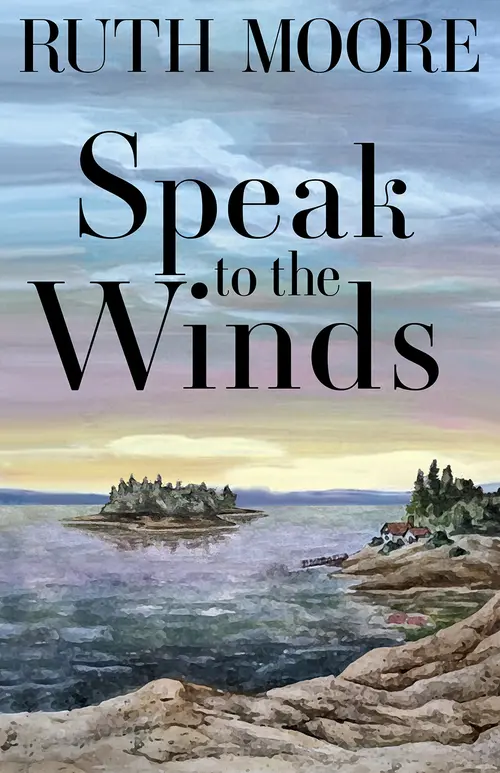
Speak to the Winds Interior
Speak to the
Winds
A Novel
Novels by Ruth Moore
The Weir (1943)
Spoonhandle (1946)
The Fire Balloon (1948)
Candlemas Bay (1950)
A Fair Wind Home (1953)
Speak to the Winds (1956)
The Walk Down Main Street (1960)
Second Growth (1962)
The Sea Flower (1965)
The Gold and Silver Hooks (1969)
“Lizzie” and Caroline (1972)
The Dinosaur Bite (1976)
Sarah Walked Over the Mountain (1979)
Collections of Poetry
Cold as a Dog and the Wind Northeast (1958)
Time’s Web (1972)
The Tired Apple Tree (1990)
Jim Nichols
Speak to the
Winds
Ruth moore
A Novel


Islandport Press
P.O. Box 10
Yarmouth, Maine 04096
Originally Published in 1956 by William Morrow & Co.
First Islandport Edition, June 2022
Copyright © 2022 The Estate of Ruth Moore
Print ISBN: 978-1-952143-37-3
ebook ISBN: 978-1-952143-43-4
LCCN: 2021946859
The background of this novel is authentic, but I have not described in it any living person, nor would I wish to do so. It would be difficult to write a story about a place so well-known and beloved as the Maine coast without apparent character resemblances; but if anyone feels he recognizes himself or his neighbor in this book, he is mistaken, and such description is only a coincidence.
Dean L. Lunt, Editor-in-Chief | Publisher
Piper Wilber, Assistant Editor
Trevor Roberson, Graphic Designer
Table of Contents
Part One: MacKechnie’s Kingdom 1
Part Two: Christmas 25
Part Three: Easter 169
Part Four: Spring 227
Part Five: Summer 257
Part Six: Autumn 276
Part Seven: Winter 292
About the Author 307
Part One
MacKechnie’s Kingdom
1855-1910
The island was off the beaten track as islands go; it was four miles from the mainland, across a stretch of dangerous water. Other islands lay around it to the north and west, but to the south and east it had nothing but open ocean, the North Atlantic stretching to the sky. The islands were of all kinds, some rocky, some low-lying and green, with harbors for boats and beaches where children could play. Wherever there was a harbor not too much of a tide hole, people lived. This one, Chin Island, as it was called, had no harbor, so that for years it went uninhabited, a jutting chin of granite thrust out into the ocean, a wild three miles of rock, spruce forest, and alders laced with blackberry vines.
In the very old time, an ancient race of Indians, the Paint People, went there for red ocher, which they mined on the west end of the island; at least, the ocher was there in a series of scratched, shallow pits; who made them, or when, was anybody’s guess. Later, the Passamaquoddy hunters must have stopped long enough to lose an occasional arrowhead near the only place where it was possible to pull up a canoe—a small, exposed beach on the western shore, which had a fine spring of clear water running out of a split rock. They might have stayed as long as the migrating flocks of sea birds did, but no longer, for the place was unsheltered, unfriendly to humans.
Its shores came down in blocks and tiers of tumbled granite, shelving off gradually underwater, so that around three sides of the island thrust out wicked snouts of rock, on which the sea loitered with intent, even in calm weather. From tidemark, ten acres of black ledges made off to the east and south, some underwater, some just awash, at different times of tide. Over them, the sea was always in motion. No matter how quiet the day, or how still the spruces baked in the summer sun, a slow, cool, sleepy sound hung over the island everywhere, a sound, it seemed, not so much of water as of air.
Perhaps on some such summer day, an early visitor to the coast, seeing the swirl of lazy green about the ledges, the rockweed lifting and falling like a field of grass, named the place The Pasture, though no one could say what pastured there, outside of crabs and cunners and south-flying sea birds. In winter, The Pasture was white water for weeks at a time. Big rollers lifted up green from across the gulf and smashed in on the headland, shattering the granite sometimes, shifting great boulders and changing the face of the shore. Sheets of spray roared up, twenty, forty, fifty feet high, drove in to freeze in white rime on the spruces, which on the eastern shore were stunted like trees at timber line.
The island was all granite, its peak a round hill a hundred feet high and naked as a cup. What grew there, grew where the land leveled out at the base of the hill, a wild tangle of northern coastal forest, on roots driven into the crevices of rock. Through centuries, it had made topsoil, deep enough on the island’s western end to grow a little grass, and on that side, too, a half-mile back from the shore, just before the hill started to climb, was a small, deep pond in an alder swamp of almost tropical lushness.
This pond was always full; it caught the wash of rain from the hill behind it, and, besides, it was spring-fed. From the high, dry, lichened ledges, no one would suspect that the island was a watery place, but deep within it flowed never-failing streams, surfacing here at the pond and trickling down, through crevices into the sea—in summer, a slow, steady drip dampening the rocks above tide line, in winter, great waterfalls of yellow ice.
The swamp flowered all summer, no matter how dry the season. Above it, the granite crisped its lichens in the sun, baked as fiercely dry as if the heat struck outward from furnace fires within. But the growth around the pond stayed brilliant, electric green. Alders grew thick as a man’s thigh, and some of the old swamp birches were three feet through at the base. Tall trees and the hill kept away the wind, so that air hung hot and still, full of jungle-rich smells of mud and moss and lush, sunny leaves. Squirrels lived in the swamp, and deer, and mink and beaver and muskrat. Hermit thrushes sang there all spring long. The trees were full of wing-flash and flutter and the four or five clear notes, repeated a thousand times, of white-throated sparrows. Ducks gathered in the pond; at fall dusk, it might be brimful of them, floating side by side. To these inhabitants, at any time of year, the swamp offered shelter, either of shade or snow.
The Indians made a few scratches on the land and went; early white settlers sailing along the coast eyed the rugged island warily. “No harbor,” they said, and passed on to other islands.
One of them must have gone ashore there for a while, and built himself some kind of house on the western side by the Passamaquoddy spring, for he left a stone foundation over a shallow cellar hole, and his initial, “A,” chiseled in a ledge by the shore. But no one knew what his name was, nor how long he might have stayed. When Robert MacKechnie and Ansel Gilman, early settlers, went to the island in 1855, they found the marked boulder; but “A’s” cellar stones were fallen in and green with moss, his initial almost obliterated by the gray rosettes of the lichen that grows on granite.
Robert MacKechnie and Ansel Gilman were quarrymen—stonecutters by trade, looking for stone. In the cities, public edifices were building—churches and courthouses, post offices, tombs. Already in the coast country, south and west, quarries were coining money, the two- and three-masted schooners sailing to New York and Boston and Philadelphia loaded deck-deep with the pink-gray granite that split so straight along the grain of the stone. MacKechnie was newly over from Scotland, where his people had owned and operated quarries for generations. Ansel Gilman, a Connecticut man, knew a good deal about stone, too, though perhaps not by instinct and by heritage, as MacKechnie did.
From the deck of a small sloop hired for the day, they saw the granite hill on Chin Island heaved up against the bay’s blue water, and MacKechnie looked and whistled. Ansel shook his head.
“I said to him,” Ansel wrote in his diary, “that’s the worst rock pile I ever saw and there’s no landing place within forty rows of apple trees. By landing place I meant a harbor where we could load stone aboard of a vessel. But Robert kept on looking at it. I will say it was a sightly island, but I did not like the look of it from the beginning.”
He also wrote, “It is a waste of time to argue with Robert, I have found out that. Because when you have got done, you find you have not changed his mind, so your time is wasted anyway.”
This was the journal which did not come to light until years after Ansel’s death, and then was rummaged out of a trunk in the attic of his empty house by his young grandson, Elbridge Gilman. There was little enough in it about the actual happenings of that day. Most of what took place, Elbridge got from his other grandfather, who was MacKechnie.
“Nevertheless I said to him,” MacKechnie said, “that I would like to land and look it over.”
They landed on Chin Island, on the beach by the stone marked “A,” and hauled up their punt; and MacKechnie went as straight as a hunting dog through the tangled thickets and the swamp to what he was looking for—the high-nosed hill, rounded, polished by weather—clean outcrop, straight-grained red granite.
“He kept up with me until we came to the swamp,” MacKechnie said, “and then he fell behind and didna catch up until I had been for some time on top of the hill. I thought it was the swamp that was bothering him—a stone man hates a swamp like a cup of cold poison, you have to have hard ground to move granite over; but it seems it was not that, or not that entirely.”
Before they left the island that day, Ansel and Robert had a fight. They stood toe to toe on the level bank near the stone marked “A” and decided whether or not to put their money into a granite quarry on the island. Robert wanted to; Ansel didn’t; and Robert won.
It was a long time afterwards and Ansel had been dead for years, before MacKechnie told his grandson, Elbridge Gilman, the grandson of them both, how the settlement on the island had begun with a fight.
“And a bloody one,” MacKechnie said. “My nose bled for a week. We told the girls we’d fallen down yon mountain.”
Elbridge grinned, remembering his grandmother, “Big” Sarah MacKechnie, long dead, but a power in her time. “The girls,” Sarah MacKechnie and Jennie Gilman, doubtless guessed what had taken place. In a country where the custom was to tell women only what was supposed to be good for them to know, most women learned early to put two and two together. He recalled hearing Big Sarah say, once, with a snort, “The lies, for heb’m sakes, that men tell women! If ’twas only about each other, I could put up with it, makes things more fun not to have the like of that nailed down, cut and dry. But he wants to burn coal in the stove, too lazy to cut wood—so he tells me now, after fifty years, that wood will ruin the chimney!”
And indeed, it did seem to Elbridge, thinking over the lore of the country, that some of it might be based on, not lies exactly, but on men’s convenience. Weeds are good for the garden, they shade the plants. Potatoes grow better on new ground if you don’t shake out the turf. Cistern water is better to drink than well water; such things. Oh, yes, the girls would have guessed about the fight. Anse and Robert would not have wanted them to know that a decision which meant so much hardship and change in their lives had depended on whose husband had the toughest fists. And Anse would not have wanted anyone to know that he had been thrashed by a man half his size.
Elbridge hid his grin. No sense to stir the old man up—he looked pretty frail today; and MacKechnie went on.
“Anse hated the place from the beginning,” MacKechnie said. “I never could see or find out why. He said, that day, it was Old Ellick, whatever that was. It sounded foolish to me and, at first, it was what made me mad, he a grown man letting himself be shaken in such an enterprise by the bogeyman, if that was what it was; I never knew. But later on that day, I was mad because I wanted the place, and to talk to him was like talking to last year’s deer hide nailed on the barn. I wanted it for the stone, though not entirely for the stone. Though it was lovely stone.
“If you could have seen yon hill that morning the way I saw it—the clean granite, none finer in Scotland or in any place in the world I ever saw, the hill itself, and the island lying there as if untouched since the start of time—I remember there away east and south was a mess of rocks and timber—plenty of poles stout enough for derricks, I noticed at once—then a black headland and a wrack of ledges breaking white, and all the sea and sky in the world. And I said, ‘What a place, Ansel! Look at yon stone!’ And he said, ‘Considerable surf, ain’t there?’ and went stomping back down the hill.
“I did not go back to the boat for three hours, but spent time going over the island to see what might be done. I found it would be a terrific job of work but could be done,” said MacKechnie.
His Scottish burr was a memory, overlaid now with a Yankee twang through years of association, and his voice had always been curiously gentle for so tempestuous, though so small sized, a man. “So I went back to the shore and there was Ansel with a face like a meat ax, because he guessed when I didna come that I was up on the hill, looking, with serious purpose in my mind. Besides, I looked as if I had swum the frog pond. My clothes were ripped from the blackberry bushes, and I had a great splat of mud across my face.
“ ‘If a hundred-and-thirty-pound man has that much trouble clawing himself down from that hill,’ he says to me, ‘what about loads of granite blocks weighing upwards of five tons?’
“If I hadna been already put out with him, I would have been then, as he well knew. I have never wished to be twitted about my size. So I went to the spring and washed my face without making him an answer.
“ ‘Do you expect to drop and bounce them, maybe?’ he says. ‘Or dig a canal in across that swamp and sail your vessels up to the foot of the hill?’
“I said, ‘We can throw a causeway across the swamp, there’s a place where ’tis no a hundred feet wide, and then all downhill and hard ground to the shore,’ and he snorted like a bull.
“ ‘And what do you plan to build a causeway out of?’ he said, and that was unreasonable, because he knew as well as I did, having seen it, that there was a part of the hill which could be blasted away, an overhang which would fall. I didna trouble to explain it to him, a child could have seen it. So I said in short words, as though to a child, ‘Yon hill is not so steep but you could ease loaded flatcars down with winches and cables. They would roll of their own weight to the shore. You’d not need any power, even, only iron rails for the cars to roll on, and cables to ease them down.’
“ ‘Why bother to ease them down,’ Anse says. ‘Take out the chocks and let them roll. They might travel fast enough to jump the gap between the shore and a vessel’s hold out in the bay. Because that’s the only living God’s way you’d ever get a vessel loaded here. Or set your granite afloat and a man with a crowbar on each block to paddle it down to Boston. There’s no harbor here. How would you load a vessel? Or have you got that figured out, too?’
“‘I have,’ I said. ‘In Scotland, on a difficult shore, we build a breakwater.’
“‘Build a causeway, build a breakwater!’ he says. ‘There are dozens of places on the mainland where we wouldn’t need to do either. Are you crazy, man?’
“So then I tried to tell him a little of what I had in mind. I did not come from Scotland, I said, to work for other men, in places they have already interfered with and chumbled over. I could have done that at home. But nobody had touched this island, and I had it in mind that we could build something lasting here on good foundations.
“He said, ‘To hell with it, Robert! I have it in mind to start a stone quarry, not a kingdom. You’ve got bees in your bonnet. Go ahead, if you want to, but count me out,’ and he started down the shore for the punt.
“It was then that I began taking off my jacket.
“I said, ‘I won’t quit the partnership, Anse, over this bee I’ve got in my bonnet, but I’ll fight you for it; win, we stay, lose, we go elsewhere,’ and I let him have a backhander, and we went to it, there on the shore.
“I didna know what possessed me to think I could lick him. He was a bookish man, not a fighter, perhaps that made the difference. Though do not get it into your head,” MacKechnie said, peering at his grandson from under his shaggy eyebrows, “that the two cannot go together. We fought for upwards of half an hour, until he hit me on the nose and the pain was tairrific, and I butted him in the belly and knocked him head over giblets into ‘A’s’ old cellar hole, where he stayed for some time.”
“That was dirty fighting, Gramp,” Elbridge said. “To butt a man in the belly.”
“It was. But he was a head and a half taller and outweighed me by forty pounds. And a fight, then, was a fight, not a punching match. I would have done worse, just so I beat him that day, or any other man who came between me and what I had made up my mind to do. Bees in my bonnet, he told me, when his own was buzzing, and did so, all his life, with notions such as he could mine profit out of a trace of gold vein in the quartz, when a child would have known that the money was in cut stone. He might have buzzed his way through the earth to China or come back with the wealth of the Indies, pairhaps, but with no more gold from that vein than he found, which was enough, precisely, to make a wedding ring—”
“Now, hold on, Gramp, you’re mixed up,” Elbridge said. “It was Father had the gold mine. Malcolm. Remember?” and the old man stared at him testily, shifting his weight a little in the bed where he now spent his days.
“—for my daughter,” he went on stubbornly, aware that he had made a mistake, not willing to admit it, passing it over quickly, as trivia from the packed trunk of his memory.
“That day, for once, I knocked the stubbornness out of him, the foolishness, the Old Ellick, whatever that was. At least, I thought I had.”
Elbridge knew what “Old Ellick” was.
The Story Continues on BooksBarbecue!
Enjoyed this preview? ❤️ Do not stop here!
Read the complete book free online → 🔗
Continue reading now on BooksBarbecue and discover every page!
Love reading? Bookmark BooksBarbecue.com for more amazing books!
Happy Reading!