Chapters (34)
- Cover
- Sanjoy Hazarika
- RITES OF PASSAGE
- Dedication
- Foreword
- Chapter One
- Chapter Two
- Chapter Three
- Chapter Four
- Chapter Five
- Chapter Six
- Chapter Seven
- Chapter Eight
- Chapter Nine
- Chapter Ten
- Chapter Eleven
- Chapter Twelve
- Chapter Thirteen
- Chapter Fourteen
- Appendices
- Footnotes
- Chapter Three
- Chapter Four
- Chapter Six
- Chapter Seven
- Chapter Eight
- Chapter Nine
- Chapter Eleven
- Chapter Twelve
- Chapter Thirteen
- Chapter Fourteen
- Appendices
- Bibliography
- Acknowledgements
Another factor that border officials must wrestle with is, literally, the shifting sands of the river. This poses an impossible task for cartographers and for the police. Where is the line to be drawn? What happens if India or Bangladesh ‘seize’ or sit upon a new bit of land that has been washed down by the Brahmaputra and has suddenly been spat out by the current in mid-stream?
A heavy downpour can cause the resetting of the border: a land mass which defined one part of the border may disappear if the river shifts course. The border could advance or be set back (depending on how you look at it) several hundred metres, causing enormous problems for border staff and the char dwellers.
The latter are pragmatic, tough and resourceful people anyway. But of which country are they nationals, especially if the border shifts from time to time for reasons beyond their control? Those who call themselves Indians move to India. Indeed, most of them do just that. They use the Bangladeshi taka and the Indian rupee to conduct their business of fish, vegetables and milk. In this no-man’s land, money, like sex, knows no nationality.
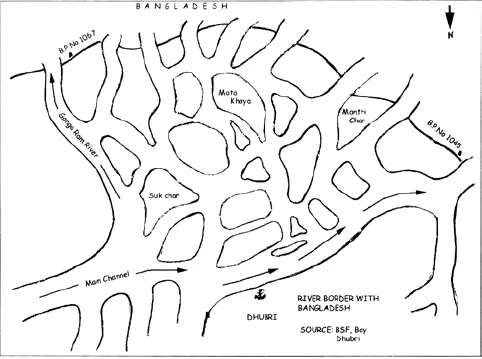
Courtesy: Anindita Dasgupta
Those from Bangladesh will not acknowledge to any Indian that they are from the other side. So how do you get anything approaching the truth out of them? By extracting a confession by force from a handful of inhabitants, making a public example of them and putting the fear of god into everyone else? Obviously not. This would create more resentment than already exists and is a recipe tailor-made for disaster.
I tried an experiment in one of the large chars near Dhubri. Some of us were there to shoot for a documentary film on the Brahmaputra which I am producing and the acclaimed Assamese director, Jahnu Barua, is directing. Even while filming, I continued researching, listening, questioning, recording events, conversations and memories. And that is how, in Bangladesh, I stumbled on to one of the most extraordinary stories of my life. But that must wait till the next chapter!
While Jahnu was organizing his shoot elsewhere, I happened to be standing next to the sound recordist and a few local charwallahs, in the usual green lungis and vests, were hanging about. While chatting with them and asking where they were from (all of them gave the uniform reply that they were born and brought up on the char), one of them turned to me and exclaimed in broken Assamese: ‘Saar, ekhetok kaouk gabolain, bhal gaan gay, picturot logabo paribo.’ Basically this meant that the chap being presented to me was a good singer and we might find his sur useful for the film.