Chapters (44)
- Cover
- Dedication
- Chapter 1
- Chapter 2
- Chapter 3
- Chapter 4
- Chapter 5
- Chapter 6
- Chapter 7
- Chapter 8
- Chapter 9
- Chapter 10
- Chapter 11
- Chapter 12
- Chapter 13
- Chapter 14
- Chapter 15
- Chapter 16
- Chapter 17
- Chapter 18
- Chapter 19
- Chapter 20
- Chapter 21
- Chapter 22
- Chapter 23
- Chapter 24
- Chapter 25
- Chapter 26
- Chapter 27
- Chapter 28
- Chapter 29
- Chapter 30
- Chapter 31
- Chapter 32
- Epilogue
- Acknowledgments
- P.S. Insights, Interviews & More . . .*
- About the Author
- About the Book
- Defeating the Silence
- Glossary of Terms Used in This Book
- Read On
- Also by Jennifer Robson
- About the Publisher
Anyone seeking to retrace Nina’s journeys should begin with the memorials to the millions who were abused and killed by the twin scourges of Nazism and fascism. In Venice you will find a memorial to the city’s murdered Jews in the main piazza of the Gheto Nuovo, as well as stolpersteine (stumbling stones) near the last known residences of many Venetians who were deported and murdered. In Poland the museum and memorial at Auschwitz-Birkenau, though often crowded, is nonetheless a deeply moving memorial. There is no memorial in Wilischthal, the forced labor camp near Zchopau, unnamed in Our Darkest Night, where Nina and Stella spent the last months of the war; its few buildings are now little more than ruins. In Bolzano, memorial friezes mark the perimeter of the now-vanished detention camp. And in Bassano, on what is now known as the viale dei Martiri—the avenue of the martyrs—memorial plaques are affixed to each of the manicured trees where thirty-one young men were hanged by the Nazis on September 26, 1944.
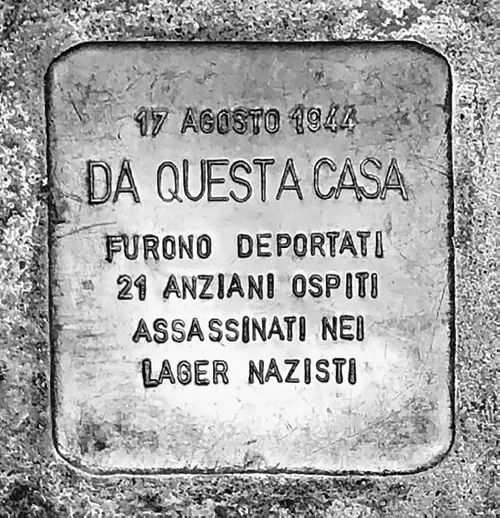
This Stolpersteine, or stumbling stone, is located near the Casa di Riposo in Venice’s Gheto Nuovo. It reads: “On 17 August 1944, from this house, 21 elderly residents were deported and murdered in the Nazi death camps.”
I have yet to visit the World Holocaust Remembrance Center at Yad Vashem in Israel, though I hope to go there one day. Among the more than twenty-seven thousand individuals named Righteous Among the Nations is the man who was the inspiration for Father Bernardi. Some might say that Giulio Bernardi, so clear-eyed in his goodness, is an improbable figure in the midst of so much intolerance and hate. I might be inclined to agree, if not for the little-known heroism of Father Oddo Stocco, a humble village priest who recognized evil, stared it in the face, and steadfastly refused to look away. 
Defeating the Silence
In late 2018, shortly before the publication of The Gown, my son came to me with a question. He’d been studying the Second World War, and with it the Holocaust, in history class at school. As school-related questions go, it was a big one: “Is it true that Daddy’s grandparents hid Jewish families during the war?” he asked.
I had to tell him that I wasn’t sure. I wanted it to be true, but I couldn’t be certain.