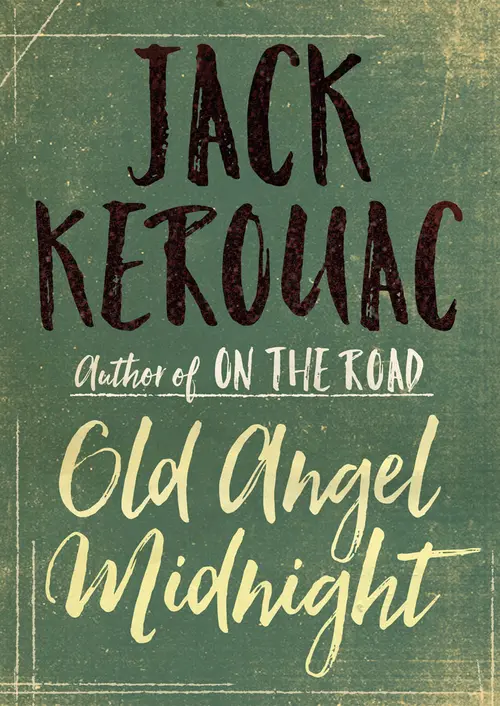
Old Angel Midnight
Chapters (7)
Cover Page

EARLY BIRD BOOKS
FRESH EBOOK DEALS, DELIVERED DAILY
LOVE TO READ?
LOVE GREAT SALES?
GET FANTASTIC DEALS ON BESTSELLING EBOOKS
DELIVERED TO YOUR INBOX EVERY DAY!

Title Page
Old Angel Midnight
Jack Kerouac
Edited by Donald Allen

Dedication
Dedicated to
Lucien Carr
the initial inspiration for
Old Angel Midnight
Publisher’s Note on Poetry
Publisher’s Note
Long before they were ever written down, poems were organized in lines. Since the invention of the printing press, readers have become increasingly conscious of looking at poems, rather than hearing them, but the function of the poetic line remains primarily sonic. Whether a poem is written in meter or in free verse, the lines introduce some kind of pattern into the ongoing syntax of the poem’s sentences; the lines make us experience those sentences differently. Reading a prose poem, we feel the strategic absence of line.
But precisely because we’ve become so used to looking at poems, the function of line can be hard to describe. As James Longenbach writes in The Art of the Poetic Line, “Line has no identity except in relation to other elements in the poem, especially the syntax of the poem’s sentences. It is not an abstract concept, and its qualities cannot be described generally or schematically. It cannot be associated reliably with the way we speak or breathe. Nor can its function be understood merely from its visual appearance on the page.” Printed books altered our relationship to poetry by allowing us to see the lines more readily. What new challenges do electronic reading devices pose?
In a printed book, the width of the page and the size of the type are fixed. Usually, because the page is wide enough and the type small enough, a line of poetry fits comfortably on the page: What you see is what you’re supposed to hear as a unit of sound. Sometimes, however, a long line may exceed the width of the page; the line continues, indented just below the beginning of the line. Readers of printed books have become accustomed to this convention, even if it may on some occasions seem ambiguous—particularly when some of the lines of a poem are already indented from the left-hand margin of the page.
But unlike a printed book, which is stable, an ebook is a shape-shifter. Electronic type may be reflowed across a galaxy of applications and interfaces, across a variety of screens, from phone to tablet to computer. And because the reader of an ebook is empowered to change the size of the type, a poem’s original lineation may seem to be altered in many different ways. As the size of the type increases, the likelihood of any given line running over increases.