Old Angel Midnight
Cover Page

EARLY BIRD BOOKS
FRESH EBOOK DEALS, DELIVERED DAILY
LOVE TO READ?
LOVE GREAT SALES?
GET FANTASTIC DEALS ON BESTSELLING EBOOKS
DELIVERED TO YOUR INBOX EVERY DAY!


Title Page
Old Angel Midnight
Jack Kerouac
Edited by Donald Allen

Dedication
Dedicated to
Lucien Carr
the initial inspiration for
Old Angel Midnight
Publisher’s Note on Poetry
Publisher’s Note
Long before they were ever written down, poems were organized in lines. Since the invention of the printing press, readers have become increasingly conscious of looking at poems, rather than hearing them, but the function of the poetic line remains primarily sonic. Whether a poem is written in meter or in free verse, the lines introduce some kind of pattern into the ongoing syntax of the poem’s sentences; the lines make us experience those sentences differently. Reading a prose poem, we feel the strategic absence of line.
But precisely because we’ve become so used to looking at poems, the function of line can be hard to describe. As James Longenbach writes in The Art of the Poetic Line, “Line has no identity except in relation to other elements in the poem, especially the syntax of the poem’s sentences. It is not an abstract concept, and its qualities cannot be described generally or schematically. It cannot be associated reliably with the way we speak or breathe. Nor can its function be understood merely from its visual appearance on the page.” Printed books altered our relationship to poetry by allowing us to see the lines more readily. What new challenges do electronic reading devices pose?
In a printed book, the width of the page and the size of the type are fixed. Usually, because the page is wide enough and the type small enough, a line of poetry fits comfortably on the page: What you see is what you’re supposed to hear as a unit of sound. Sometimes, however, a long line may exceed the width of the page; the line continues, indented just below the beginning of the line. Readers of printed books have become accustomed to this convention, even if it may on some occasions seem ambiguous—particularly when some of the lines of a poem are already indented from the left-hand margin of the page.
But unlike a printed book, which is stable, an ebook is a shape-shifter. Electronic type may be reflowed across a galaxy of applications and interfaces, across a variety of screens, from phone to tablet to computer. And because the reader of an ebook is empowered to change the size of the type, a poem’s original lineation may seem to be altered in many different ways. As the size of the type increases, the likelihood of any given line running over increases.
Our typesetting standard for poetry is designed to register that when a line of poetry exceeds the width of the screen, the resulting run-over line should be indented, as it might be in a printed book. Take a look at John Ashbery’s “Disclaimer” as it appears in two different type sizes.
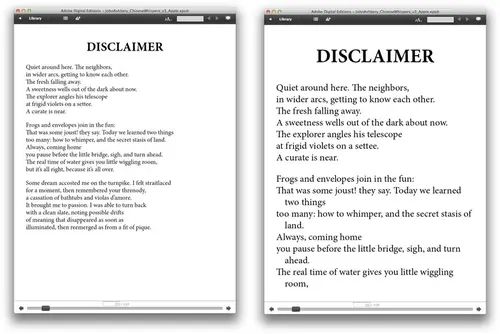
Each of these versions of the poem has the same number of lines: the number that Ashbery intended. But if you look at the second, third, and fifth lines of the second stanza in the right-hand version of “Disclaimer,” you’ll see the automatic indent; in the fifth line, for instance, the word ahead drops down and is indented. The automatic indent not only makes poems easier to read electronically; it also helps to retain the rhythmic shape of the line—the unit of sound—as the poet intended it. And to preserve the integrity of the line, words are never broken or hyphenated when the line must run over. Reading “Disclaimer” on the screen, you can be sure that the phrase “you pause before the little bridge, sigh, and turn ahead” is a complete line, while the phrase “you pause before the little bridge, sigh, and turn” is not.
Open Road has adopted an electronic typesetting standard for poetry that ensures the clearest possible marking of both line breaks and stanza breaks, while at the same time handling the built-in function for resizing and reflowing text that all ereading devices possess. The first step is the appropriate semantic markup of the text, in which the formal elements distinguishing a poem, including lines, stanzas, and degrees of indentation, are tagged. Next, a style sheet that reads these tags must be designed, so that the formal elements of the poems are always displayed consistently. For instance, the style sheet reads the tags marking lines that the author himself has indented; should that indented line exceed the character capacity of a screen, the run-over part of the line will be indented further, and all such runovers will look the same. This combination of appropriate coding choices and style sheets makes it easy to display poems with complex indentations, no matter if the lines are metered or free, end-stopped or enjambed.
Ultimately, there may be no way to account for every single variation in the way in which the lines of a poem are disposed visually on an electronic reading device, just as rare variations may challenge the conventions of the printed page, but with rigorous quality assessment and scrupulous proofreading, nearly every poem can be set electronically in accordance with its author’s intention. And in some regards, electronic typesetting increases our capacity to transcribe a poem accurately: In a printed book, there may be no way to distinguish a stanza break from a page break, but with an ereader, one has only to resize the text in question to discover if a break at the bottom of a page is intentional or accidental.
Our goal in bringing out poetry in fully reflowable digital editions is to honor the sanctity of line and stanza as meticulously as possible—to allow readers to feel assured that the way the lines appear on the screen is an accurate embodiment of the way the author wants the lines to sound. Ever since poems began to be written down, the manner in which they ought to be written down has seemed equivocal; ambiguities have always resulted. By taking advantage of the technologies available in our time, our goal is to deliver the most satisfying reading experience possible.
Old Angel Midnight
1Friday Afternoon In The Universe, in all directions in & out you got your men women dogs children horses pones tics perts parts pans pools palls pails parturiences and petty Thieveries that turn into heavenly Buddha—I know boy what’s I talkin about case I made the world & when I made it I no lie & had Old Angel Midnight for my name and concocted up a world so nothing you had forever thereafter make believe it’s real—but that’s alright because now everything’ll be alright & we’ll soothe the forever boys & girls & before we’re thru we’ll find a name for this Goddam Golden Eternity & tell a story too—and but d y aver read a story as vast as this that begins Friday Afternoon with workinmen on scaffolds painting white paint & ants merlying in lil black dens & microbes warring in yr kidney & mesaroolies microbing in the innards of mercery & microbe microbes dreaming of the ultimate microbe-hood which then ultimates outward to the endless vast empty atom which is this imaginary universe, ending nowhere & ne’er e’en born as Bankei well poled when he ferried his mother over the rocks to Twat You Tee and people visit his hut to enquire “What other planet features this?” & he answers “What other planet?” tho the sounds of the entire world are now swimming thru this window from Mrs McCartiola’s twandow & Ole Poke’s home dronk again & acourse you hear the cats wailing in the wailbar wildbar wartfence moonlight midnight Angel Dolophine immensity Visions of the Tathagata’s Seat of Purity & Womb so that here is all this infinite immaterial meadowlike golden ash swimswarming in our enlighten brains & the silence Shh shefallying in our endless ear & still we refuse naked & blank to hear What the Who? the Who? Too What You? will say the diamond boat & Persepine, Recipine, Mill town, Heroine, & Fack matches the silver ages everlasting swarmswallying in a simple broom—and at night ya raise the square white light from your ghost beneath a rootdrinkin tree & Coyote wont hear ya but you’ll ward off the inexistency devils just to pass the time away & meanwhile it’s timeless to the ends of the last lightyear it might as well be gettin late Friday afternoon where we start so’s old Sound can come home when worksa done & drink his beer & tweak his children’s eyes—
2and what talents it takes to bail boats out you’d never flank till flail pipe throwed howdy who was it out the bar of the seven seas and all the Italians of 7th Street in Sausaleety slit sleet with paring knives that were used in the ream kitchens to cut the innards of gizzards out on a board, wa, twa, wow, why, shit, Ow, man, I’m tellin you—Wait—We bait the rat and forget to mark the place and soon Cita comes and eat it and puke out grit—fa yen pas d cas, fa yen pas d case, chanson d idiot, imbecile, vas malade—la sonora de madrigal—but as soon as someone wants to start then the world takes on these new propensities:
1.Bardoush
(the way the craydon bi fa shta ma j en vack)
2.Flaki—arrete—interrupted chain saw sting eucalyptus words inside the outside void that good God we cant believe is anything so arsaphallawy any the pranaraja of madore with his bloody arse kegs, shit—go to three.
3Finally just about the time they put wood to the poets of France & fires broke out recapitulating the capitulation of the continent of Mu located just south of Patch, Part, with his hair askew and wearing goldring ears & Vaseline Hair Oil in his arse ass hole flaunted all the old queers and lecherous cardinals who wrote (write) pious manuals & announced that henceforth he was to be the sole provender provider this side of Kissthat.
Insteada which hey marabuda you son of a betch you cucksucker you hey hang dat board down here I’ll go cot you on the Yewneon ya bum ya—lick, lock, lick, lock, mix it for pa-tit a a lamana lacasta reda va da Poo moo koo—la—swinging Friday afternoon in eternity here comes Kee pardawac with long golden robe flowing through the Greek Islands with a Bardic (forgot) with a lard (?) with a marde manual onder his Portugee Tot Sherry Rotgut, singing “Kee ya.”
Tried to warn all of you, essence of stuff wont do—God why did you make the world?
Answer: – Because I gwt pokla renamash ta va in ming the atss are you forever with it?
I like the bliss of mind.
Awright I’ll call up all the fuckin Gods, right now! Parya! Arrive! Ya damn hogfuckin lick lip twillerin fishmonger! Kiss my purple royal ass baboon! Poota! Whore! You and yr retinues of chariots & fucks! Devadatta! Angel of Mercy! Prick! Lover! Mush! Run on ya dog eared kiss willying nilly Dexter Michigan ass-war-lerin ratpole! The rat in my cellar’s an old canuck who wasnt fooled by rebirth but b God gotta admit I was born for the same reason I bring this glass to my lip—?
Rut! Old God whore, the key to ecstasy is forever-more furthermore blind! Potanyaka! God of Mercy! Boron O Mon Boron! All of ye! Rush! Ghosts & evil spirits, if you appear I’m saved. How can you fool an old man with a stove & wine drippin down his chin? The flowers are my little sisters and I love them with a dear heart. Ashcans turn to snow and milk when I look. I know sinister alleys. I had a vision of Han Shan a darkened by sun bum in odd rags standing short in the gloom scarey to see. Poetry, all these vicious writers and bores & Scriptural Apocraphylizers fucking their own dear mothers because they want ears to sell—
And the axe haiku.
All the little fine angels amercyin and this weary prose hand handling dumb pencils like in school long ago the first redsun special. Henry Millers everywhere Fridaying the world—Rexroths. Rexroths not a bad egg. Creeley. Creeley. Real magination realizing rock roll rip snortipatin oyster stew of Onatona Scotiat Shores where six birds week the nest and part wasted his twill till I.
Mush. Wish. Wish I could sing ya songs of a perty nova spotia patonapeein pack wallower wop snot polly—but caint—cause I’ll get sick & die anyway & you too, born to die, little flowers. Fiorella. Look around. The burlap’s buried in the wood on an angle, axe haiku. La religion c’est d la marde! Pa! d la marde! J m en dor.—
God’s asleep dreaming, we’ve got to wake him up! Then all of a sudden when we’re asleep dreaming, he comes and wakes us up—how gentle! How are you Mrs Jones? Fine Mrs Smith! Tit within Tat—Eye within Tooth—Bone within Light, like—Drop some little beads of sweetness in that stew (O Phoney Poetry!)—the heart of the onion—That stew’s too good for me to eat, you!—
People, shmeople
4Boy, says Old Angel, this amazing nonsensical rave of yours wherein I spose you’d think you’d in some lighter time find hand be-almin ya for the likes of what ya davote yaself to, pah—bum with a tail only means one thing,—They know that in sauerkraut bars, god the chew chew & the wall lips—And not only that but all them in describable paradises—aye ah—Old Angel m boy—Jack, the born with a tail bit is a deal that you never dream’d to redeem—verify—try to see as straight—you wont believe even in God but tbe devil worries you—you & Mrs Tourian—great gaz-zuz & I’d as lief be scoured with a leaf rust as hear this poetizin horseshit everyhere I want to hear the sounds thru the window you promised me when the Midnight bell on 7th St did toll bing bong & Burroughs and Ginsberg were asleep & you lay on the couch in that timeless moment in the little red bulblight bus & saw drapes of eternity parting for your hand to begin & so’s you could affect—& eeffect—the total turningabout & deep revival of world robeflowing literature till it shd be something a man’d put his eyes on & continually read for the sake of reading & for the sake of the Tongue & not just these insipid stories writ in insipid aridities & paranoias bloomin & why yet the image—let’s hear the Sound of the Universe, son, & no more part twaddle—And dont expect nothing from me, my middle name is Opprobrium, Old Angel Midnight Opprobrium, boy, O.A.M.O.—
Pirilee pirilee, tzwé tzwi tzwa,—tack tick—birds & firewood. The dream is already ended and we’re already awake in the golden eternity.
5Then when rat tooth come ravin and fradilaboodala back-ala backed up, trip tripped himself and fell falling on top of Old Smokey because his pipe was not right, had no molasses in it, tho it looked like a morasses brarrel, but then the cunts came. She had a long cunt that sitick out of her craw a mile long like Mexican Drawings showing hungry drinkers reaching Surrealistic Thirsts with lips like Aztec—Akron Lehman the Hart Crane Hero of Drunken Records came full in her cunt spoffing & overflowing white enlightened seminal savior juice out of his canal-hole into her hungry river bed and that made the old nannies gab and kiss that.
60 he was quite racy—real estate queen—Europe & Niles—for pleasure—stom stomp absulute raze making noise—I can write them but I cant puctuate them—then he said comma comma comma—That skinny guy with black hair—Atlean Rage—in India in the last year he’s getting even ignoring all common publications & getting Urdu Nothing Sanskrit by Sir Yak Yak Yak forty page thing Norfolk—let’s all get drunk I wanta take pictures—dont miss with Mrs. lately in trust picture pitcher pithy lisp—that’s an artistic kit for sex—Trying to think of a rule in Sankrit Mamma Sanskrit Sounding obviously twins coming in here Milltown Equinell Miopa Parte Watacha Peemana Kowava you get sticky ring weekends & wash the tub, Bub—I’ll be gentle like a Iamb in the Bible—Beautiful color yr lipstick thanx honey—Got a match Max?—Taxi crabs & murdercycles—Let’s go to Trilling & ask him—I gotta wash my conduct—Dont worry about nothin—I love Allen Ginsberg—Let that be recorded in heaven’s unchangeable heart—Either bway—Rapples—Call up Allen Price Jones—Who is that?—They re having fun on the bed there—Soo de ya bee la—And there came the picture of Ang Bong de Beela—Fuck it or get it in or wait something for the bee slime—Then the ants’ll crawl over bee land—Ants in bands wailing neath my bloody ow pants, owler pants—Ta da ba dee—He thinlis I’m competive in a long pleasant souse of Wishing all of ye bleed stay meditation everybody martini destroy my black—Allen ye better voice the stare, this beer these room sandwiches—Where did you get these? Big greasy socialists—Are you gonna konk, Allen? Mighty tall in the saddle—Anybody got a ceegiboo?—The moon is a piece of tea—(Under the empty blue sky, vertebrate zoology.)
7And make the most malign detractor eat from the love of the lamb—and the pot that’s for everybody not diminish when somebody comes—Tathagata, give me that—
Visions of Al
Women are so variously beautiful it’s such a pleasure
The Story Continues on BooksBarbecue!
Enjoyed this preview? ❤️ Do not stop here!
Read the complete book free online → 🔗
Continue reading now on BooksBarbecue and discover every page!
Love reading? Bookmark BooksBarbecue.com for more amazing books!
Happy Reading!