Chapters (7)
Our typesetting standard for poetry is designed to register that when a line of poetry exceeds the width of the screen, the resulting run-over line should be indented, as it might be in a printed book. Take a look at John Ashbery’s “Disclaimer” as it appears in two different type sizes.
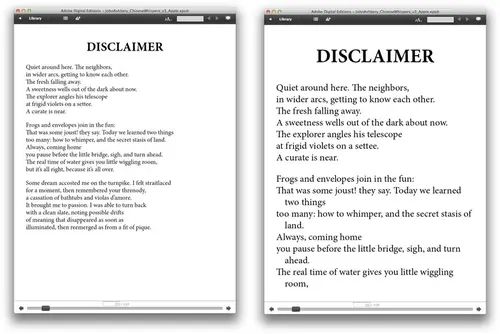
Each of these versions of the poem has the same number of lines: the number that Ashbery intended. But if you look at the second, third, and fifth lines of the second stanza in the right-hand version of “Disclaimer,” you’ll see the automatic indent; in the fifth line, for instance, the word ahead drops down and is indented. The automatic indent not only makes poems easier to read electronically; it also helps to retain the rhythmic shape of the line—the unit of sound—as the poet intended it. And to preserve the integrity of the line, words are never broken or hyphenated when the line must run over. Reading “Disclaimer” on the screen, you can be sure that the phrase “you pause before the little bridge, sigh, and turn ahead” is a complete line, while the phrase “you pause before the little bridge, sigh, and turn” is not.
Open Road has adopted an electronic typesetting standard for poetry that ensures the clearest possible marking of both line breaks and stanza breaks, while at the same time handling the built-in function for resizing and reflowing text that all ereading devices possess. The first step is the appropriate semantic markup of the text, in which the formal elements distinguishing a poem, including lines, stanzas, and degrees of indentation, are tagged. Next, a style sheet that reads these tags must be designed, so that the formal elements of the poems are always displayed consistently. For instance, the style sheet reads the tags marking lines that the author himself has indented; should that indented line exceed the character capacity of a screen, the run-over part of the line will be indented further, and all such runovers will look the same. This combination of appropriate coding choices and style sheets makes it easy to display poems with complex indentations, no matter if the lines are metered or free, end-stopped or enjambed.
Ultimately, there may be no way to account for every single variation in the way in which the lines of a poem are disposed visually on an electronic reading device, just as rare variations may challenge the conventions of the printed page, but with rigorous quality assessment and scrupulous proofreading, nearly every poem can be set electronically in accordance with its author’s intention. And in some regards, electronic typesetting increases our capacity to transcribe a poem accurately: In a printed book, there may be no way to distinguish a stanza break from a page break, but with an ereader, one has only to resize the text in question to discover if a break at the bottom of a page is intentional or accidental.