Chapters (26)
- Cover
- Title
- Dedication
- FOREWORD
- INTRODUCTION
- CHAPTER ONE
- CHAPTER TWO
- CHAPTER THREE
- CHAPTER FOUR
- MEET YOUR . . .
- MEET YOUR . . .
- MEET YOUR . . .
- MEET YOUR . . .
- MEET YOUR . . .
- MEET YOUR . . .
- MEET YOUR . . .
- MEET YOUR . . .
- MEET YOUR . . .
- MEET YOUR . . .
- CHAPTER FIVE
- CONCLUSION
- SOURCES
- DOGS IN THIS BOOK
- ACKNOWLEDGMENTS
- ABOUT THE AUTHOR
- Chronicle Ebooks
In Italy, these dogs continued to be popular for their specialized niche in water (“lagot” in the regions dialect of Romagna) up through the nineteenth century. They were later aptly named the Lagotto Romagnolo for their role in water bird retrieval and lowland hunting in marshes and wetlands, until they later became valuable as truffle hunters.(36) In Portugal a few hundred years later, a similar water dog came to make waves—the Cão de Água (meaning “dog of water”).(37)(38)(39) This highly specialized breed we now know as the Portuguese Water Dog was used for herding fish into nets, as well as retrieving nets for the fishermen. Breeds such as the Poodle (Pudelhund) from Germany, and Irish and American Water Spaniels, still exhibit this hallmark curly-haired feature of the original ancient water dogs. Similar curly-haired water dogs continued to spread across Europe, likely giving rise to some of the first known spaniels and setters.
Pointing, or setting, refers to the behavior of a hunting dog freezing, or “pointing” to the prey to show the hunter its location. Normally the hunting process looks like this: orient-eye-stalk-chase, grab-bite, kill-bite, dissect/consume. But for this type of dog, a genetic anomaly in the complete natural predatory sequence created a pause in the orient step in the process. This prevented the continuation to the eye, stalk, chase, grab-bite, and kill-bite steps of hunting, and proved valuable to humans, since the dog would quietly reveal game birds in their hiding places without spooking them. Spanish water dogs (spaniels and possibly setting spaniels) were thought to have contributed to the first official pointers, developed in England by crossbreeding hunting dogs such as Foxhounds and Bloodhounds.(40)(41) Pointers have also continued to be developed into a number of varieties, and have maintained a position as popular pets over the years as well.
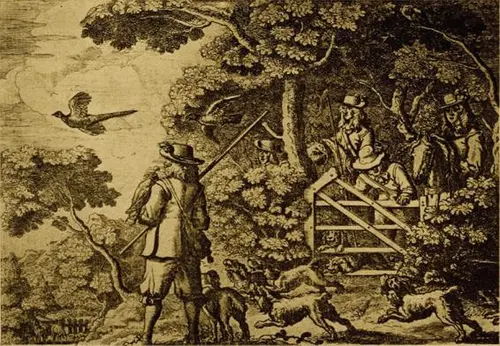
The Dog Book: A Popular History of the Dog, with Practical Information as to Care and Management of House, Kennel, and Exhibition Dogs; And Descriptions of All the Important Breeds (1906, Doubleday).
Historically, gun dogs were not only used in the pursuit of game birds in and around the water, but even for the occasional fish. The most outstanding example of such dogs are the retrievers, developed in England from the now extinct St. John’s dog from Newfoundland. This landrace of water dog native to the area, originally used as a working companion to fisherman for retrieving nets, is thought to have derived from Portuguese, Irish, and English working dogs.(42) This “lesser Newfoundland” became the foundation for the modern Labrador, Flat-Coated, Golden, and Chesapeake Bay Retrievers. These breeds were diversified for retrieving game birds both in and out of the water over the years, beyond their original function as fisherman’s helpers.(43)