Chapters (25)
- Title Page
- Dedication
- Introduction
- I - Into the Wild Blue
- Chapter 1 - Every Man a Tiger
- Chapter 2 - The Big Lie
- Chapter 3 - The Vision of Bill Creech
- II - Shield in the Sky
- Chapter 4 - Mission to Jeddah
- Chapter 5 - CENTCOM Forward
- Chapter 6 - Planning the Storm
- Chapter 7 - Band of Brothers and Sisters
- III - The Thousand-Hour War
- Chapter 8 - Storm!
- Chapter 9 - Hits and Misses
- Chapter 10 - Lost and Found
- Chapter 11 - Punch and Counterpunch
- Chapter 12 - A Day in the War
- Chapter 13 - The Ten Percent War
- Chapter 14 - Shock and Awe
- Chapter 15 - Building Coalitions
- Chapter 16 - Beyond Iraqi Freedom
- Acknowledgements
- BIBLIOGRAPHY
- INDEX
What gave interest to this sea of monotony were the Scuds at night, combat losses, and the weather, which was a constant problem, as waves of low pressure swept down across Baghdad toward Basra.
Meanwhile, the tank plinkers were bagging up to 150 tanks per night, which was the best news Chuck Horner could give General Schwarzkopf, who was by then engrossed with the details of the ground offensive plan. This last was in turn good news to Horner, because, first, it meant they were closer to going home, and, second, it meant that the CINC pretty much stayed out of Horner’s business, except for his nightly reorganizing of the target list of Iraqi Army units.
The question remained: “When will the ground war start?” Part of the answer depended on accurate knowledge of BDA—bomb damage assessment. But here there was controversy. “Have we destroyed a third of the Iraqi tanks? Half? A quarter?” The desired number was 50 percent, but how close or how far Horner’s pilots were to attaining that number was a matter of dispute, according to the estimating body.
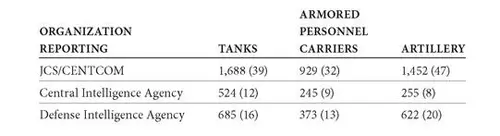
A comparison of estimates gives insight into the confusion, the inter-agency bickering, and, in Horner’s words, “the slavish desire to count beans rather than estimate combat power” that surrounded what some call the great Battle Damage Assessment War. On February 23, in an effort to determine when to start the ground war, various intelligence agencies reported the following:
Numbers (percent) of Reported Iraqi Equipment Losses
Chuck Horner comments:
Needless to say, such wide variance was not only fiercely debated between Washington and the theater, it turned into an ugly game of intelligence analysts’ one-upmanship. After the war, it was learned that JCS/CENTCOM numbers had been not too far off the mark. Based on this more accurate database, it appears that on or about February 23, the Iraqis had actually lost 48 percent of their tanks, 30 percent of their armored personnel carriers, and 59 percent of their artillery pieces.