Chapters (25)
- Title Page
- Dedication
- Introduction
- I - Into the Wild Blue
- Chapter 1 - Every Man a Tiger
- Chapter 2 - The Big Lie
- Chapter 3 - The Vision of Bill Creech
- II - Shield in the Sky
- Chapter 4 - Mission to Jeddah
- Chapter 5 - CENTCOM Forward
- Chapter 6 - Planning the Storm
- Chapter 7 - Band of Brothers and Sisters
- III - The Thousand-Hour War
- Chapter 8 - Storm!
- Chapter 9 - Hits and Misses
- Chapter 10 - Lost and Found
- Chapter 11 - Punch and Counterpunch
- Chapter 12 - A Day in the War
- Chapter 13 - The Ten Percent War
- Chapter 14 - Shock and Awe
- Chapter 15 - Building Coalitions
- Chapter 16 - Beyond Iraqi Freedom
- Acknowledgements
- BIBLIOGRAPHY
- INDEX
We’ll look at the answers to these questions over the course of this chapter.
BEATING DOWN THE IRAQIS
The answer to question one depended on three factors. First: battlefield preparation. How successful was Coalition airpower in reducing Iraqi armor and artillery? Second: The choice of which Iraqi units to hit, how hard, and when. (These two issues were related, but they were kept separate at CENTCOM and CENTAF, because of the understandable interest of Coalition ground units in the condition of the Iraqi units they themselves would be facing.) Third: PSYOPS. How successful were Coalition psychological-warfare efforts in undermining the morale of Iraqi ground forces? An army that has no taste to fight is an army that is beaten—even if they are equipped with state-of-the-art equipment in pristine shape.
★ Though air attacks had hurt Iraqi forces in the KTO before the beginning of February, the Iraqis were still a reasonably effective fighting force. February ruined them. The following summary is based on a Chris Christon report from February 10, 1991.
In his view, initial attacks—primarily directed against the air defense system, Scud sites, infrastructure, leadership, and weapons research, development, and production facilities—had had no major impact on the Iraqi Army. Commanders and their staffs had proved very flexible in handling the difficulties that Coalition air attacks had imposed on their operations. For example, when air attacks cut telephone lines, the Iraqis used message carriers on motorcycles. When air disrupted their command-and-control networks (as part of the destruction of the centralized air defense system), the Iraqis developed work-arounds; and their command-and-control network remained effective, secure, and capable of supporting major military operations.
On the front lines, they had adjusted their routines around the timing of air attacks, and for the first part of the war, the Iraqi Army found sanctuary at night. They were able to do this because the most capable Coalition systems for night attack—F-117s, F-111s, and LANTIRN-equipped F-15Es and F-16s—were tied up chasing Scuds or hitting fixed targets outside the KTO, which left the job of hitting the Iraqi Army at night mostly to A-10s, A-6s, and B-52s hitting area targets.
All this changed in February, when most of the air effort was devoted to shaping the battlefield. For example, of the 986 bombing sorties scheduled for February 11, 933 of them were tasked to that mission. And here is how shaping-the-battlefield sorties were allocated by corps during the period from February 10 through February 12:
Sample Sortie Allocations69 (in percents)
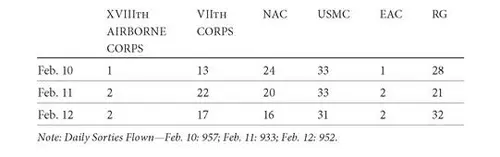
By mid-February, the total air campaign was well under way. Now the sorties against front-line forces were flying night and day. Now attacks on the Iraqi transportation system were starting to have effect, and enemy reports of food and water shortages began to filter into the intelligence system. Now the war was almost as boring as an airline schedule—except that it wasn’t passengers that were being delivered.