Chapters (25)
- Title Page
- Dedication
- Introduction
- I - Into the Wild Blue
- Chapter 1 - Every Man a Tiger
- Chapter 2 - The Big Lie
- Chapter 3 - The Vision of Bill Creech
- II - Shield in the Sky
- Chapter 4 - Mission to Jeddah
- Chapter 5 - CENTCOM Forward
- Chapter 6 - Planning the Storm
- Chapter 7 - Band of Brothers and Sisters
- III - The Thousand-Hour War
- Chapter 8 - Storm!
- Chapter 9 - Hits and Misses
- Chapter 10 - Lost and Found
- Chapter 11 - Punch and Counterpunch
- Chapter 12 - A Day in the War
- Chapter 13 - The Ten Percent War
- Chapter 14 - Shock and Awe
- Chapter 15 - Building Coalitions
- Chapter 16 - Beyond Iraqi Freedom
- Acknowledgements
- BIBLIOGRAPHY
- INDEX
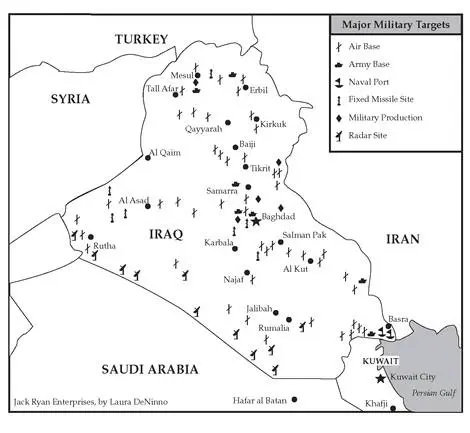
To make all this work, Horner had Glosson build a series of plastic overlays with symbols showing where the various aircraft would be at various times, together with the targets they were planning to strike. Thus, the 0300 overlay showed F-117s near Baghdad, while the tankers with assorted fighters were well to the south, and the Rivet Joint and AWACS were in the orbits they usually occupied. Then the 0400 overlay showed explosion symbols on the targets being struck, together with the next wave of attackers. This overlay also showed the MiG CAPS over Iraq and not Saudi Arabia, as they had been all during Desert Shield. The movie unwound before the viewer not unlike a primitive jerky cartoon. Even so, anybody watching would get a sense of the timing, the enormity, the integration, and the sequence of attacks and how they related to taking down the air defenses, and hitting critical time-sensitive targets.
Owing to the CINC’s anxieties about the Republican Guard, one significant element was added by Schwarzkopf to the plan, and to the briefing. Provisions had to be made to attack the elite Iraqi force early and often. The problem for him was this: Colin Powell had decreed that success involved killing the Republican Guard, which for him was the Iraqis’ strategic military center of gravity. Thus, Schwarzkopf did not want the loss of the Republican Guard to take place on his watch, and so he feared that when the bombing started, the Republican Guard would pull up stakes and head for Baghdad, and he would be judged a failure. In order to ease the CINC’s ever-growing anxieties, a large part of the air campaign was given over to preventing the Republican Guards from leaving the battlefield. They were bombed heavily, with more B-52 sorties added later. (In fact, Horner always doubted that the Republican Guards would leave the field. First of all, it would have put them on the roads, where they would have been easy pickings. And second, if Saddam’s strategy remained as it appeared then—that is, to plunge Coalition forces into the defensive arrangements he had worked so hard to erect along the border—then it didn’t make sense to remove his strongest forces from the battle. In this, Horner later proved to be right.)
After Horner and Glosson worked through this “movie briefing,” Glosson went back into his office, and a few hours later he emerged with the plastic overlay briefing that was to be his until the war started in January (though updated and fine-tuned constantly). This briefing in its various evolutions was given many times to General Schwarzkopf (who liked it enough to instantly make it his own), to Colin Powell on his September 12 visit to Riyadh, and to the Secretary of Defense and the President in Washington, D.C., a month later.