Walk on Earth a Stranger
Chapters (44)
- Dedication
- Dramatis Personae
- Map
- JANUARY 1849
- Chapter One
- Chapter Two
- Chapter Three
- Chapter Four
- Chapter Five
- Chapter Six
- Chapter Seven
- Chapter Eight
- Chapter Nine
- Chapter Ten
- Chapter Eleven
- Chapter Twelve
- Chapter Thirteen
- Chapter Fourteen
- Chapter Fifteen
- Chapter Sixteen
- Chapter Seventeen
- Chapter Eighteen
- Chapter Nineteen
- Chapter Twenty
- Chapter Twenty-One
- Chapter Twenty-Two
- Chapter Twenty-Three
- Chapter Twenty-Four
- Chapter Twenty-Five
- Chapter Twenty-Six
- Chapter Twenty-Seven
- Chapter Twenty-Eight
- Chapter Twenty-Nine
- Chapter Thirty
- Chapter Thirty-One
- Chapter Thirty-Two
- Chapter Thirty-Three
- Chapter Thirty-Four
- Author’s Note
- Back Ad
- About the Author
- Books by Rae Carson
- Credits
- About the Publisher
Dedication
For Martha Mihalick, editrix extraordinaire
Dramatis Personae
IN DAHLONEGA, GEORGIA
The Westfalls
Reuben “Lucky” Westfall, a gold prospector
Elizabeth Westfall, his wife
Leah “Lee” Westfall, their fifteen-year-old daughter
Hiram Westfall, Reuben’s brother
The McCauleys
Mr. McCauley, a gold prospector from Ireland
Jefferson McCauley, his sixteen-year-old son
The Smiths
Judge Smith, Lumpkin County judge and landowner
Mrs. Smith, his wife
Annabelle Smith, their sixteen-year-old daughter
Jeannie Smith, their slave
James “Free Jim” Boisclair, a storeowner
Abel Topper, unemployed mine foreman
TO INDEPENDENCE, MISSOURI
The Brothers
Zeke Tackett
Emmett Tackett
Ronnie Tackett
The Flatboat Crew
Captain Rodney Chisholm
Fiddle Joe
Red Jack
The Joyners
Andrew Joyner, a gentleman
Rebekah “Becky” Joyner, his wife
Olive Joyner, their six-year-old daughter
Andrew Joyner Jr., their four-year-old son
Matilda “Aunt Tildy” Dudley, their cook
THE WAGON TRAIN
From Missouri
Frank Dilley, leader of twenty wagons of Missouri men
Jonas Waters, Frank Dilley’s foreman
From Arkansas
Major Wally Craven, the wagon train guide
Josiah Bledsoe, a sheep farmer with ten wagons
Hampton, Mr. Bledsoe’s slave
The Illinois College Men
Jasper Clapp, studied medicine
Thomas Bigler, studied law
Henry Meek, studied literature
From Ottawa Valley
Charles Robichaud, a ranch hand
Lucie Robichaud, his wife
Jeremy and Samuel, their five-year-old twin sons
From Kentucky
Reverend Ernest Lowrey, a Presbyterian pastor
Mary Lowrey, his wife
From Ohio
Herman Hoffman, a farmer from Germany
Helma Hoffman, his wife
Therese, their fifteen-year-old daughter
Martin, their thirteen-year-old son
Luther, their twelve-year-old son
Otto, their nine-year-old son
Carl, their eight-year-old son
Doreen, their five-year-old daughter
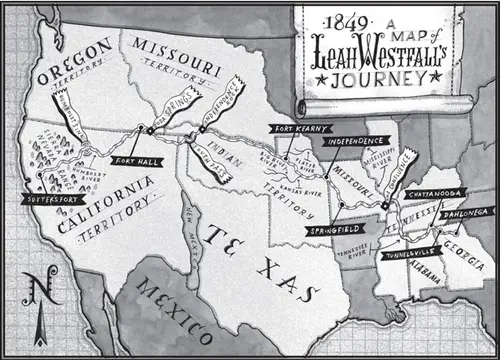
Map
JANUARY 1849
Chapter One
I hear the deer before I see him, though he makes less noise than a squirrel—the gentle crunch of snow, a snapping twig, the soft whuff as he roots around for dead grass. I can hardly believe my luck.
As quietly as falling snow, I raise the butt of my daddy’s Hawken rifle to my shoulder and peer down the muzzle. A crisscross of branches narrows my view. The deer must be allowed to wander into my sights, but that’s all right. I am patient. I am a ghost.
I’ve tucked myself into a deadfall, the result of an ancient, dying oak looming above me. Snow fills the cracks between branches, creating a barrier to the wind. I can barely see out, but I’m almost warm. The snow around me clinks and tinkles like bells, melting in the early morning warm snap. The hem of my skirt and the petticoats underneath are ragged and soaked. If the girls at school saw me now, I’d hear no end of it, but it doesn’t matter. We have to eat.
Which means I have to make this shot. If only I could conjure up fresh game whenever we needed. Now that would be a useful magic.