Chapters (54)
I stared at the objects in the images, particularly at the excavated block of ice flanked by two humans to add the perspective of size.
The flesh on the back of my neck prickled.
“The marine biologist on loan to us could not identify either species, though he believed the animals may have lived during—”
“—the Miocene,” I finished. “This creature here—the one that’s being eaten—I’m reasonably certain it was a giant species of caiman called a Purussaurus.”
Brandy looked perplexed. “Caiman? Ye mean, like a crocodile?”
“Yes, only this one was fifty feet long. Purussaurus remains have been found in the Peruvian Amazon in South America. Two distinct species of Crocodylia were discovered—brasiliensis and mirandai. Purussaurus mirandai had a wider, far more elongated skull that was extremely flat. Its nostrils were unusually large, the openings three feet long. No one seems to know what they were used for.”
Ben glanced at Dr. Ahmed. “Looks like you found your brainiac. Hey, Zach, what do you call the big python that choked trying to eat the pussy-saurus?”
“Pu-rus-sau-rus. And I have no idea. The biggest snake fossil ever found belonged to Titanoboa, which grew to forty-five feet. But it lived sixty million years ago, and even that monster was too small to go after an adult Purussaurus. Dr. Liao, you say your team found these remains on the Amery Ice Shelf?”
“Yes, but that’s not where this epic battle took place. Dr. Ahmed, please show Dr. Wallace the I.P.R. image.”
Reaching into the file, the Pakistani scientist removed a black-and-white satellite image taken of the Antarctic continent, only without its two-mile-thick ice cap.
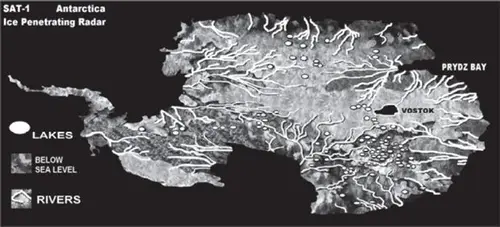
“Thanks to the development of radio echo-sounding, reflection seismology, and ice-penetrating radar, we now know what Antarctica’s geology looks like beneath the ice sheet and how the terrain would have appeared millions of years ago. As you can see, Dr. Wallace, the Antarctic landmass possesses more than a hundred and fifty lakes. Think of them as subglacial reservoirs of meltwater. As the ice sheet moves, its flow rate is affected by the level of these lakes, which rise and fall like the locks on the Panama Canal. The meltwater drains into a network of subglacial streams and rivers, which in turn keep the glacier moving out to sea. As the ice sheet passes over a lake, it causes some of its surface water to freeze. Anything caught in this accretion ice becomes part of the ice sheet.”
“Which is how these monsters’ remains came to be discovered in the Loose Tooth rift.”